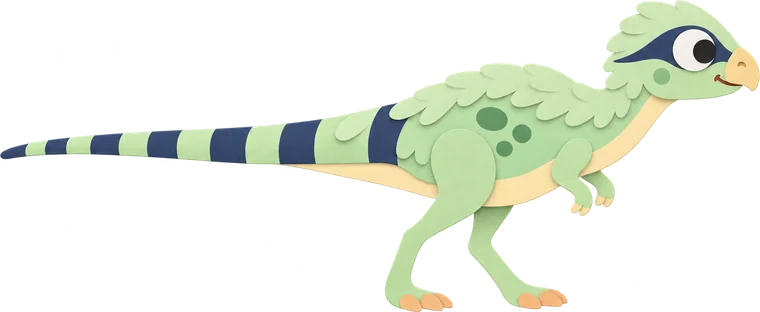
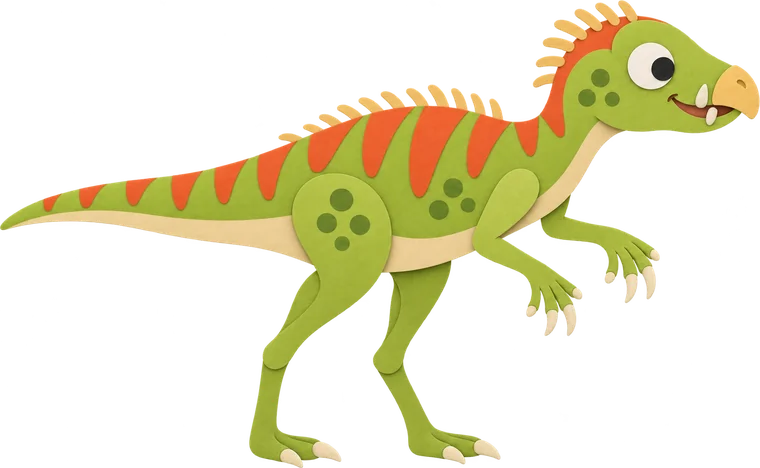
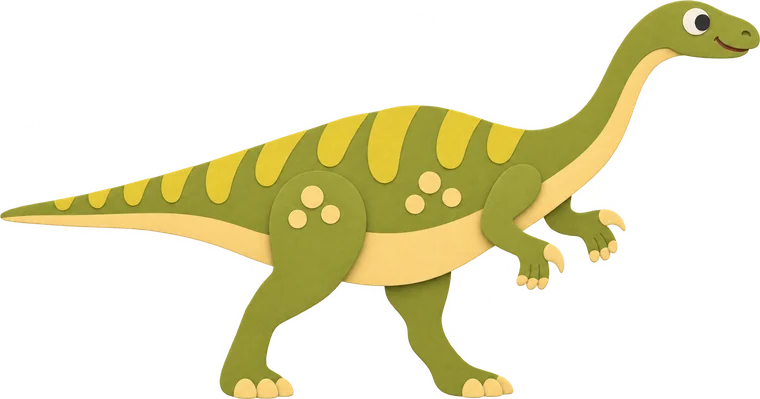
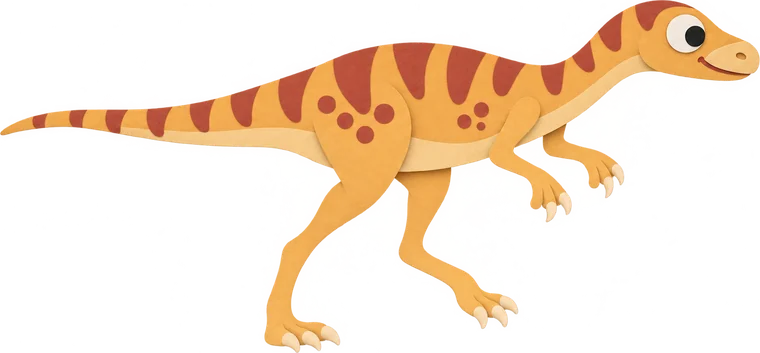
"Dad, you said this one is a friend of the dome-heads, so why is its head flat?" Your child has spotted the one dinosaur with a flat head among all the round-headed ones.
Homalocephale was a member of the dome-headed dinosaur group that lived in the Late Cretaceous where the Gobi Desert of Mongolia is today. It was about as long as a dad is tall, and the roof of its head was flat but made of thick bone. Its unusually wide hips are another special feature. The questions your child is likely to ask, with answers in a child's words, are below. You can read them out loud.
Fact cardHomalocephale
- Name means
- flat head
- Lived
- Late Cretaceous (about 70 million years ago)
- Length
- about 1.8 m (6 ft)
- Weight
- not known exactly (thought to be about the weight of a big dog)
- Food
- Plant-eater (may have eaten animals too)
- Found in
- Asia (Gobi Desert, Mongolia)
- Group
- Dome-headed and unusual dinosaurs
- A flat, level head
- Rough little bumps at the back of the head
- Wide hips
How big was Homalocephale? Measure it with your own height
When your child asks, answer like this
 What does Homalocephale mean?

How big was it?
What did it eat?
What did it do when a scary dinosaur came?
Who lived with it?
- Tarbosaurus predatorsame time and place
The big meat-eating dinosaur Tarbosaurus lived in the same place. Little Homalocephale probably ran away quickly to keep clear of it. - Prenocephale neighboursame time and place
Its relative Prenocephale, which had a round dome head, lived in the same place too. Nobody knows much yet about how the two got along.
When and where did it live?
What was it like as a baby? Did it live with friends?
Are there dinosaurs that look like it?
Who found it first?
Homalocephale facts that make kids say “Wow!”
- Homalocephale belongs with the dome-headed dinosaurs, yet its own head is flat and has no dome.
- Only one Homalocephale fossil has ever been found.
- Some scientists thought Homalocephale was really a young Prenocephale, but a study in 2018 said they were different dinosaurs.
- Because its hips were wide, there was once an idea that it gave birth to live babies instead of laying eggs, but there is no evidence for that.
From head to tail
- It was about 1.5 to 1.8 m (5 to 6 ft) long, close to how tall a dad is.
- The roof of its head was flat, with no dome, but the bone was thick.
- Its eye sockets were large and round, so it probably had big eyes.
- Its hip bones were unusually wide compared with those of its dome-headed relatives.
A Homalocephale story to read aloud
Homalocephale pokes its head out between the bushes in the forest by the river. Under its flat head, its big round eyes shine. It nips off low plants and leaves with its small beak. Prenocephale, with its round head, lives nearby too. Far away, the thud, thud of a Tarbosaurus's footsteps can be heard. Homalocephale runs quickly into the bushes on its long legs.
A quiz to do together
Tap an answer.
What shape is the head of Homalocephale?
Where was the fossil of Homalocephale found?
Which part of the body of Homalocephale was unusually wide?
You finished the quiz! Well done.
Colouring page
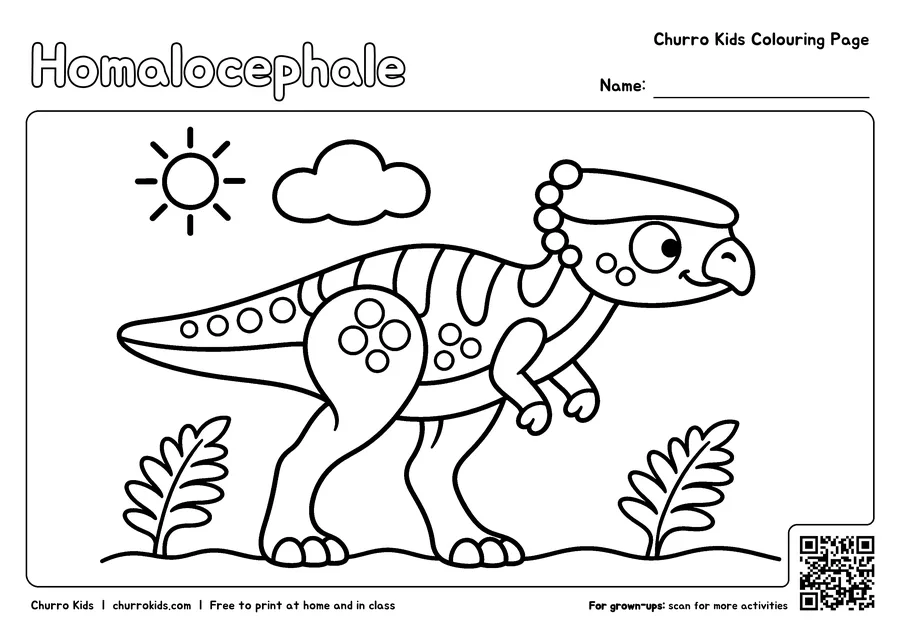
One A4 page, and it is free. Print it freely at home or in class.
Good for parents to know
- Only one fossil has ever been found. There is no reliable number for its weight, so it is guessed to be about that of a big dog, and its length is given as 1.8 metres in some places and 1.5 metres in others.
- Some researchers have argued that Homalocephale is a young Prenocephale. A study in 2018 treated them as two different dinosaurs, so you can say "scientists are still working it out."
- Almost nothing is known about how it lived, and no eggs or babies have been found yet. The old idea that its wide hips meant it gave birth to live babies has no evidence behind it.