"Mum, could Spinosaurus swim?" your child asks, pointing at the dinosaur with a sail in a picture book. Scientists are still talking about that question too.
Spinosaurus was a big meat-eating dinosaur that lived beside the great rivers of North Africa in the Late Cretaceous. It had a sail on its back as tall as a grown-up, and it ate mostly fish, which it caught with a long snout like a crocodile's. It was much longer than a bus, and it is counted as the longest meat-eating dinosaur known so far. Below are the questions children ask most, with answers at a child's level. You can read them out loud as they are.
Fact cardSpinosaurus
- Name means
- spine lizard
- Lived
- Late Cretaceous (about 100 to 94 million years ago)
- Length
- about 14 m (46 ft)
- Weight
- about 7 tonnes
- Food
- Meat-eater that ate mostly fish
- Found in
- North Africa (Egypt, Morocco)
- Group
- Big meat-eating dinosaurs
- A big sail on its back
- A long snout like a crocodile's
- A wide, flat tail like a paddle
Watch the video
Hana asks and Churro explains all about Spinosaurus. The video is in Korean; the facts below are the same ones.
How big was Spinosaurus? Measure it with your own height
When your child asks, answer like this
 What does Spinosaurus mean?

How big was it?
What did it eat?
How did it hunt?
Who lived with it?
- Onchopristis preysame time and place
Onchopristis, a big fish with a snout like a saw, lived in the same rivers. Spinosaurus probably caught and ate this fish at the water's edge. - Carcharodontosaurus neighboursame time and place
The big meat-eating dinosaur Carcharodontosaurus lived in the same place. Spinosaurus ate mostly fish and Carcharodontosaurus ate mostly plant-eating dinosaurs on land, so they probably did not compete much.
When and where did it live?
What was it like as a baby? Did it live with friends?
Are there dinosaurs that look like it?
Who found it first?
Spinosaurus facts that make kids say “Wow!”
- Spinosaurus had a sail on its back as tall as a grown-up, and it caught and ate fish at the water's edge.
- Spinosaurus is counted as the longest meat-eating dinosaur known so far.
- The first fossil was lost in the war, so for a long time scientists had to study it from drawings and photos only.
- The place where Spinosaurus lived is a desert today, but back then it was a land of water with big rivers.
From head to tail
- The bones that held up the sail on its back were more than 1.65 m (5.4 ft) long.
- Its skull was about 1.6 m (5.2 ft) long, longer than a big brother or sister in primary school is tall.
- Its tail was about 5 m (16 ft) long, and it was tall and flat like a paddle.
- Its leg bones were solid and heavy. This probably helped to stop its body from bobbing up in the water.
A Spinosaurus story to read aloud
Sunlight sparkles on the big river. Spinosaurus steps into the shallow water and stands very still. A big sail stands tall on its back. It holds its long, crocodile-like snout close to the water and waits. When a fish swims by, it snaps it up with its cone-shaped teeth. Its paddle-like tail sways gently in the water. On the land across the river, a Carcharodontosaurus walks by.
A quiz to do together
Tap an answer.
What does Spinosaurus have on its back?
What did Spinosaurus mostly eat?
The tail of Spinosaurus is wide and flat like what?
You finished the quiz! Well done.
Colouring page
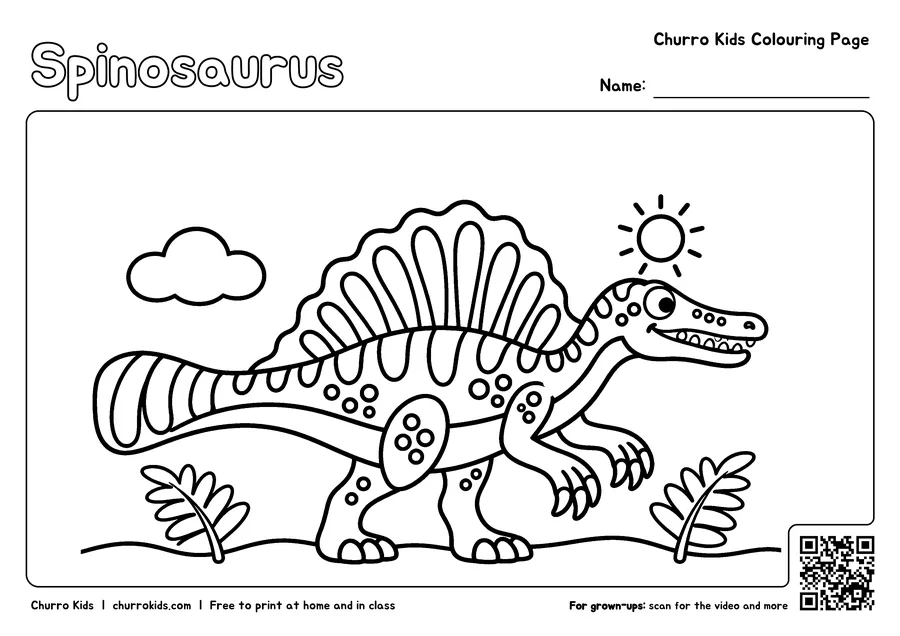
One A4 page, and it is free. Print it freely at home or in class.
Good for parents to know
- Its size differs a lot from book to book. Recent studies put it at about 14 metres long and about 7 tonnes. Older estimates gave a length of 15 to 18 metres.
- Scientists still disagree about how it stood and moved on land, and about how it fished: swimming after its prey under the water, or standing at the water's edge like a heron. It is enough to say "It caught fish at the water's edge. People are still finding out how well it could swim."
- The first fossil was lost in the war in 1944, and the paddle-like tail only became known in 2020. So pictures in older books may look different from the animal in this guide.