"Is that long thing on its head a horn?" Your child points at the head of Parasaurolophus in a picture book. It is a crest, and it is hollow inside.
Parasaurolophus was a duck-billed dinosaur that lived in North America in the Late Cretaceous. It was as long as a bus and had a long, tube-shaped crest stretching back from its head. The crest was hollow, so it probably made a low, deep sound like a horn. Below are the questions children ask most, with answers at a child's level. You can read them out loud as they are.
Fact cardParasaurolophus
- Name means
- a lizard close to the crested lizard (Saurolophus)
- Lived
- Late Cretaceous (about 76.5 to 73 million years ago)
- Length
- about 9 m (30 ft)
- Weight
- about 2.5 to 5 tonnes
- Food
- Plant-eater
- Found in
- North America (Alberta in Canada; New Mexico and Utah in the USA)
- Group
- Duck-billed dinosaurs and friends
- A long tube-shaped crest stretching back from its head
- A flat bill like a duck's
- It walked on two legs and on four
Watch the video
Hana asks and Churro explains all about Parasaurolophus. The video is in Korean; the facts below are the same ones.
How big was Parasaurolophus? Measure it with your own height
When your child asks, answer like this
 What does Parasaurolophus mean?

How big was it?
What did it eat?
What did it do when a scary dinosaur came?
Who lived with it?
- Gorgosaurus predatorsame time and place
Gorgosaurus was a big meat-eating dinosaur that lived on the same land in Alberta, Canada. It probably hunted duck-billed dinosaurs like Parasaurolophus. - Corythosaurus neighboursame time and place
Corythosaurus was a duck-billed neighbour that lived in the same riverside forests. Corythosaurus was common, but scientists say Parasaurolophus was very rare. - Teratophoneus predatorsame time and place
Near the Parasaurolophus that lived in Utah, USA, there was Teratophoneus, a relative of Tyrannosaurus. It probably went after young Parasaurolophus.
When and where did it live?
What was it like as a baby? Did it live with friends?
Are there dinosaurs that look like it?
Who found it first?
Parasaurolophus facts that make kids say “Wow!”
- The long crest on its head was hollow, so it probably made a low, deep sound like a horn.
- Scientists long ago thought the long crest was a snorkel for breathing under water, but there is no hole at the tip of the crest, so the idea turned out to be wrong.
- The first Parasaurolophus ever found has signs that its back and ribs were hurt and then healed, and it may have been hit by a falling tree.
- When scientists made the sound of the crest on a computer, it came out as a very low, humming sound.
From head to tail
- Its head, measured to the end of the crest, was about 1.6 m (over 5 ft) long, as tall as a grown-up.
- Inside the crest there was a long air passage that went up from the nostrils to the tip of the crest and came back down again.
- One thigh bone was more than 1 m (3 ft) long, about as tall as a five-year-old child.
- Skin fossils show that its body was covered in small, bumpy scales.
A Parasaurolophus story to read aloud
The morning sun shines on the forest by the river. Parasaurolophus nips off leaves and twigs with its flat beak. It munches them up small with the many teeth in its mouth. It rears up and tastes the conifer needles on a high branch too. A baby with a crest like a small bump toddles along beside its mother. When a meat-eating dinosaur comes into view far away, Parasaurolophus makes a low sound with its long crest to tell its friends. Then they all run away together on their strong back legs.
A quiz to do together
Tap an answer.
What is the inside of the long crest of Parasaurolophus like?
What did Parasaurolophus eat?
What shape was the crest of a one-year-old baby Parasaurolophus?
You finished the quiz! Well done.
Colouring page
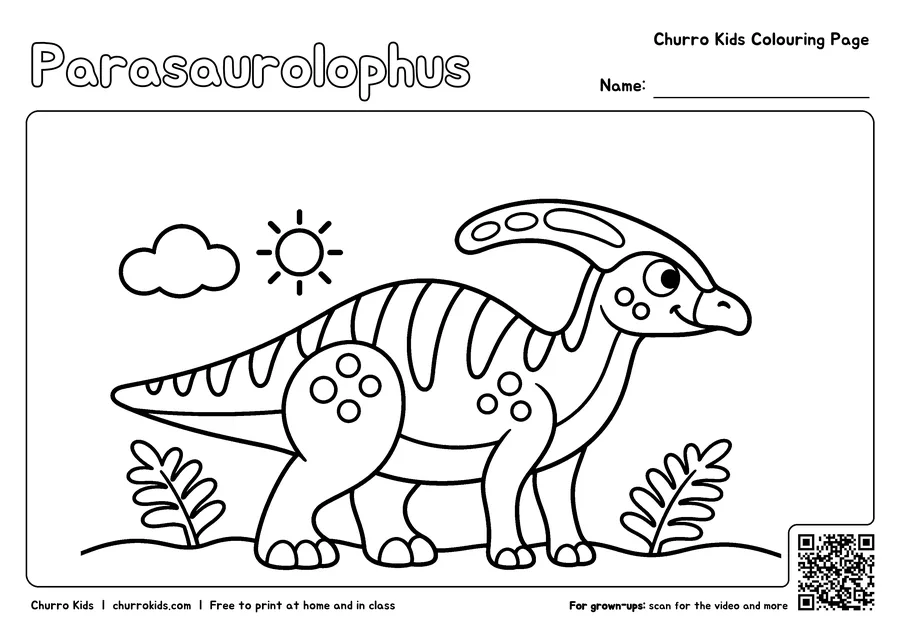
One A4 page, and it is free. Print it freely at home or in class.
Parasaurolophus: how to draw, colouring page, paper figure →
Good for parents to know
- The idea that the crest was used for making sound, for showing off, or for both is a well-supported hypothesis. It is not a proven fact, so it is best to say "it probably made sounds."
- Adult size differs between sources: about 7.5 to 9.5 metres long and about 2.6 to 5 tonnes.
- Saurolophus has a similar name but is a different dinosaur. Its crest is a pointed spike. The idea that meat-eating dinosaurs such as Gorgosaurus hunted Parasaurolophus comes from the fact that they lived at the same time in the same place.