"Mum, does it hurt when this dinosaur bangs its head?" When children see a picture of a dinosaur with a round head like a helmet, this is the question they ask.
Pachycephalosaurus was a dome-headed dinosaur that lived in North America in the Late Cretaceous, at the very end of the age of dinosaurs. It was about as long as a car, and its skull was about as thick as a grown-up's hand span. It walked on two legs and probably ate leaves, seeds and fruit. Below are the questions children ask most, with answers at a child's level. You can read them out loud as they are.
Fact cardPachycephalosaurus
- Name means
- thick-headed lizard
- Lived
- Late Cretaceous (about 70 to 66 million years ago)
- Length
- about 4.5 m (15 ft)
- Weight
- about 370 to 450 kg
- Food
- Plant-eater (leaves, seeds and fruit)
- Found in
- North America (Montana, South Dakota and Wyoming in the USA; Alberta in Canada)
- Group
- Dome-headed and unusual dinosaurs
- A round, thick head
- Bumpy knobs around the head
- Walked on two legs
Watch the video
Hana asks and Churro explains all about Pachycephalosaurus. The video is in Korean; the facts below are the same ones.
How big was Pachycephalosaurus? Measure it with your own height
When your child asks, answer like this
 What does Pachycephalosaurus mean?

How big was it?
What did it eat?
What did it do when a scary dinosaur came?
Who lived with it?
- Another Pachycephalosaurus rivalfossil evidence
Some round skull fossils have several marks where they were hurt and then healed. So scientists think these dinosaurs probably had pushing contests with their heads. - Tyrannosaurus predatorsame time and place
The huge Tyrannosaurus lived in the same forests. When Pachycephalosaurus saw one, it probably ran away quickly. - Triceratops neighboursame time and place
It lived on the same plains as Triceratops, the dinosaur with three horns. They probably ate plants and leaves at different heights and got along side by side.
When and where did it live?
What was it like as a baby? Did it live with friends?
Are there dinosaurs that look like it?
Who found it first?
Pachycephalosaurus facts that make kids say “Wow!”
- The skull of Pachycephalosaurus was more than 20 cm (8 inches) thick, about a grown-up's hand span, so it looked as if it was wearing a helmet.
- About one in five of the round skull fossils of dome-headed dinosaurs has marks where it was hurt and then healed.
- Pachycephalosaurus was one of the very last dinosaurs alive at the end of the age of dinosaurs.
- Two spiky-horned dinosaurs called Dracorex and Stygimoloch may really be young Pachycephalosaurus.
From head to tail
- It weighed about 370 to 450 kg, about as much as a big horse.
- Its eyes were big and faced forward, so it could probably judge distance well with both eyes.
- Its teeth were very small, with bumpy edges like a saw.
- Its tail was probably held out straight like a stick, thanks to stiff tendons.
A Pachycephalosaurus story to read aloud
The morning sun comes up, and Pachycephalosaurus walks out of the forest by the river. It nips off leaves with its small beak and looks for seeds and fruit to eat. Out on the plain, a Triceratops is calmly eating plants. Pachycephalosaurus looks around with its big eyes. When it meets another Pachycephalosaurus, it pushes its round head forward to show how strong it is. When a Tyrannosaurus comes into view far away, it hurries off on its strong back legs. It looks very speedy as it runs with its tail held out straight.
A quiz to do together
Tap an answer.
What shape is the head of Pachycephalosaurus?
Which big meat-eating dinosaur lived in the same place as Pachycephalosaurus?
How many legs did Pachycephalosaurus walk on?
You finished the quiz! Well done.
Colouring page
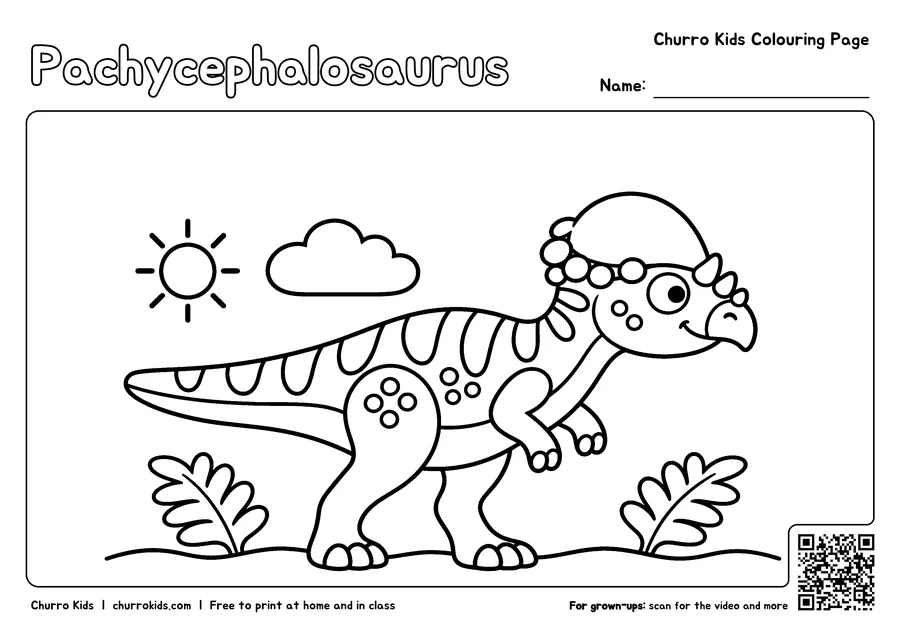
One A4 page, and it is free. Print it freely at home or in class.
Pachycephalosaurus: how to draw, colouring page, paper figure →
Good for parents to know
- Whether it really butted heads is still debated. Skulls have marks that were hurt and then healed, so scientists think it had pushing contests, but other ideas are that it shoved sides or used the dome for showing off. It is safest to say "it may have butted heads."
- Most of the fossils found are skulls, so the body size is an estimate. Some museums list it as 3 metres long and others as about 4.5 metres.
- Dracorex and Stygimoloch may be young Pachycephalosaurus. Its diet of leaves, seeds and fruit is also an estimate, and because the front teeth are pointed, some think it may have eaten a little meat.