Your child is turning the pages of a dinosaur book and points at a picture of an animal in the sky. "Why does this one have no teeth?"
Pteranodon was not a dinosaur, but it lived in the age of dinosaurs. It was a pterosaur, a flying reptile. In the Late Cretaceous it flew over a wide, shallow sea in the middle of North America. With his wings spread, a male was longer than a car, and it probably caught fish in its toothless beak and swallowed them whole. Below are the questions children ask most, with answers at a child's level. You can read them out loud as they are.
Fact cardPteranodon
- Name means
- toothless wing
- Lived
- Late Cretaceous (about 86 to 78 million years ago)
- Length
- about 5.6 m (18 ft) wingspan
- Weight
- about 20 to 35 kg
- Food
- Fish-eater
- Found in
- North America (USA: Kansas, Nebraska, Wyoming, South Dakota, Alabama)
- Group
- Friends from the age of dinosaurs (not dinosaurs)
- A long crest pointing back from the head
- A pointed beak with no teeth
- Very big, wide wings
Watch the video
Hana asks and Churro explains all about Pteranodon. The video is in Korean; the facts below are the same ones.
How big was Pteranodon? Measure it with your own height
When your child asks, answer like this
 What does Pteranodon mean?

How big was it?
What did it eat?
How did it hunt?
Who lived with it?
- Cretoxyrhina (a big shark) predatorfossil evidence
A fossil has been found with a tooth from this shark stuck in a Pteranodon neck bone. It shows that the shark bit the Pteranodon. Nobody knows yet if the shark hunted it or fed on it after it had already died. - Nyctosaurus (a small pterosaur) rivalsame time and place
A smaller pterosaur that flew over the same sea. Both liked fish, so they probably competed for food. - Ichthyornis (a seabird with teeth) neighboursame time and place
A small bird that caught fish in the same sea. It probably flew in the same sky as Pteranodon.
When and where did it live?
What was it like as a baby? Did it live with friends?
Are there dinosaurs that look like it?
Who found it first?
Pteranodon facts that make kids say “Wow!”
- Pteranodon had no teeth at all, so it probably caught fish in its beak and gulped them down.
- About 1,200 fossils have been found so far, more than for any other pterosaur.
- Most of the fossils come from places that were far out at sea, hundreds of kilometres (hundreds of miles) from the shore.
- On the ground it probably folded its wings and walked on all fours.
From head to tail
- With his wings spread, a male was more than 5.6 m (18 ft) across, longer than a car.
- A female's wingspan was about 3.8 m (12.5 ft), much smaller than a male's.
- The tail was very short. Even on the biggest male it was only about 25 cm (10 inches), about as long as one and a half pencils.
- Its wings were long and narrow, like the wings of the albatross, a seabird alive today.
A Pteranodon story to read aloud
The morning sun sparkles on the wide sea. Pteranodon spreads its long, narrow wings and rides the wind. The long crest at the back of its head shines in the sunlight. It lands gently on the water and dips its long beak under the surface. It has no teeth, so it gulps the fish down whole. There is a big shark in the sea, so it has to be careful. With a full belly, Pteranodon flies up into the sky again.
A quiz to do together
Tap an answer.
Did Pteranodon have teeth?
What was Pteranodon's favourite food?
Is Pteranodon a dinosaur or a pterosaur?
You finished the quiz! Well done.
Colouring page
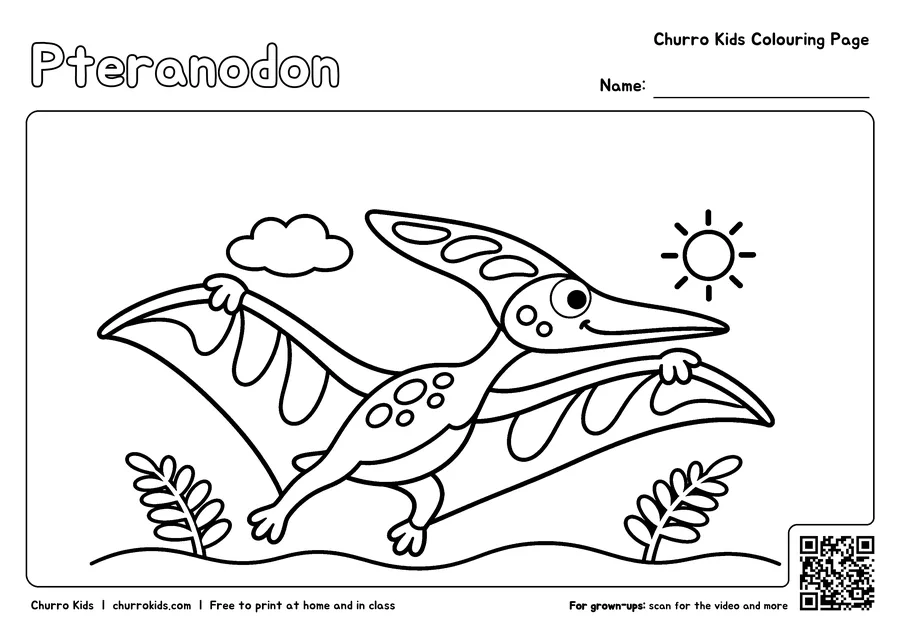
One A4 page, and it is free. Print it freely at home or in class.
Good for parents to know
- Pteranodon was a pterosaur and not a dinosaur. You can tell your child, "It was not a dinosaur, but it was a friend in the sky that lived in the age of dinosaurs."
- The 5.6 metre wingspan is the average for a fully grown male. Females were much smaller, at about 3.8 metres. Its weight differs from source to source, from 20 kg up to 50 kg.
- There is a fossil neck bone with a shark tooth stuck in it, but nobody knows yet if the shark hunted the Pteranodon or fed on it after it had died. It is safest to say "there are signs that a shark bit it."