A child who loves raptor dinosaurs will ask one day, "Mum, did raptors really have feathers?" The fossils of Sinornithosaurus show the answer.
Sinornithosaurus was a small meat-eating dinosaur that lived in the Early Cretaceous in what is now Liaoning Province in China. It was a relative of Velociraptor, its body was covered in feathers like a bird's, and it had a hooked claw on each back foot. It weighed about the same as a cat. Below are the questions children ask most, with answers at a child's level. You can read them out loud as they are.
Fact cardSinornithosaurus
- Name means
- Chinese bird lizard
- Lived
- Early Cretaceous (about 125 to 122 million years ago)
- Length
- about 1.2 m (4 ft)
- Weight
- about 3 to 5 kg
- Food
- Meat-eater
- Found in
- Asia (Liaoning Province, China)
- Group
- Dinosaurs of Korea and Asia
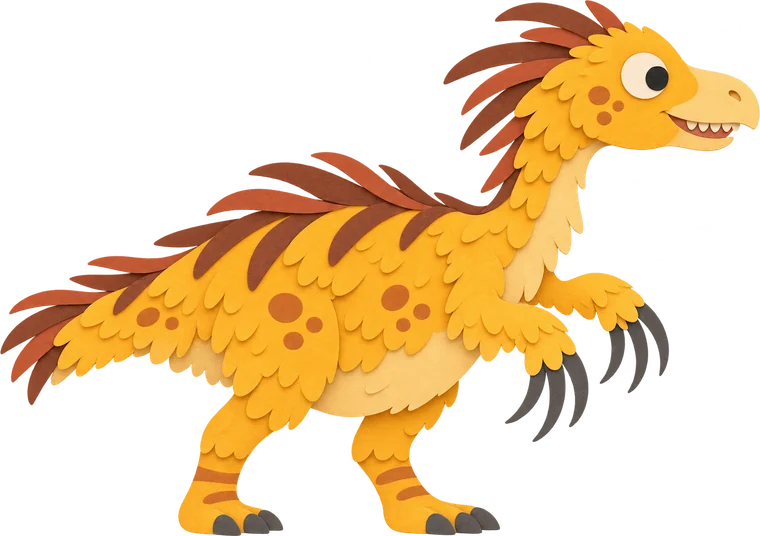
- Feathers all over its body
- A hooked claw on each foot
- Long arms that looked like wings
How big was Sinornithosaurus? Measure it with your own height
When your child asks, answer like this
 What does Sinornithosaurus mean?

How big was it?
What did it eat?
How did it hunt?
Who lived with it?
- Sinocalliopteryx predatorfossil evidence
The leg bone of a small dinosaur was found in the belly of a fossil of Sinocalliopteryx, a bigger meat-eating dinosaur. Scientists say this leg bone seems to belong to Sinornithosaurus, but that is not certain yet. - Confuciusornis preysame time and place
Confuciusornis was an early bird that lived in very large numbers in the same forests. Sinornithosaurus probably hunted one now and then. - Sinosauropteryx rivalsame time and place
Sinosauropteryx was another feathered dinosaur that hunted small animals in the same place. The two probably competed for the same food.
When and where did it live?
What was it like as a baby? Did it live with friends?
Are there dinosaurs that look like it?
Who found it first?
Sinornithosaurus facts that make kids say “Wow!”
- Sinornithosaurus was a relative of Velociraptor, and its whole body was covered in feathers like a bird's.
- Sinornithosaurus was the first dinosaur of the Velociraptor group to be found with feather marks.
- One fossil with almost all of its bones has the nickname Dave.
- Scientists still do not agree on whether it could glide through the air.
From head to tail
- The first fossil found was about 1.2 m (4 ft) long and weighed about 3 to 5 kg, about the same as a cat.
- Its body feathers were 3 to 4.5 cm (1 to 2 inches) long, about as long as a child's finger.
- It had fluffy feathers like down, and also feathers with a central shaft like a bird's feathers.
- Scientists looked at the pigments in its feathers and say it probably had black and reddish brown mixed over its body.
A Sinornithosaurus story to read aloud
As the sun goes down, the forest by the lake grows quiet. Sinornithosaurus folds its long feathered arms and tiptoes along. It is a hunter that is awake for short spells both by day and by night. A small lizard rustles in the undergrowth. Sinornithosaurus leaps and grabs it tight with its hooked claw. But far away, a big Sinocalliopteryx comes into view. Sinornithosaurus quickly hides behind a tree.
A quiz to do together
Tap an answer.
Whose relative is Sinornithosaurus?
What did Sinornithosaurus have on its feet?
What was the body of Sinornithosaurus covered with?
You finished the quiz! Well done.
Colouring page
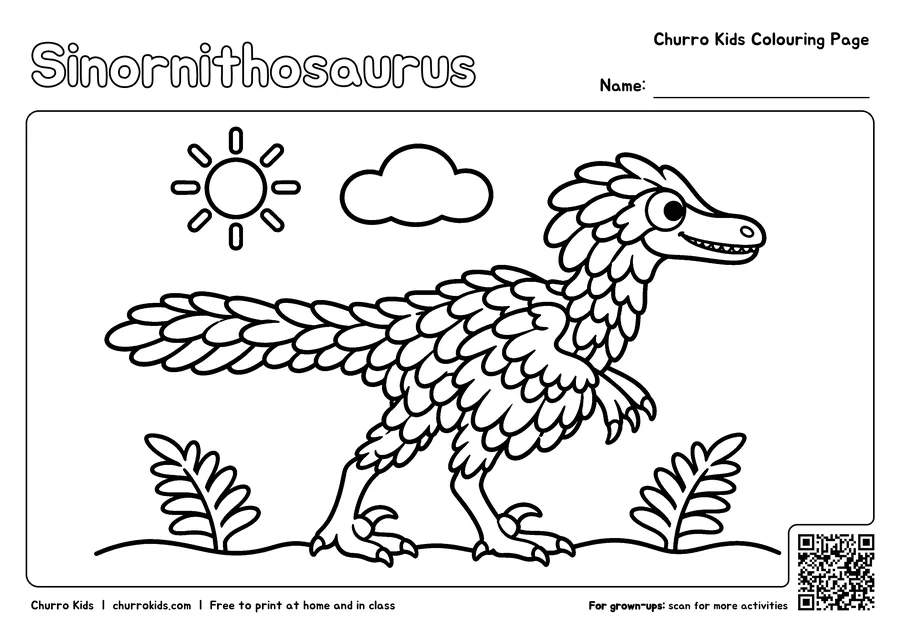
One A4 page, and it is free. Print it freely at home or in class.
Good for parents to know
- In 2009 it was claimed that it had a venomous bite, but the claim was disputed and most researchers do not accept it today. If a book or video introduces it as a venomous dinosaur, you can say "that has not been confirmed."
- Scientists still do not agree on whether it could glide through the air. Most sources put its length at about 1.2 metres, but some say 2 metres.
- The leg bone of a small dinosaur found in the belly of a Sinocalliopteryx fossil seems to belong to Sinornithosaurus, but that is not certain. Rather than saying Sinocalliopteryx was its predator for sure, it is best to say "it may have been."