"Dad, this dinosaur has such long claws. Is it a scary one?" When children see a picture of Beipiaosaurus, the claws are the first thing they point at.
Beipiaosaurus was a feathered dinosaur that lived in the Early Cretaceous, about 125 million years ago, in what is now Liaoning Province in China. It was a little longer than a grown-up lying down, with a chubby belly and long, curved claws on its hands. The claws look scary, but scientists think it probably ate plants such as leaves. Below are the questions children ask most, with answers at a child's level. You can read them out loud as they are.
Fact cardBeipiaosaurus
- Name means
- lizard of Beipiao (a city in China)
- Lived
- Early Cretaceous (about 125 million years ago)
- Length
- about 2.2 m (7 ft)
- Weight
- about 27 to 50 kg
- Food
- Plant-eater
- Found in
- Asia (Liaoning Province, China)
- Group
- Dinosaurs of Korea and Asia
- Long, curved claws on its hands
- Shaggy feathers
- A round, chubby belly
How big was Beipiaosaurus? Measure it with your own height
When your child asks, answer like this
 What does Beipiaosaurus mean?

How big was it?
What did it eat?
What did it do when a scary dinosaur came?
Who lived with it?
- Yutyrannus predatorsame time and place
Yutyrannus was a big feathered meat-eating dinosaur that lived in Liaoning at the same time. When Beipiaosaurus saw Yutyrannus, it probably hid in the forest. - Psittacosaurus rivalsame time and place
Psittacosaurus was a small plant-eating dinosaur that lived in the same place in very large numbers. The two probably shared the plants of the same forest. - Sinornithosaurus neighboursame time and place
Sinornithosaurus was a small feathered dinosaur found near the same village of Sihetun. They lived as neighbours in the same lakeside forest.
When and where did it live?
What was it like as a baby? Did it live with friends?
Are there dinosaurs that look like it?
Who found it first?
Beipiaosaurus facts that make kids say “Wow!”
- The long claws of Beipiaosaurus look scary, but it probably ate plants and leaves.
- The species name inexpectus means unexpected, and it was given because the animal looked so unexpected.
- Scientists looked at the pigments in the fossil and say its feathers were probably brownish.
- Beipiaosaurus had two kinds of feathers: short ones like down, and long, stiff ones.
From head to tail
- It was about 1.8 to 2.2 m (6 to 7 ft) long, about as long as a grown-up lying down.
- Its long, stiff feathers were 10 to 15 cm (4 to 6 inches) long and about 3 mm (one eighth of an inch) wide.
- Each hand claw was as long as the finger bone it was attached to.
- The five bones at the end of its tail were joined into one, as in birds.
A Beipiaosaurus story to read aloud
On a chilly morning, Beipiaosaurus opens its eyes in the forest by the lake. Its shaggy feathers wrap its body up warm. It sticks out its chubby belly and waddles along on two legs. It pulls a ginkgo branch closer with its long hand claws. It strips off the leaves with its small, leaf-shaped teeth. Beside it, a Psittacosaurus is eating ferns too. When Yutyrannus comes into view far away, Beipiaosaurus raises its long feathers and hides in the forest.
A quiz to do together
Tap an answer.
What did Beipiaosaurus, with its long claws, eat?
Who found Beipiaosaurus?
What were the hand claws of Beipiaosaurus like?
You finished the quiz! Well done.
Colouring page
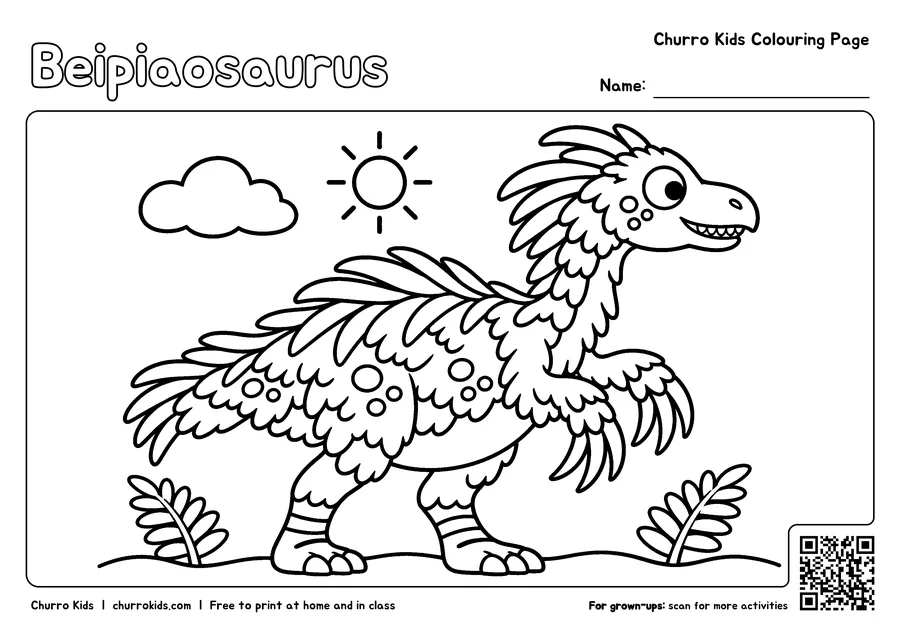
One A4 page, and it is free. Print it freely at home or in class.
Good for parents to know
- That it ate plants is worked out from the shape of its teeth and from related dinosaurs. No food has been found in its belly, so it is best to say "it probably ate leaves."
- The best-known fossil was an animal that was not fully grown. That is why sources give different numbers, from 1.8 to 2.2 metres long and from 27 to 50 kilograms.
- It is easy to mix up with its relative Therizinosaurus, which had very long claws. Therizinosaurus was as big as a bus and lived in Mongolia in the Late Cretaceous. Beipiaosaurus was about the size of a grown-up person and lived in the Early Cretaceous.