"It is a long-necked dinosaur, but it has a hammer on its tail!" Your child is turning over dinosaur cards one by one, eyes wide.
Shunosaurus was a plant-eating dinosaur that lived between the Middle and the Late Jurassic in what is now Sichuan, China. It was as long as a bus, but for a long-necked dinosaur its neck was on the short side. At the end of its tail it had a club made of bone with two pointed spikes on top. Below are the questions children ask most, with answers at a child's level. You can read them out loud.
Fact cardShunosaurus
- Name means
- lizard of Shu (an old name for Sichuan)
- Lived
- Middle to Late Jurassic (about 170 to 157 million years ago)
- Length
- about 10 m (33 ft)
- Weight
- about 3 tonnes
- Food
- Plant-eater
- Found in
- Asia, China (Sichuan)
- Group
- Dinosaurs from around the world
- A club at the end of its tail
- A short neck for a long-necked dinosaur
- A body that walked on four legs
How big was Shunosaurus? Measure it with your own height
When your child asks, answer like this
 What does Shunosaurus mean?

How big was it?
What did it eat?
What did it do when a scary dinosaur came?
Who lived with it?
- Gasosaurus predatorsame time and place
Gasosaurus was a meat-eating dinosaur about 3.5 to 4 metres (11 to 13 feet) long that lived in the same place. It may have gone after young Shunosaurus. - Huayangosaurus neighboursame time and place
Huayangosaurus was a small plant-eating dinosaur about 4 metres (13 feet) long with plates on its back. The two probably ate low plants together in the same forest. - Omeisaurus neighboursame time and place
Omeisaurus was a plant-eating dinosaur with a very long neck. Omeisaurus ate leaves high up and Shunosaurus ate plants low down, so they probably did not fight over food.
When and where did it live?
What was it like as a baby? Did it live with friends?
Are there dinosaurs that look like it?
Who found it first?
Shunosaurus facts that make kids say “Wow!”
- Shunosaurus had a club with pointed spikes at the end of its tail, and it probably used it to protect itself.
- Almost the whole skeleton has been found, so it is one of the long-necked dinosaurs whose looks we know very well.
- When it was named, nobody knew it had a tail club. The club became known a few years later, in 1989.
- The Zigong Dinosaur Museum now stands on the spot where the fossils were found.
From head to tail
- One tooth could be up to 8 cm (3 in) long, as long as a grown-up's finger.
- The spikes on top of the tail club were about 5 cm (2 in) long.
- It weighed about 3 tonnes, about the same as an elephant.
- It is one of the few long-necked dinosaurs found with the very last bone at the tip of its tail.
A Shunosaurus story to read aloud
Shunosaurus walks out of the forest by the lake, where the trees grow thick. It lowers its short neck and snips off plants that grow low down. Beside it, Omeisaurus with its very long neck is eating leaves from a tall tree. Huayangosaurus, with plates on its back, walks past too. Then Gasosaurus creeps closer between the trees. Shunosaurus swishes the club at the end of its tail. Gasosaurus gets a surprise and goes back into the forest.
A quiz to do together
Tap an answer.
What is at the end of the tail of Shunosaurus?
In which country was Shunosaurus found?
How does the neck of Shunosaurus compare with other long-necked dinosaurs?
You finished the quiz! Well done.
Colouring page
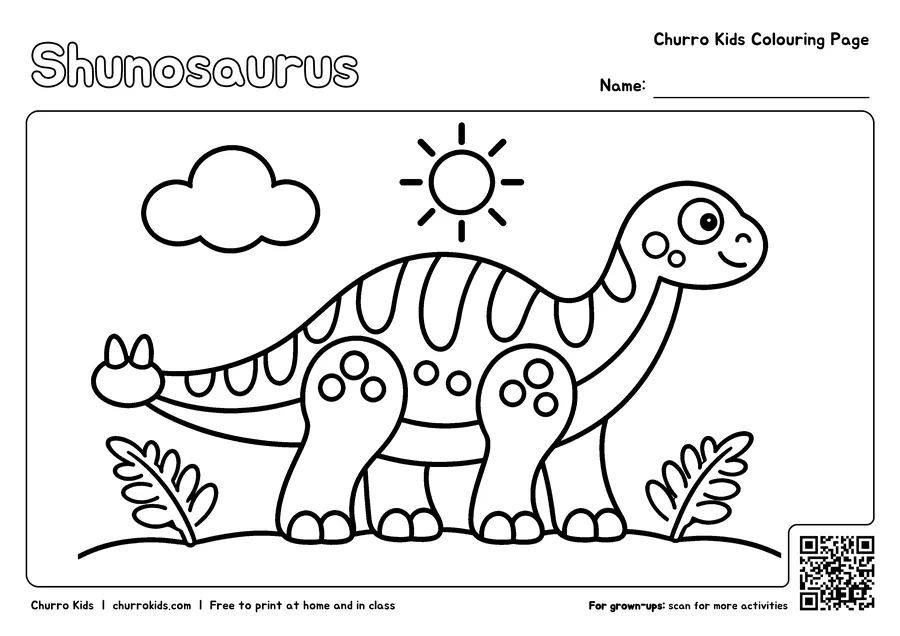
One A4 page, and it is free. Print it freely at home or in class.
Good for parents to know
- The idea that it swung its tail club to drive off meat-eating dinosaurs is a likely guess, and it has not been proven. You can say "it probably swung its tail to protect itself."
- Most books say it lived in the Middle Jurassic. Recent studies suggest it may have lived a little later, early in the Late Jurassic, about 161 to 157 million years ago. So this guide covers both and says about 170 to 157 million years ago. Different books may give different times.
- Because of the club on its tail, it can be mixed up with Ankylosaurus. Shunosaurus has no armour on its back and has a long neck and a long tail.