"Why does this dinosaur have such big spikes on its shoulders?" Your child has lined up the armoured dinosaur toys and holds one up to show you.
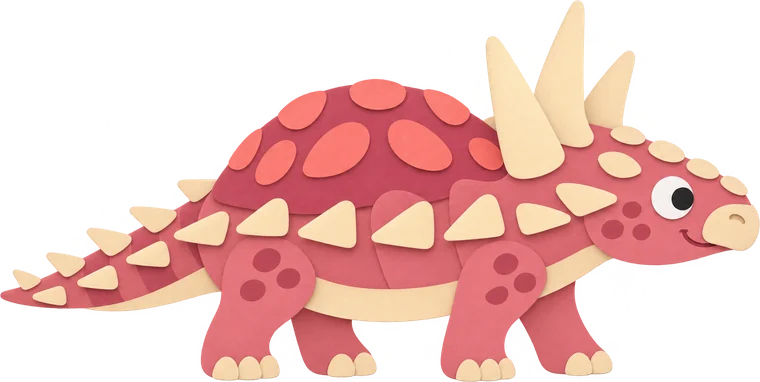
Sauropelta was an armoured dinosaur that lived in North America in the Early Cretaceous. Its back was covered with hard bony armour, and big pointed spikes stood in rows on its neck and shoulders. Its tail was almost half the length of its body, but there was no club at the end. Below are the questions children ask most, with answers at a child's level. You can read them out loud.
Fact cardSauropelta
- Name means
- lizard shield
- Lived
- Early Cretaceous (about 115 to 108 million years ago)
- Length
- about 5.5 m (18 ft)
- Weight
- about 1.5 to 2 tonnes
- Food
- Plant-eater
- Found in
- North America, the United States (Wyoming, Montana)
- Group
- Dinosaurs from around the world
- Big spikes on its neck and shoulders
- Hard armour covering its back
- A long tail with no club
How big was Sauropelta? Measure it with your own height
When your child asks, answer like this
 What does Sauropelta mean?

How big was it?
What did it eat?
What did it do when a scary dinosaur came?
Who lived with it?
- Deinonychus predatorsame time and place
Deinonychus was a quick meat-eating dinosaur about 3 metres (10 feet) long that lived in the same place. The armour and spikes of Sauropelta were so hard that even Deinonychus probably could not attack it easily. - Acrocanthosaurus predatorsame time and place
Acrocanthosaurus was the biggest meat-eating dinosaur in the same land. Sauropelta probably protected itself with its armour and shoulder spikes. - Tenontosaurus neighboursame time and place
Tenontosaurus was the most common plant-eating dinosaur on the same plains. It probably lived beside Sauropelta, eating plants by the river.
When and where did it live?
What was it like as a baby? Did it live with friends?
Are there dinosaurs that look like it?
Who found it first?
Sauropelta facts that make kids say “Wow!”
- Sauropelta had long, pointed spikes on its neck and shoulders, so meat-eating dinosaurs probably could not bite it easily.
- Dr Ostrom, who named Sauropelta, also named its neighbour Deinonychus.
- Over its hips it had a wide shield made of many pieces of bone joined together.
- Flat, triangle-shaped bony plates ran in rows along both sides of its tail.
From head to tail
- Its tail was very long, almost half the length of its body.
- One fossil was found with 40 tail bones, and there were probably more than 50 at first.
- Its skull was about 35 cm (14 in) wide behind the eyes.
- It weighed 1.5 to 2 tonnes, about the same as a big car.
A Sauropelta story to read aloud
Sauropelta walks slowly across the river plain, where thick conifer forests grow. With its narrow snout it picks the plant it wants and nips it off with its beak. Its long tail sways along behind it. Close by, some Tenontosaurus are eating plants. Then quick Deinonychus comes near. But it sees the hard armour and the pointed shoulder spikes of Sauropelta and just walks past. Sauropelta walks on to find more tasty plants.
A quiz to do together
Tap an answer.
Does Sauropelta have a club at the end of its tail?
Where are the big, pointed spikes of Sauropelta?
What does the name Sauropelta mean?
You finished the quiz! Well done.
Colouring page
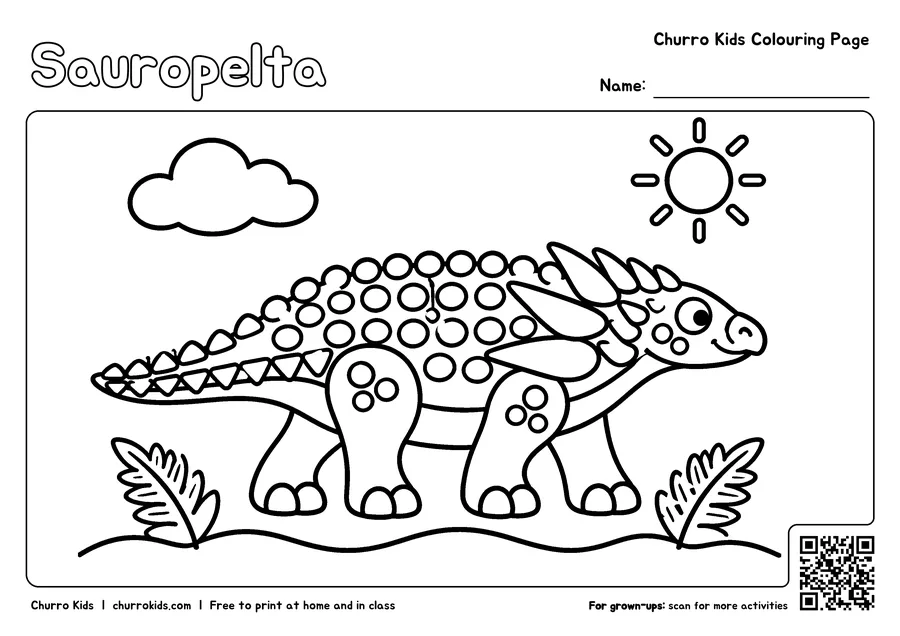
One A4 page, and it is free. Print it freely at home or in class.
Good for parents to know
- Sources give its length as anywhere from 5.2 to 6.5 metres. The time it lived also differs a little from book to book. Some say about 108.5 million years ago, and others give a wider part of the Early Cretaceous.
- It is often mixed up with Ankylosaurus. If there is no club at the end of the tail, the snout is narrow and there are big spikes on the shoulders, it is Sauropelta.
- There is no fossil evidence that it met Deinonychus or Acrocanthosaurus. We only know that they lived in the same place at the same time. So it is best to say "its armour and spikes were so hard that they probably could not attack it easily."