"Why does this dinosaur have spikes on its sides?" Your child was turning the pages of a dinosaur book and has stopped at a dinosaur covered in spikes.
Gastonia was a plant-eating dinosaur that lived in the Early Cretaceous, in the land that is now Utah in the USA. It was as long as a car, and its body was flat and low. Pointed spikes stuck out in rows along its sides, and its hips were covered by a hard shield. Below are the questions children ask most, with answers at a child's level. You can read them out loud.
Fact cardGastonia
- Name means
- named after Robert Gaston, who found the fossils
- Lived
- Early Cretaceous (about 139 to 125 million years ago)
- Length
- about 5 m (16 ft)
- Weight
- about 1.9 tonnes
- Food
- Plant-eater
- Found in
- North America, the USA (Utah)
- Group
- Dinosaurs from around the world
- Pointed spikes sticking out from the sides of its body
- A shield covering its hips
- A flat, low body
How big was Gastonia? Measure it with your own height
When your child asks, answer like this
 What does Gastonia mean?

How big was it?
What did it eat?
What did it do when a scary dinosaur came?
Who lived with it?
- Utahraptor predatorsame time and place
Utahraptor fossils came from the same place where Gastonia was first found. Gastonia probably used its spikes and armour to protect itself from meat-eating dinosaurs like Utahraptor. - Hippodraco neighboursame time and place
Hippodraco was a plant-eating dinosaur that lived in the same land. It probably lived alongside Gastonia, eating plants by the river. - Cedarosaurus neighboursame time and place
Cedarosaurus was a long-necked plant-eating dinosaur that lived in the same land. Cedarosaurus probably ate leaves high up, and Gastonia ate plants low down.
When and where did it live?
What was it like as a baby? Did it live with friends?
Are there dinosaurs that look like it?
Who found it first?
Gastonia facts that make kids say “Wow!”
- Gastonia had rows of pointed spikes along the sides of its body, so it probably protected itself like a hedgehog.
- Gastonia was one of the most common dinosaurs in the place where it lived.
- In 2004 four skulls had been found, and by 2014 the number had grown to ten.
- In 2016 a second kind of Gastonia was given a new name.
From head to tail
- Its skull was about 30 cm (12 in) long, the same as a school ruler.
- It had about five pairs of big, flat, triangle-shaped spikes on the sides of its body.
- Its hips were about 1.1 m (3.6 ft) high, close to the height of a five-year-old child.
- It had 15 or 16 small teeth on each side of its upper jaw.
A Gastonia story to read aloud
Gastonia crawls along with its low body, between the river forest and the open field. It plucks the plants that grow close to the ground with its toothless beak. Far away, long-necked Cedarosaurus is eating leaves high up. Just then Utahraptor creeps closer. Gastonia lowers its body, holds out its pointed spikes and stays very still. Utahraptor is afraid of the spikes and goes off somewhere else. Gastonia slowly starts eating plants again.
A quiz to do together
Tap an answer.
What grows on the sides of Gastonia's body?
Does Gastonia have a club at the end of its tail?
Where does the name Gastonia come from?
You finished the quiz! Well done.
Colouring page
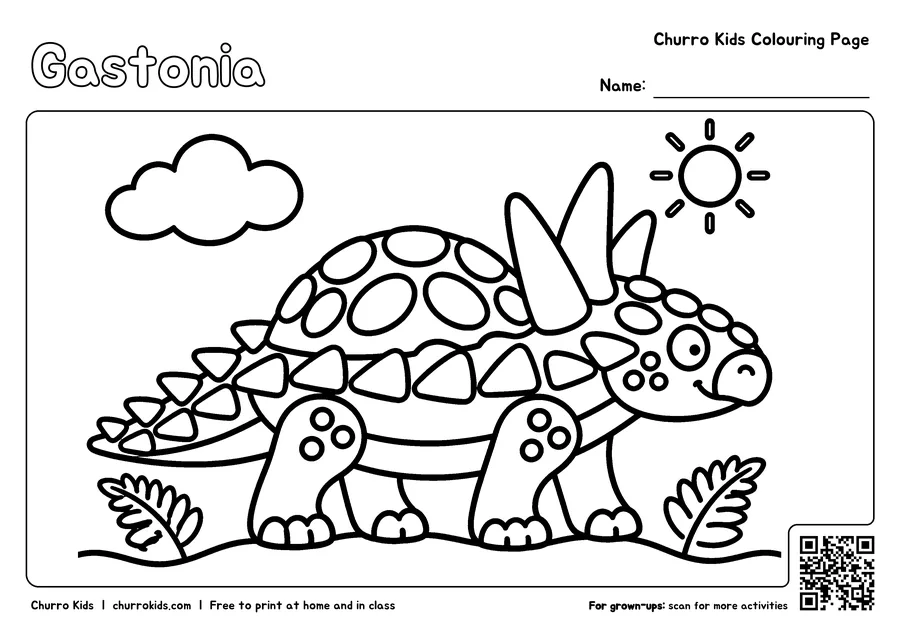
One A4 page, and it is free. Print it freely at home or in class.
Good for parents to know
- Sources give its length as anything from about 4.6 to 6 metres (15 to 20 feet). This guide uses about 5 metres (16 feet).
- The fossils were found jumbled together, so nobody is sure exactly how many spikes it had or how they were arranged. Pictures can differ a little from book to book.
- It is easy to mix up with Ankylosaurus, but Gastonia has no club at the end of its tail. Living in herds and males testing their strength against each other are both guesses, so "scientists think it may have" is the right way to say it.