"Why is this dinosaur's nose so bumpy? Did it bang into something?" your child asks with a worried face, looking at a Muttaburrasaurus in a picture book.
Muttaburrasaurus was a plant-eating dinosaur that lived in the Early Cretaceous in what is now Queensland, Australia. It was about 8 metres (26 feet) long, a little shorter than a bus. It had a rounded, hollow bump on top of its nose, and it cut up tough plants with a beak-like mouth and teeth that closed together like scissors. Its name comes from the town of Muttaburra, where the fossil was found. Below are the questions children ask most, with answers at a child's level. You can read them out loud.
Fact cardMuttaburrasaurus
- Name means
- lizard of Muttaburra (the name of a town in Australia)
- Lived
- Early Cretaceous (about 112 to 100 million years ago)
- Length
- about 8 m (26 ft)
- Weight
- about 3 to 9 tonnes
- Food
- Plant-eater
- Found in
- Oceania, Australia (Queensland)
- Group
- Dinosaurs from around the world
- A rounded bump on top of its nose
- A mouth shaped like a beak
- Strong back legs and a long tail
How big was Muttaburrasaurus? Measure it with your own height
When your child asks, answer like this
 What does Muttaburrasaurus mean?

How big was it?
What did it eat?
What did it do when a scary dinosaur came?
Who lived with it?
- Kunbarrasaurus neighboursame time and place
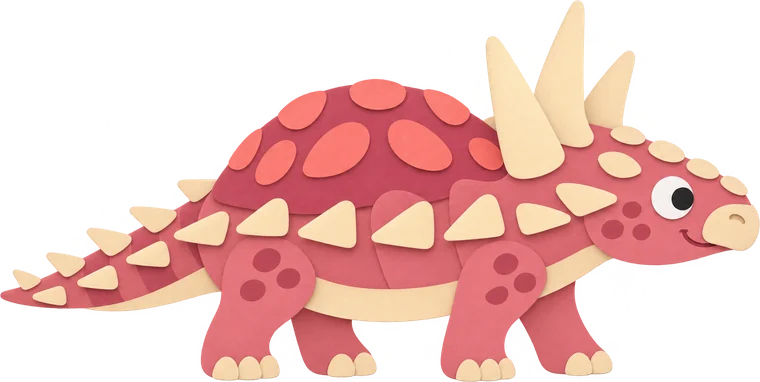
Kunbarrasaurus was a small armoured dinosaur that lived in the same Queensland, Australia, at about the same time. Both of them ate plants, and nobody knows yet if they ever met. - Kronosaurus neighboursame time and place
Kronosaurus was a big sea reptile that lived in the shallow sea next to the land where Muttaburrasaurus lived. Muttaburrasaurus lived on the land, and Kronosaurus lived in the sea.
When and where did it live?
What was it like as a baby? Did it live with friends?
Are there dinosaurs that look like it?
Who found it first?
Muttaburrasaurus facts that make kids say “Wow!”
- Muttaburrasaurus had a rounded bump rising on top of its nose, and it is a dinosaur that was found in Australia.
- In 1987 a fourteen-year-old boy named Robert Walker helped to find the skull of another Muttaburrasaurus.
- It was chosen as the fossil that stands for the state of Queensland in Australia.
- The first skeleton came from mud that settled on a seashore long ago, so the body seems to have been washed onto the shore and buried there.
From head to tail
- One thigh bone is about 1 metre (3 feet) long.
- Its feet were long and wide, with four toes on each.
- Its teeth closed together like scissors, so it could cut even tough plants.
- Recent studies say it probably weighed about 8 to 9 tonnes, more than a big elephant.
A Muttaburrasaurus story to read aloud
In a conifer forest close to a shallow sea, Muttaburrasaurus opens its eyes. It lifts its head, with the rounded bump on its nose, and sniffs the air. Standing on four legs, it nips off the ferns and cycads under the trees with its beak. Its scissor-like teeth snip, snip through the tough leaves. Maybe a small armoured dinosaur, Kunbarrasaurus, was eating plants nearby too. With a full tummy, Muttaburrasaurus stands up on its strong back legs and walks off along the forest path.
A quiz to do together
Tap an answer.
What is on top of the nose of Muttaburrasaurus?
In which country was Muttaburrasaurus found?
What did Muttaburrasaurus eat?
You finished the quiz! Well done.
Colouring page
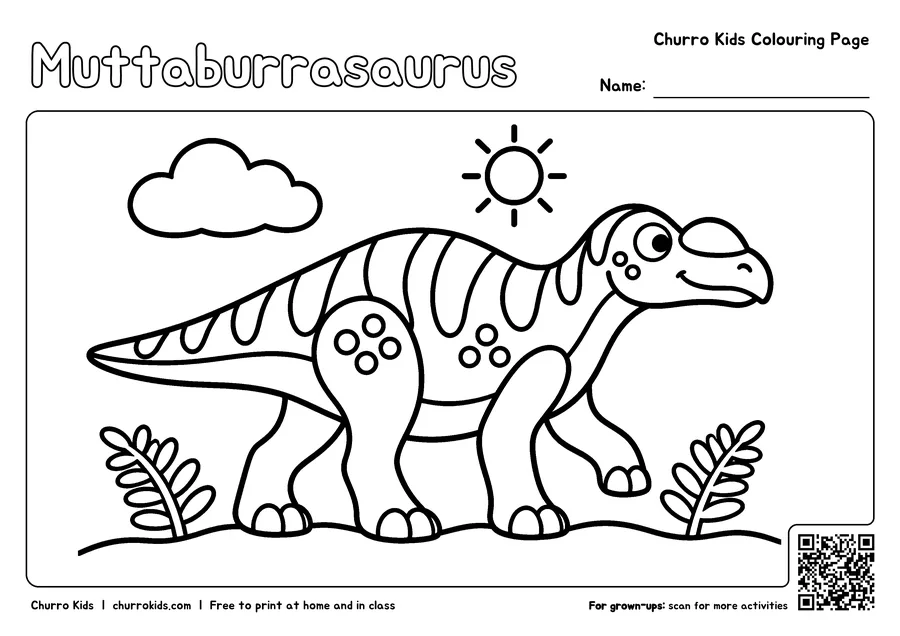
One A4 page, and it is free. Print it freely at home or in class.
Good for parents to know
- Its weight differs a lot from study to study. Older work puts it at about 2.8 tonnes, and recent studies put it at about 8 to 9 tonnes. Its length is given as 7 metres (23 feet) in some places and 8 metres (26 feet) in others. If books give different numbers, neither is simply wrong.
- Nobody is sure yet if the bump on its nose was for making sounds or for smelling. You can say, "Scientists are still finding out." It is also not certain that it had a thumb spike like Iguanodon.
- This guide gives its time as the Early Cretaceous, but the first skeleton found may come from the very start of the Late Cretaceous.