At the museum, your child stops under a huge pterosaur model hanging from the ceiling. "Did something that big really fly?"
Quetzalcoatlus was not a dinosaur, but it lived in the age of dinosaurs. It was a pterosaur, a flying reptile, and it lived in the Late Cretaceous in what is now Texas in the USA. Scientists think its spread wings were as long as a bus, and when it stood on the ground it was as tall as a giraffe. It probably walked on the ground and picked up small animals to eat, rather than snatching food from the air. Below are the questions children ask most, with answers at a child's level. You can read them out loud as they are.
Fact cardQuetzalcoatlus
- Name means
- named after Quetzalcoatl, a feathered serpent god
- Lived
- Late Cretaceous (about 68 to 66 million years ago)
- Length
- about 10.5 m (34 ft) wingspan
- Weight
- about 200 to 250 kg
- Food
- Meat-eater (it ate small animals)
- Found in
- North America (Texas, USA)
- Group
- Friends from the age of dinosaurs (not dinosaurs)
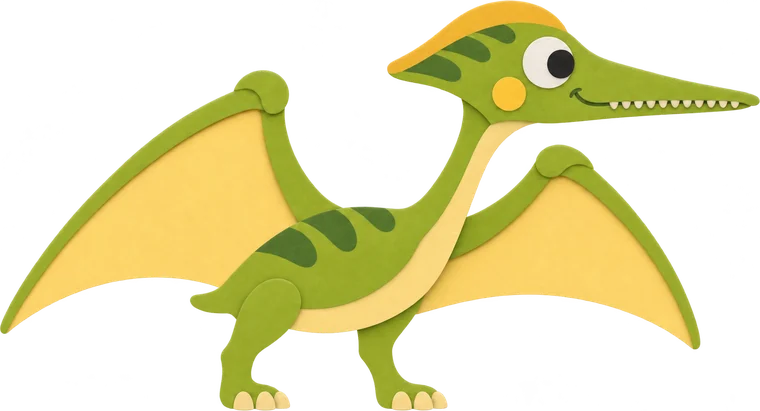
- A neck as long as a giraffe's
- A very long beak with no teeth
- Huge wings that cover the sky
How big was Quetzalcoatlus? Measure it with your own height
When your child asks, answer like this
 What does Quetzalcoatlus mean?

How big was it?
What did it eat?
How did it hunt?
Who lived with it?
- Alamosaurus neighboursame time and place
A huge long-necked dinosaur that lived in the same place. Quetzalcoatlus probably looked for small animals in the fields where Alamosaurus walked by. - Tyrannosaurus neighboursame time and place
Tyrannosaurus fossils have been found in the same land too. If Quetzalcoatlus met a big meat-eating dinosaur, it probably flew away quickly to stay safe.
When and where did it live?
What was it like as a baby? Did it live with friends?
Are there dinosaurs that look like it?
Who found it first?
Quetzalcoatlus facts that make kids say “Wow!”
- When Quetzalcoatlus stood on the ground it was as tall as a giraffe, and it was one of the biggest animals that ever flew.
- To take off, it probably pushed hard off the ground with all four limbs and leapt into the air.
- Only a few wing bones of the biggest species have been found, so its exact size is an estimate worked out by scientists.
- In Haenam, in South Jeolla Province in Korea, footprints have been found of a big pterosaur that seems to belong to the same group as Quetzalcoatlus.
From head to tail
- With its wings spread it was probably 10 to 11 m (33 to 36 ft) across, as long as a bus.
- Standing on all fours, its shoulders alone were 2 to 3 m (6.5 to 10 ft) high, much taller than a grown-up.
- Even the smaller relative species had a skull about 95 cm (37 inches) long, as long as a child is tall.
- It had 9 neck bones, and each one was very long.
A Quetzalcoatlus story to read aloud
When the sun comes up, Quetzalcoatlus folds its wings and walks across the field on all fours. It is as tall as a giraffe, so it can see a long way. Over there, a long-necked Alamosaurus walks slowly by. Quetzalcoatlus bends its long neck down and looks through the bushes. When it finds a small animal, it picks it up with its long beak and gulps it down. Then it pushes hard off the ground with all four limbs and flies up into the sky.
A quiz to do together
Tap an answer.
When Quetzalcoatlus stood on the ground, it was as tall as which animal?
Did the beak of Quetzalcoatlus have teeth?
Where in Korea were the footprints of a big pterosaur found?
You finished the quiz! Well done.
Colouring page
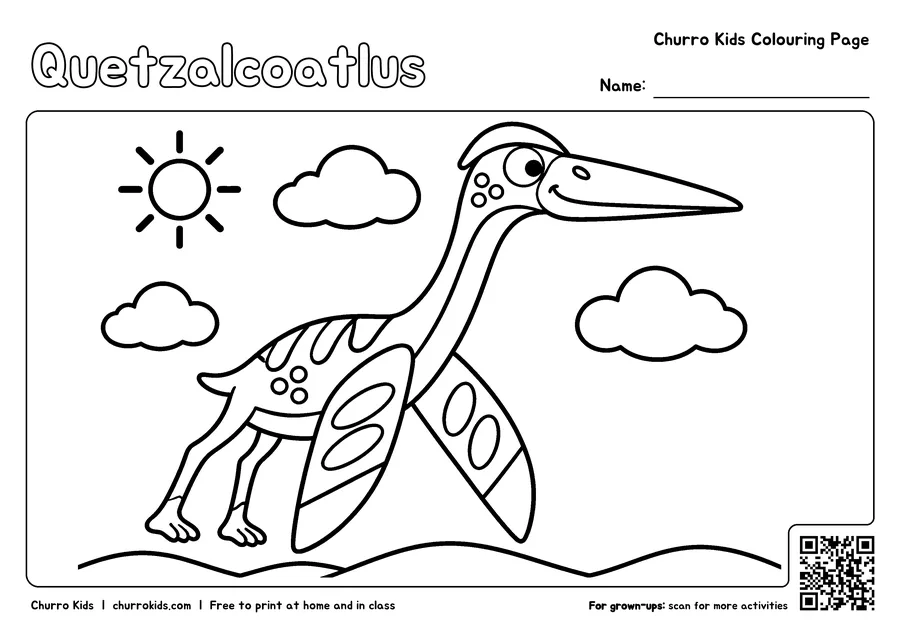
One A4 page, and it is free. Print it freely at home or in class.
Good for parents to know
- Quetzalcoatlus was a pterosaur, which is a different group from the dinosaurs. You can tell your child, "It was not a dinosaur, but it lived in the age of dinosaurs."
- Only a few wing bones of the biggest species have been found. So the wingspan of 10 to 11 metres and the weight of 200 to 250 kg are both estimates. A study in 2021 put its weight at about 150 kg.
- Tyrannosaurus fossils come from the same land, and that is all we know. There is no fossil evidence that the two ever met, so it is safest to say "they lived in the same place."