Your child is lining up toy dinosaurs and tilts their head. "Long-necked dinosaurs have no armour, so how do they protect themselves?" Saltasaurus is a good dinosaur to bring up at that moment.
Saltasaurus was a long-necked dinosaur that lived in Argentina, in South America, in the Late Cretaceous. It was a little shorter than a bus, and hard bony armour was set in its back and sides. It was also the first long-necked dinosaur that was found to have armour. Below are the questions children ask most, with answers at a child's level. You can read them out loud like a storybook.
Fact cardSaltasaurus
- Name means
- lizard of Salta (a place in Argentina)
- Lived
- Late Cretaceous (about 70 to 68 million years ago)
- Length
- about 8.5 m (28 ft)
- Weight
- about 2.5 to 7 tonnes
- Food
- Plant-eater
- Found in
- South America (Argentina)
- Group
- Long-necked dinosaurs
- Hard bony armour set in its back
- A short neck and short legs
- A plump, wide belly
How big was Saltasaurus? Measure it with your own height
When your child asks, answer like this
 What does Saltasaurus mean?

How big was it?
What did it eat?
What did it do when a scary dinosaur came?
Who lived with it?
- Meat-eating dinosaurs of the abelisaur group predatorsame time and place
Teeth of meat-eating dinosaurs from the abelisaur group were also found in the land where Saltasaurus was found. Dinosaurs like these probably went after Saltasaurus. - Noasaurus neighboursame time and place
Noasaurus was a small meat-eating dinosaur that lived in the same place. It probably could not take on a fully grown Saltasaurus, but the young ones probably had to be careful. - Enantiornis neighboursame time and place
Early birds such as Enantiornis lived in the same place, so they probably flew over the heads of Saltasaurus.
When and where did it live?
What was it like as a baby? Did it live with friends?
Are there dinosaurs that look like it?
Who found it first?
Saltasaurus facts that make kids say “Wow!”
- Saltasaurus was a long-necked dinosaur, but it had hard bony armour on its back, so it could protect its body.
- Saltasaurus was the first long-necked dinosaur that was found to have armour.
- Before Saltasaurus was found, people thought long-necked dinosaurs protected themselves only with their big bodies.
- Inside the eggs of closely related dinosaurs, even the bumpy skin prints of baby dinosaurs have been found.
From head to tail
- The big bony plates were about 12 cm (5 inches) long, the size of a grown-up's palm.
- Between the plates, tiny bones about 7 mm (a quarter of an inch) across, the size of beans, were packed in tightly.
- It was about 8.5 m (28 ft) long, a little shorter than a bus.
- It weighed about 2.5 to 7 tonnes, about as much as one elephant.
A Saltasaurus story to read aloud
It is the Late Cretaceous, and a herd of Saltasaurus walks across plains with rivers and lakes. They waddle along on short legs, but hard bony armour shines on their backs. Saltasaurus pulls off low ferns and leaves and gulps them down. Early birds fly overhead. Even when a meat-eating dinosaur comes near, bony plates the size of a palm and little bones the size of beans protect its body. The Saltasaurus stay close to one another and walk on to the next feeding ground.
A quiz to do together
Tap an answer.
What did Saltasaurus have on its back?
In which country was Saltasaurus found?
How big was Saltasaurus next to other long-necked dinosaurs?
You finished the quiz! Well done.
Colouring page
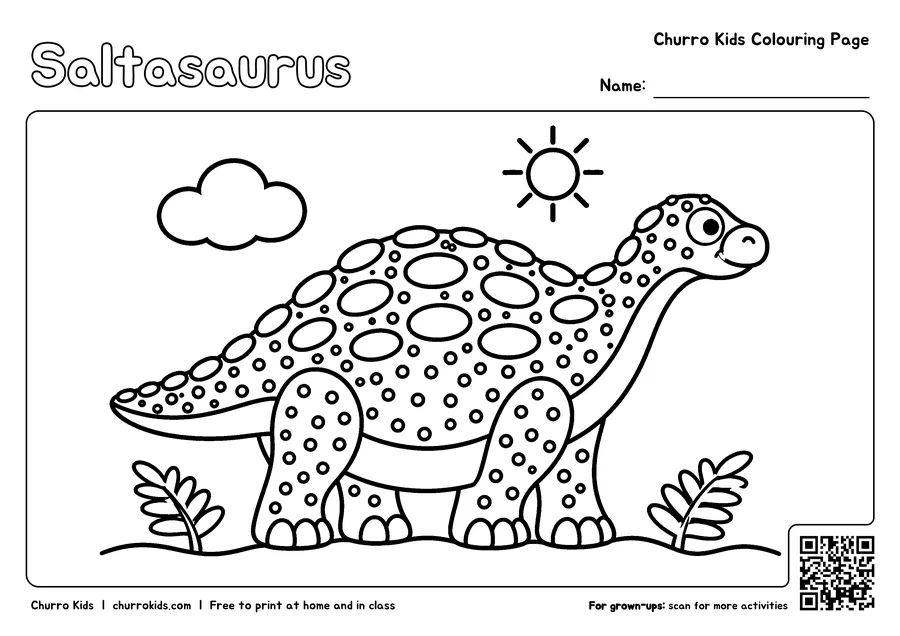
One A4 page, and it is free. Print it freely at home or in class.
Good for parents to know
- Size figures vary a lot between sources. Length estimates run from about 6 metres to nearly 13 metres, and weight from about 2.5 to 7 tonnes. The Natural History Museum in London lists 12 metres, so you may see a number different from the 8.5 metres given here.
- Because it has armour on its back, it can be mixed up with armoured dinosaurs such as Ankylosaurus. Saltasaurus is a long-necked dinosaur with a long neck and tail and no club at the end of its tail.
- The fifteen to forty eggs come from what we know about closely related dinosaurs. Saltasaurus probably did the same, so it is best to say "its relatives did." The idea that meat-eating dinosaurs went after it also comes only from teeth found in the same land.