"This dinosaur has an axe stuck on its head!" Your child was putting dinosaur stickers on a page and is now pointing at a strange crest.
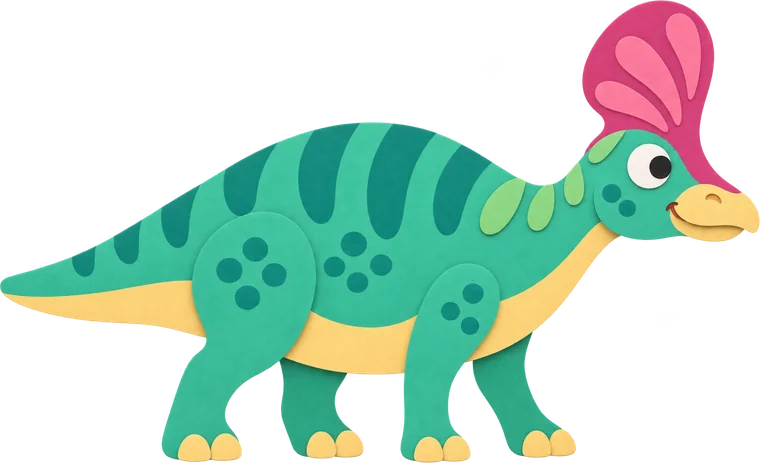
Lambeosaurus was a duck-billed dinosaur that lived in the Late Cretaceous, in the land that is now Alberta in Canada. It was as long as two cars in a row and had a crest shaped like an axe on its head. The crest was small when the animal was young and grew bigger and bigger as it became an adult. It was hollow, so it probably made sounds ring out. Below are the questions children ask most, with answers at a child's level. You can read them out loud.
Fact cardLambeosaurus
- Name means
- Lambe's lizard (the name comes from the Canadian fossil scientist Lawrence Lambe)
- Lived
- Late Cretaceous (about 76.5 to 74.5 million years ago)
- Length
- about 7.5 m (25 ft)
- Weight
- about 2.5 to 3.5 tonnes
- Food
- Plant-eater
- Found in
- North America (Alberta, Canada)
- Group
- Duck-billed dinosaurs and friends
- A crest shaped like an axe
- A pointed rod sticking out behind the crest
- A flat duck bill
How big was Lambeosaurus? Measure it with your own height
When your child asks, answer like this
 What does Lambeosaurus mean?

How big was it?
What did it eat?
What did it do when a scary dinosaur came?
Who lived with it?
- Gorgosaurus predatorsame time and place
Gorgosaurus was a quick relative of Tyrannosaurus that lived in the same Alberta in Canada. It probably hunted duck-billed dinosaurs like Lambeosaurus. - Corythosaurus rivalsame time and place
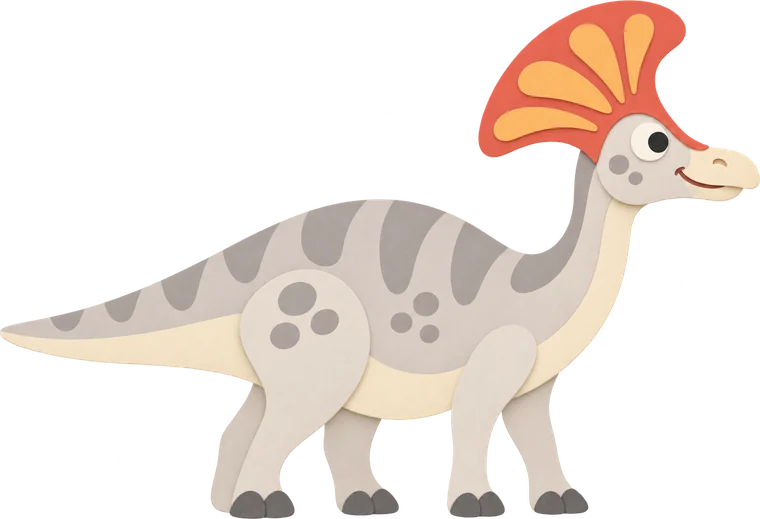
Corythosaurus was a close relative with a crest shaped like a helmet. They ate the same kinds of plants in the same forest, and they probably told each other apart by the shape of their crests. - Prosaurolophus neighboursame time and place
Prosaurolophus was a duck-billed dinosaur neighbour that lived in the same place. The way their teeth wore down shows that Lambeosaurus ate plants lower down, so they probably quarrelled less over food.
When and where did it live?
What was it like as a baby? Did it live with friends?
Are there dinosaurs that look like it?
Who found it first?
Lambeosaurus facts that make kids say “Wow!”
- The crest of Lambeosaurus was small when it was young and grew bigger and bigger as it became an adult.
- Baby Lambeosaurus looked so different from the adults that people once thought they were another dinosaur and gave them a different name.
- Corythosaurus has big round scales on its legs and Lambeosaurus does not, so the two can be told apart by their skin as well.
- Inside the crest there were winding air paths that led from the nose, so it probably made its sounds ring out loudly.
From head to tail
- The scales on its body were 7 to 9 mm (about a third of an inch) across, the size of a pea.
- One thigh bone was about 1 m (3 ft) long, close to the height of a five-year-old child.
- Each front foot had four fingers and no thumb.
- It could walk on two legs and on four legs.
A Lambeosaurus story to read aloud
In a forest by the river, Lambeosaurus lowers its head. It tears off low ferns and leaves with its sharp beak. It grinds them up small with its teeth, which stand in about forty rows, and swallows. Next to it is its relative Corythosaurus, with a half-moon crest. Their crests have different shapes, so they can tell at once who is who. The crest of a young Lambeosaurus is still small, but it grows a little every day. When danger comes close, they make a sound ring through their crests and run away together.
A quiz to do together
Tap an answer.
What does the crest of Lambeosaurus look like?
Whose name does Lambeosaurus come from?
What happens to the crest of Lambeosaurus as it grows up?
You finished the quiz! Well done.
Colouring page
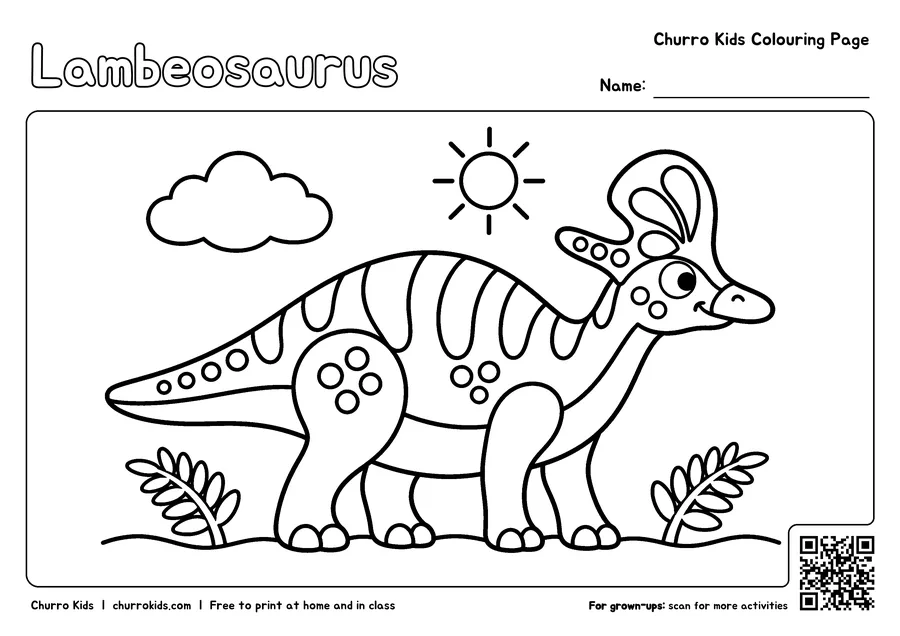
One A4 page, and it is free. Print it freely at home or in class.
Good for parents to know
- The shape of the crest differs with the kind of Lambeosaurus and with age, and males and females were probably different too. The axe-shaped crest in this guide is that of one fully grown kind. Another kind has a bigger crest with no rod sticking out behind. Recent studies put its length at about 7 to 7.7 metres, while some museum pages and older books say about 9 metres.
- Its body is almost exactly like that of its relative Corythosaurus, so the two are easy to mix up. An axe-shaped crest that leans forward means Lambeosaurus, and a round half-moon crest means Corythosaurus.
- Making sounds with the crest and telling each other apart by crest shape are both guesses. You can say "it probably made sounds ring through its crest." That Gorgosaurus hunted it is also a guess, based on the two living at the same time and place.