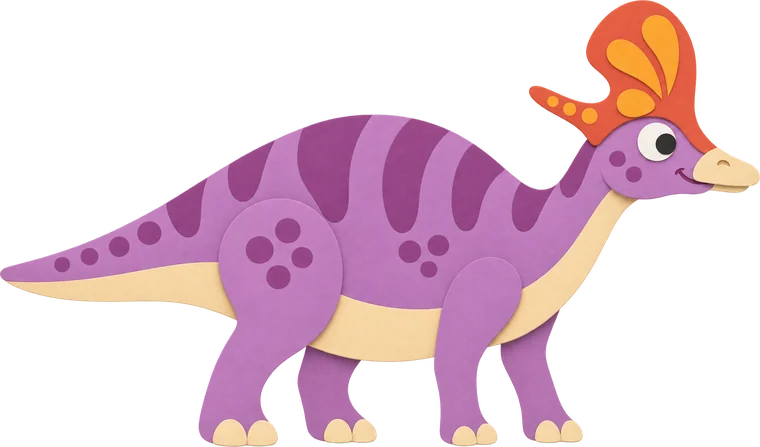
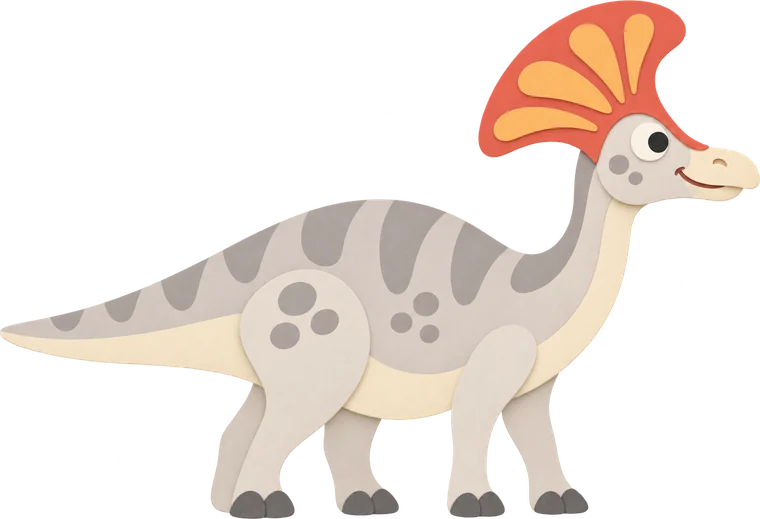
"Is this dinosaur wearing a hat?" your child asks, pulling a Corythosaurus out of the toy box and pointing at its round crest.
Corythosaurus was a duck-billed dinosaur that lived in the Late Cretaceous in what is now Alberta, Canada. It was as long as a bus, and the round crest on its head looks like the helmet of a soldier from long ago, so it was named the "helmet lizard". Conifer needles, seeds and fruit were found inside the body of a fossil, so we even know what it ate. Below are the questions children ask most, with answers at a child's level. You can read them out loud.
Fact cardCorythosaurus
- Name means
- helmet lizard
- Lived
- Late Cretaceous (about 77 to 75.7 million years ago)
- Length
- about 9 m (30 ft)
- Weight
- about 2.5 to 4 tonnes
- Food
- Plant-eater
- Found in
- North America (Alberta, Canada)
- Group
- Duck-billed dinosaurs and friends
- A helmet crest shaped like a half moon
- A narrow duck bill
- A long, flat tail
How big was Corythosaurus? Measure it with your own height
When your child asks, answer like this
 What does Corythosaurus mean?

How big was it?
What did it eat?
What did it do when a scary dinosaur came?
Who lived with it?
- Gorgosaurus predatorsame time and place
Gorgosaurus was a big meat-eating dinosaur that lived by the same rivers in Alberta, Canada. It probably hunted duck-billed dinosaurs like Corythosaurus. - Centrosaurus neighboursame time and place
Centrosaurus was a horned dinosaur neighbour with a big horn on its nose. It is often found in the same places as Corythosaurus fossils, so the two probably lived on the same plains. - Lambeosaurus rivalsame time and place
Lambeosaurus was a close relative with a crest shaped like an axe. The two probably shared similar plants in the same forest.
When and where did it live?
What was it like as a baby? Did it live with friends?
Are there dinosaurs that look like it?
Who found it first?
Corythosaurus facts that make kids say “Wow!”
- The round crest on top of its head looks like the helmet of a soldier from long ago, so it is called the "helmet lizard".
- In 1916 a ship carrying two Corythosaurus fossils to England sank during the war, so those fossils are still at the bottom of the sea.
- More than twenty skulls have been found, so scientists know well how the crest grew.
- People once thought it had webbed hands and feet, but the marks were really made by the thick pads of its feet being pressed flat.
From head to tail
- Its head, measured up to the crest, was about 70 cm (28 inches) high, close to the height of a dining table.
- The air passage inside the crest winds around like the letter S.
- It had more than 61 tail bones, so its tail was very long.
- Skin fossils show that its body had scales of many shapes, and on its belly the scales bulged like limpet shells.
A Corythosaurus story to read aloud
Corythosaurus lives in a forest where a big river flows. With its narrow beak it picks soft leaves and fruit, one by one. It munches conifer needles and seeds happily too. Nearby are the horned dinosaur Centrosaurus and its relative Lambeosaurus. On the head of a young Corythosaurus, the crest is only just starting to rise. When the meat-eating Gorgosaurus appears, Corythosaurus makes a low sound with its crest. Then it runs away quickly with its friends.
A quiz to do together
Tap an answer.
What does the crest of Corythosaurus look like?
What was found inside the body of a Corythosaurus fossil?
When did the crest of Corythosaurus begin to grow?
You finished the quiz! Well done.
Colouring page
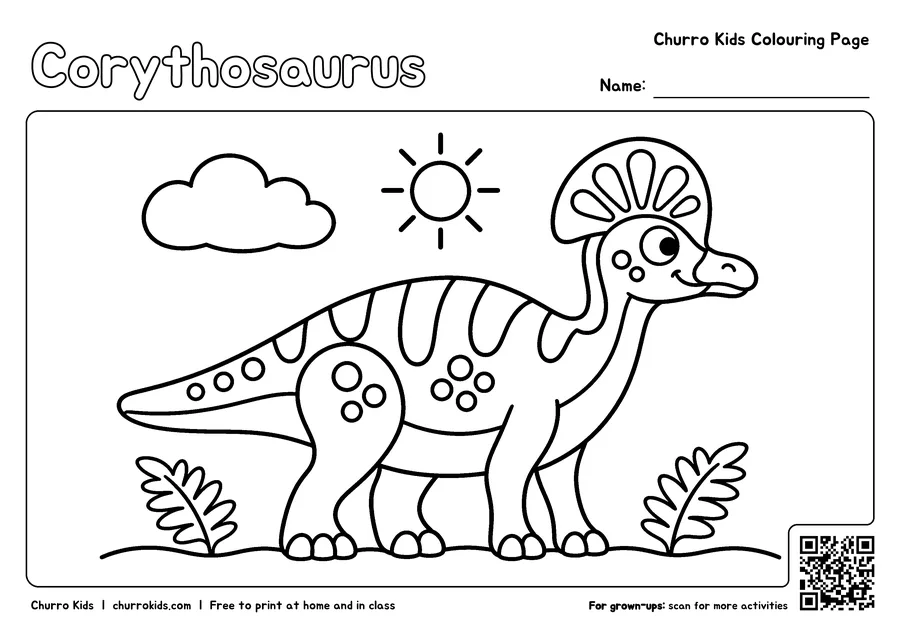
One A4 page, and it is free. Print it freely at home or in class.
Good for parents to know
- Depending on the study, its length is given as about 7.7 to 9 metres and its weight as 2.5 to 3.8 tonnes. Some museum pages give 10 metres. Books may give slightly different numbers.
- Scientists think the crest was used for making sounds and for showing off to each other, but this is not proven. Keep the guess in your words, as in "it probably made low sounds with its crest."
- Its body looks very much like that of its relative Lambeosaurus. A round half-moon crest means Corythosaurus, and an axe-shaped crest with a rod pointing backward means Lambeosaurus. People once thought it had webbed hands and feet, but the marks were made by the thick pads of its feet being pressed flat.