Your child is brushing their teeth, looks in the mirror and asks, "How many teeth does a dinosaur have?" For a talk about teeth, Edmontosaurus is a good one to bring up.
Edmontosaurus was a duck-billed dinosaur that lived in North America in the Late Cretaceous. It was a little longer than a bus, and it had hundreds of small teeth packed tightly in its mouth, so it could grind up even tough plants. It is also a dinosaur known from several "dinosaur mummies" with even the skin preserved as fossil. Below are the questions children ask most, with answers at a child's level. You can read them out loud as they are.
Fact cardEdmontosaurus
- Name means
- lizard of Edmonton
- Lived
- Late Cretaceous (about 73 to 66 million years ago)
- Length
- about 12 m (39 ft)
- Weight
- about 4 to 6 tonnes
- Food
- Plant-eater
- Found in
- North America (Canada; Alaska, Montana, Wyoming and other parts of the USA)
- Group
- Duck-billed dinosaurs and friends
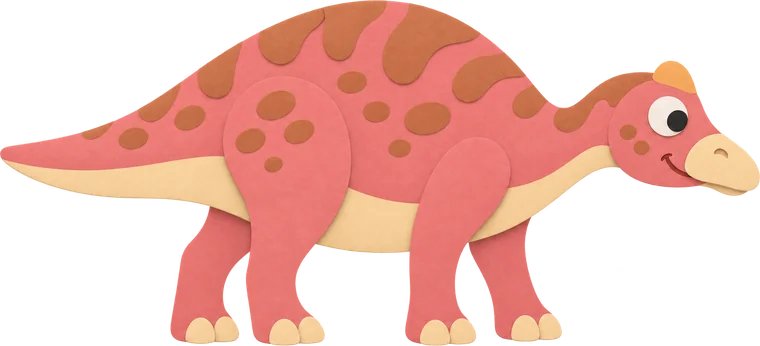
- A wide bill like a duck's
- A smooth head with no crest
- A very big, long body
How big was Edmontosaurus? Measure it with your own height
When your child asks, answer like this
 What does Edmontosaurus mean?

How big was it?
What did it eat?
What did it do when a scary dinosaur came?
Who lived with it?
- Tyrannosaurus predatorfossil evidence
A toe bone of Edmontosaurus has tooth marks that look like those of Tyrannosaurus. There is also a duck-billed dinosaur, thought to be Edmontosaurus, with a piece of Tyrannosaurus tooth stuck in tail bones that healed around it. So some of them were probably bitten and still got away and lived. - Albertosaurus predatorfossil evidence
Edmontosaurus bones found all together in Alberta, Canada, have many tooth marks on them, and many teeth that had fallen out of Albertosaurus were found beside them. Scientists think the Albertosaurus fed on them after they had died. It does not look like a hunt. - Triceratops neighboursame time and place
Triceratops was a neighbour that lived in North America at the very end of the Late Cretaceous too. They probably ate different plants on the same plains.
When and where did it live?
What was it like as a baby? Did it live with friends?
Are there dinosaurs that look like it?
Who found it first?
Edmontosaurus facts that make kids say “Wow!”
- It had hundreds of small teeth packed tightly in its mouth, so it could grind up even tough plants and leaves.
- Several "dinosaur mummies" with even the skin preserved as fossil have been found, so we know the shape of its scales in detail.
- On top of the head of one animal there was a crest made of soft flesh with no bone in it, standing up like a rooster's comb.
- Even in northern Alaska, where the sun hardly rises in winter, Edmontosaurus probably stayed through the winter without leaving.
From head to tail
- The skull of a fully grown adult is more than 1 m (3 ft) long.
- The teeth were stacked in layers, up to six in each stack, and when they wore down new teeth kept coming up.
- Each front foot had four fingers, and each back foot had three toes shaped like hooves.
- A computer study showed that it could probably run at about 45 km (28 miles) an hour, as fast as a car driving along a neighbourhood street.
A Edmontosaurus story to read aloud
A herd of Edmontosaurus is gathered on the wide plain. They pull off tough plants with their wide beaks and grind them like a millstone with their stacked teeth. Beside them, their neighbour Triceratops is eating plants too. Just then a Tyrannosaurus appears far away. The Edmontosaurus run away as fast as they can on their strong back legs. The big herd moves together, so each one feels safe. When the sun goes down, they all rest together by the river.
A quiz to do together
Tap an answer.
Which big meat-eating dinosaur left tooth marks on the bones of Edmontosaurus?
Does Edmontosaurus have a bony crest on its head?
What is preserved on the "dinosaur mummy" fossils?
You finished the quiz! Well done.
Colouring page
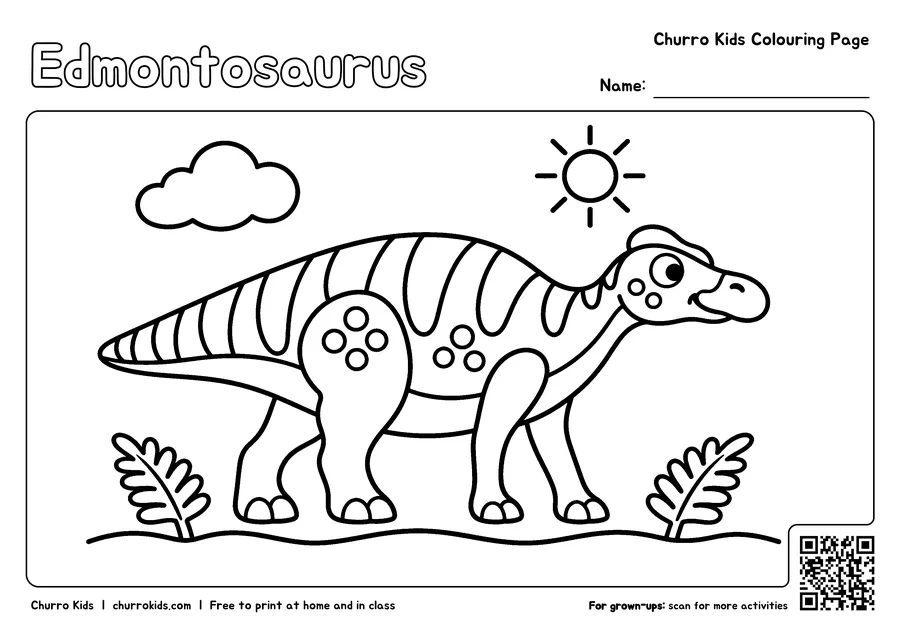
One A4 page, and it is free. Print it freely at home or in class.
Good for parents to know
- Many books say "about a thousand" teeth, but the exact number is not well established. It is safest to say "hundreds."
- Size depends on the kind and on the source. A typical adult is put at 9 to 12 metres and about 4 to 6 tonnes, and very large individuals may have reached about 15 metres. The soft, fleshy crest on the head is known from just one fossil.
- The tooth marks on a toe bone, which look like those of Tyrannosaurus, are fossil evidence. The healed tail bones with a piece of Tyrannosaurus tooth stuck in them belong to a duck-billed dinosaur thought to be Edmontosaurus, so it is best to say "it was probably bitten and got away." The Albertosaurus traces look like feeding after the animals had died.