A child looking up at a long-necked dinosaur skeleton in a museum asks, "Mum, did a dinosaur this big live in Korea too?" Pukyongosaurus, found in Hadong in South Gyeongsang Province, is a dinosaur like that.
Pukyongosaurus was a long-necked plant-eating dinosaur that lived in the Early Cretaceous in what is now Hadong in South Gyeongsang Province. Its length is guessed to be about 15 metres, as long as one and a half buses, and it was named after Pukyong National University. A tail bone that seems to belong to it still has tooth marks from meat-eating dinosaurs. Below are the questions children ask most, with answers at a child's level. You can read them out loud as they are.
Fact cardPukyongosaurus
- Name means
- lizard of Pukyong (University)
- Lived
- Early Cretaceous (about 118 to 112 million years ago)
- Length
- about 15 m (49 ft)
- Weight
- about 20 to 25 tonnes (estimated)
- Food
- Plant-eater
- Found in
- Asia (Hadong, South Gyeongsang Province, South Korea)
- Group
- Dinosaurs of Korea and Asia
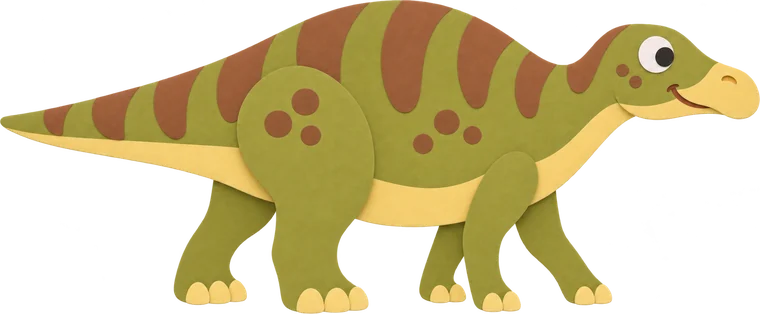
- A very long neck
- Four legs like pillars
- A long tail
How big was Pukyongosaurus? Measure it with your own height
When your child asks, answer like this
 What does Pukyongosaurus mean?

How big was it?
What did it eat?
What did it do when a scary dinosaur came?
Who lived with it?
- Big and small meat-eating dinosaurs neighbourfossil evidence
A tail bone that seems to belong to Pukyongosaurus has tooth marks from meat-eating dinosaurs on it. Scientists do not think these are marks from a hunt. They think big and small meat-eaters came to feed after the Pukyongosaurus had already died. - The turtle of Hadong (Proadocus) neighboursame time and place
Fossils of turtles, crocodile relatives and fish were also found in the same rock layer. When Pukyongosaurus came to drink, it probably met turtles at the riverside. - Pterosaurs neighboursame time and place
Pterosaur bones and footprints have also been found in Hadong. Pterosaurs probably flew above the head of Pukyongosaurus.
When and where did it live?
What was it like as a baby? Did it live with friends?
Are there dinosaurs that look like it?
Who found it first?
Pukyongosaurus facts that make kids say “Wow!”
- Pukyongosaurus is a long-necked dinosaur that was found in Korea and given a Korean name.
- The species name of Pukyongosaurus, millenniumi, was given to celebrate the new millennium.
- The tooth mark on the tail bone is 17 cm (7 inches) long and 1.5 cm (over half an inch) deep. When it was announced, it was introduced as the longest and deepest tooth mark left on a dinosaur bone.
- Pukyongosaurus is a dinosaur named after a school.
From head to tail
- Its length is guessed to be about 15 m (49 ft), as long as one and a half buses.
- Its weight is guessed to be about 20 to 25 tonnes, about the same as four or five elephants.
- The longest tooth mark on the tail bone that seems to belong to Pukyongosaurus is 17 cm (7 inches) long, about the length of a grown-up's palm.
- Only a few bones have been found, such as neck and back bones and a rib, so the whole body is drawn by looking at related dinosaurs.
A Pukyongosaurus story to read aloud
Pukyongosaurus comes thumping across a plain where a winding river flows. It walks slowly on four legs like pillars. It stretches its long neck way up and strips the leaves from a tall conifer tree. It gulps them down without chewing. At the riverside a turtle is warming itself in the sun, and pterosaurs fly in the sky. Pukyongosaurus is so big that it has nothing to fear. When its tummy is full, it drinks from the river and sets off again.
A quiz to do together
Tap an answer.
Where does the name Pukyongosaurus come from?
What is the neck of Pukyongosaurus like?
What is left on the tail bone of Pukyongosaurus?
You finished the quiz! Well done.
Colouring page
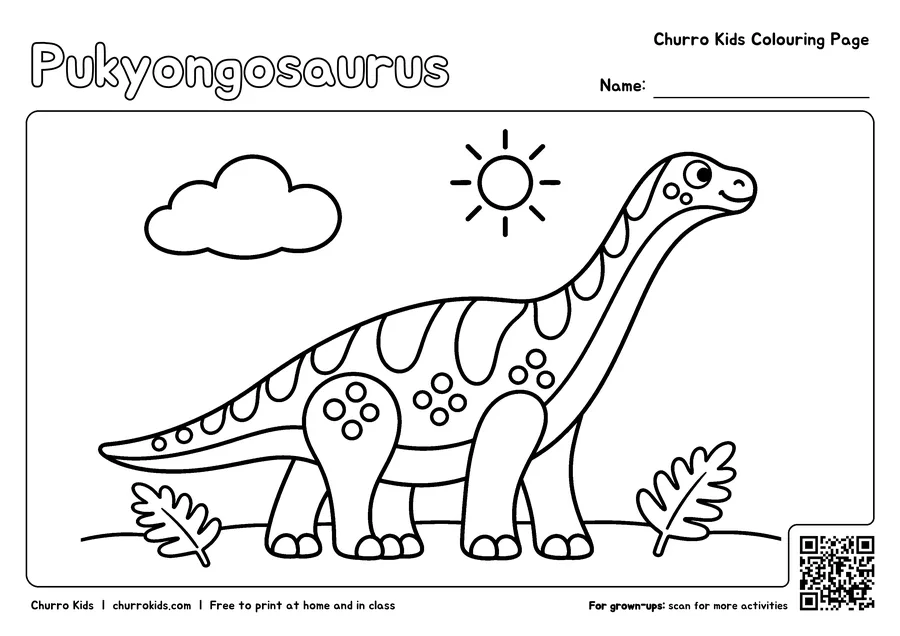
One A4 page, and it is free. Print it freely at home or in class.
Good for parents to know
- Only a few bones have been found, such as neck and back bones and a rib, so the length of about 15 metres and the weight of about 20 to 25 tonnes are both rough guesses. The whole body is also drawn from related dinosaurs.
- There are so few bones that scientists today are not sure Pukyongosaurus really is a different kind from other long-necked dinosaurs. With a child, you can say "only a few bones turned up, so there is more to find out."
- The tooth marks on the tail bone are not thought to come from a hunt. Scientists think meat-eating dinosaurs came and fed after the Pukyongosaurus had died.
Sources
- en.wikipedia.org/wiki/Pukyongosaurus
- ko.wikipedia.org/wiki/부경고사우루스
- asiae.co.kr/en/article/2024082713354451220
- en.wikipedia.org/wiki/Hasandong_Formation
- blog.everythingdinosaur.com/blog/_archives/2011/07/26
- data.kigam.re.kr/ieg/user/ipRsrchInfo/selectIpPersonalRegnList.do?seqNo=262
- dhnews.co.kr/news/view/179511025053665