Your child stands an Allosaurus toy and a Stegosaurus toy face to face and asks, "Dad, did these two ever really meet?" Fossils give us part of the answer.
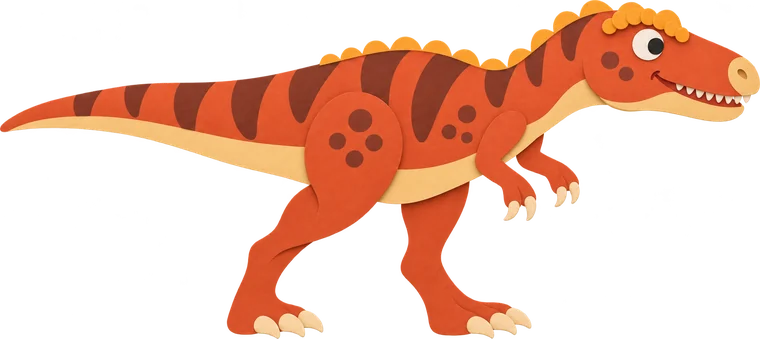
Allosaurus was a meat-eating dinosaur that lived in the Late Jurassic, in what is now the USA and Portugal. It had small horns above its eyes and big claws on its three fingers. It lived about 80 million years before Tyrannosaurus and was smaller. Below are the questions children ask most, with answers at a child's level. You can read them out loud.
Fact cardAllosaurus
- Name means
- different lizard
- Lived
- Late Jurassic (about 155 to 145 million years ago)
- Length
- about 8.5 m (28 ft)
- Weight
- about 1.7 to 2.7 tonnes
- Food
- Meat-eater
- Found in
- North America (USA), Europe (Portugal)
- Group
- Big meat-eating dinosaurs
- Small horns above the eyes
- Three fingers with big claws
- Teeth with saw edges
Watch the video
Hana asks and Churro explains all about Allosaurus. The video is in Korean; the facts below are the same ones.
How big was Allosaurus? Measure it with your own height
When your child asks, answer like this
 What does Allosaurus mean?

How big was it?
What did it eat?
How did it hunt?
Who lived with it?
- Stegosaurus preyfossil evidence
An Allosaurus tail bone has been found with a hole in it. The hole was made by a Stegosaurus tail spike and then healed. A Stegosaurus neck plate also has an Allosaurus bite mark on it. - Apatosaurus (a long-necked dinosaur) preysame time and place
Apatosaurus bones have been found with scratches from the teeth of a large meat-eater, and once a broken Allosaurus tooth was found beside them. So scientists think these are probably marks from Allosaurus feeding on an Apatosaurus after it had died. - Ceratosaurus rivalsame time and place
Ceratosaurus, a meat-eating dinosaur with a horn on its nose, lived in the same place. The two probably chose different food and so stayed out of each other's way.
When and where did it live?
What was it like as a baby? Did it live with friends?
Are there dinosaurs that look like it?
Who found it first?
Allosaurus facts that make kids say “Wow!”
- Allosaurus was one of the most fearsome hunters of the Jurassic.
- An Allosaurus fossil nicknamed Big Al has nineteen places where it had been hurt or sick.
- Allosaurus was chosen as the state fossil of Utah, USA.
- Of the big meat-eating dinosaurs from its time and place, Allosaurus is the one whose fossils are found most often.
From head to tail
- Its skull was about 85 cm (33 inches) long, about as far as a child can stretch both arms out.
- It had about 70 saw-edged teeth in its mouth.
- Scientists say it could open its jaws very wide, to more than 90 degrees.
- It could probably run at 30 to 55 km (about 19 to 34 miles) an hour.
A Allosaurus story to read aloud
A dry wind blows across the wide Jurassic plain. Allosaurus walks through the fern forest by the river. A small pointed horn stands above each eye. Far away, a Stegosaurus is swinging its tail spikes. Allosaurus comes closer, slowly and carefully. It spreads its three fingers with their big claws and opens its mouth very wide. Its saw-edged teeth shine in the sunlight.
A quiz to do together
Tap an answer.
How many fingers does Allosaurus have on each hand?
When did Allosaurus live?
Which dinosaur once poked an Allosaurus with its tail spike?
You finished the quiz! Well done.
Colouring page
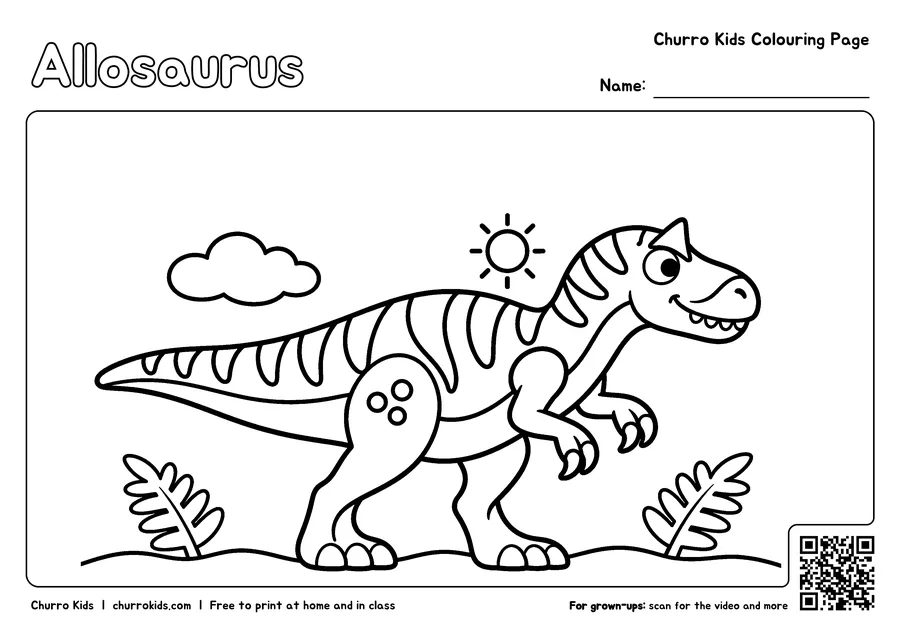
One A4 page, and it is free. Print it freely at home or in class.
Good for parents to know
- A typical adult Allosaurus was about 7.5 to 8.5 metres long. If a book gives a bigger number, it is based on rare large fossils. Weight also differs from study to study, from about 1 to 4 tonnes.
- The signs that it met Stegosaurus are in the fossils. An Allosaurus tail bone has a hole that was made by a tail spike and then healed, and a Stegosaurus neck plate has a bite mark. Nobody knows who won, so it is safest to say "There are marks on the bones that show the two met."
- Scientists do not agree on whether it hunted in groups or alone. The tooth marks on Apatosaurus bones are thought to come from feeding on a dinosaur that was already dead.