At the museum, your child looks up at a long skeleton and tugs your hand. "Where does that tail end?" With Diplodocus, the talk usually starts with the tail.
Diplodocus was a long-necked dinosaur that lived in North America in the Late Jurassic. It was longer than two buses, and about 80 tail bones in a row made its tail more than half the length of its body. It probably used its pencil-thin teeth to strip the leaves off branches. Below are the questions children ask most, with answers at a child's level. You can read them out loud as they are.
Fact cardDiplodocus
- Name means
- double beam (two beams)
- Lived
- Late Jurassic (about 152 to 149 million years ago)
- Length
- about 26 m (85 ft)
- Weight
- about 12 to 15 tonnes
- Food
- Plant-eater
- Found in
- North America (USA)
- Group
- Long-necked dinosaurs
- A long, thin tail like a whip
- A long neck stretched out in front
- A long, slim body
Watch the video
Hana asks and Churro explains all about Diplodocus. The video is in Korean; the facts below are the same ones.
How big was Diplodocus? Measure it with your own height
When your child asks, answer like this
 What does Diplodocus mean?

How big was it?
What did it eat?
What did it do when a scary dinosaur came?
Who lived with it?
- Allosaurus predatorsame time and place
Allosaurus was the most common meat-eating dinosaur on the same plains, so it probably went after young or weak Diplodocus. - Camarasaurus neighboursame time and place
Camarasaurus ate tough leaves and Diplodocus ate soft plants, so they probably did not quarrel over food. - Stegosaurus neighboursame time and place
Stegosaurus, with plates on its back, probably lived on the same plains too, nibbling low plants.
When and where did it live?
What was it like as a baby? Did it live with friends?
Are there dinosaurs that look like it?
Who found it first?
Diplodocus facts that make kids say “Wow!”
- The tail of Diplodocus was longer than half its body, and it probably swung it like a whip.
- Models of a Diplodocus skeleton nicknamed "Dippy" were sent as gifts to London and other museums around the world about a hundred years ago.
- It probably had a row of pointed spines running along its back and tail.
- It was as long as 26 m (85 ft) but weighed 12 to 15 tonnes, which was lighter than the shorter Apatosaurus.
From head to tail
- About 80 tail bones were joined in a row, so the tail was more than half the length of the body.
- It had about 15 neck bones, more than twice as many as a giraffe, which has only 7.
- Each tooth was replaced by a new one after about a month.
- Skin fossils show that its scales were tiny, each one less than 1 cm (under half an inch) across.
A Diplodocus story to read aloud
The sun rises over the wide plains of the Late Jurassic. Diplodocus stretches its long neck out in front and walks to the fern forest by the river. It holds a branch with its thin teeth and pulls, stripping off just the leaves. Beside it, Stegosaurus is nibbling low plants. With every step Diplodocus takes, its long, whip-like tail sways gently behind it. When evening comes, it walks slowly on with its friends to find the next forest.
A quiz to do together
Tap an answer.
The tail of Diplodocus is long and thin like what?
Where in its mouth did Diplodocus have its teeth?
Which one is slimmer, Diplodocus or Apatosaurus?
You finished the quiz! Well done.
Colouring page
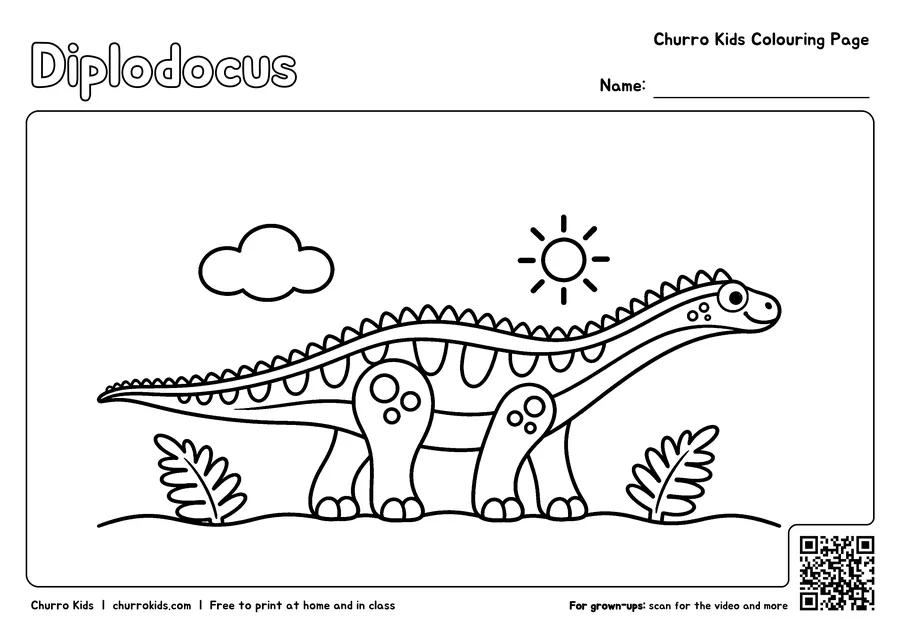
One A4 page, and it is free. Print it freely at home or in class.
Good for parents to know
- The idea that it cracked its tail like a whip to drive enemies away is a hypothesis. It has not been proven, so it is best to say "some scientists think it did."
- The length of 26 metres is the figure most often used. The largest kind may have reached about 29 to 33 metres, so books give different numbers.
- It is often mixed up with Apatosaurus. Diplodocus is slimmer and lighter, with a thinner neck. The idea that Allosaurus went after young Diplodocus comes from the fact that they lived at the same time in the same place.