"Which one is the biggest, Patagotitan or Argentinosaurus?" A child who loves ranking the big dinosaurs will ask this at least once.
Patagotitan was a long-necked dinosaur that lived in Patagonia, in Argentina, South America, in the Early Cretaceous. Its name means "giant of Patagonia". One thigh bone was about 2.4 metres (8 feet) long, much longer than a grown-up is tall, and the bones of more than six animals were found together in one place. Below are the questions children ask most, with answers at a child's level. You can read them out loud as they are.
Fact cardPatagotitan
- Name means
- giant of Patagonia
- Lived
- Early Cretaceous (about 101 million years ago)
- Length
- about 37 m (121 ft)
- Weight
- about 50 to 69 tonnes
- Food
- Plant-eater
- Found in
- South America (Patagonia, Argentina)
- Group
- Long-necked dinosaurs
- A very, very long neck
- A gigantic body
- A long, thick tail
How big was Patagotitan? Measure it with your own height
When your child asks, answer like this
 What does Patagotitan mean?

How big was it?
What did it eat?
What did it do when a scary dinosaur came?
Who lived with it?
- Tyrannotitan predatorsame time and place
Tyrannotitan was a big meat-eating dinosaur that lived on the same land. As many as 57 teeth of meat-eating dinosaurs were found beside the bones of Patagotitan, so dinosaurs like this probably fed on Patagotitan that had died.
When and where did it live?
What was it like as a baby? Did it live with friends?
Are there dinosaurs that look like it?
Who found it first?
Patagotitan facts that make kids say “Wow!”
- The bones of Patagotitan were first found by a man who worked on a ranch in Argentina.
- The skeleton model in the natural history museum in New York, USA, is so long that its head sticks out through the door of the hall.
- At first it was called the biggest dinosaur in the world, but when it was measured again later, it was probably no bigger than Argentinosaurus.
- The bones of more than six Patagotitan were found together in one place.
From head to tail
- One thigh bone was about 2.4 m (8 ft) long, much longer than a grown-up is tall.
- The upper arm bone was about 1.7 m (5.5 ft) long too, as tall as a grown-up.
- It was about 31 to 37 m (102 to 121 ft) long, as long as three buses in a row.
- It weighed about 50 to 69 tonnes, about as much as ten elephants.
A Patagotitan story to read aloud
It is the Early Cretaceous, and Patagotitan walks into a forest of tall conifers. It stretches out its very, very long neck and pulls leaves from the high branches. It gulps them down without chewing and moves its neck to the next branch. Its body is enormous, so it has to eat all day long. A meat-eating Tyrannotitan passes on the far side of the forest, but it cannot easily come near the huge Patagotitan. Patagotitan walks slowly across the riverside plains with its friends.
A quiz to do together
Tap an answer.
Who first found the bones of Patagotitan?
What does the name Patagotitan mean?
In which country was Patagotitan found?
You finished the quiz! Well done.
Colouring page
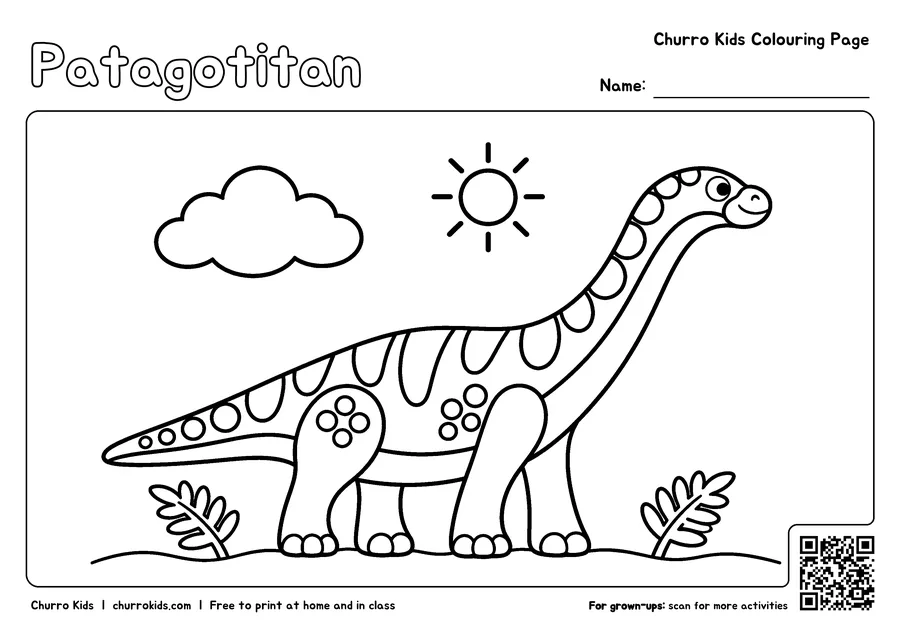
One A4 page, and it is free. Print it freely at home or in class.
Good for parents to know
- The figures of 37 metres and 69 tonnes come from the first description in 2017, and 37 metres is also the length of the museum skeleton models. Later studies suggest something smaller, roughly 31 metres and 50 to 60 tonnes. Please present 37 metres as the upper estimate.
- At first it was called the biggest dinosaur in the world, but it is now thought to have been no bigger than Argentinosaurus. You could say "at first people said it was the biggest, but when they measured again it probably was not."
- Many museums round its age to about 100 million years and label it Late Cretaceous. The ash bed at the dig site is about 101.6 million years old, so here it is placed at the very end of the Early Cretaceous.