Your child is looking at a dinosaur book from the library, and their eyes go wide. "This dinosaur has spines on its neck! What are they for?" Once you have seen Amargasaurus, it is hard to forget.
Amargasaurus was a long-necked dinosaur that lived in Argentina, in South America, in the Early Cretaceous. Long spines stood in two rows, side by side, along its neck and back, and the longest was about 60 cm (2 feet). It was about as long as a bus, which is small for a long-necked dinosaur. Below are questions your child may ask, with easy answers. You can read them out loud.
Fact cardAmargasaurus
- Name means
- lizard of La Amarga (the place where it was found)
- Lived
- Early Cretaceous (about 130 to 120 million years ago)
- Length
- about 10 m (33 ft)
- Weight
- about 2.5 to 4 tonnes
- Food
- Plant-eater
- Found in
- South America (Argentina)
- Group
- Long-necked dinosaurs
- Two rows of long spines on its neck
- A short neck for a long-necked dinosaur
- A small body
How big was Amargasaurus? Measure it with your own height
When your child asks, answer like this
 What does Amargasaurus mean?

How big was it?
What did it eat?
What did it do when a scary dinosaur came?
Who lived with it?
- Amargatitanis neighboursame time and place
Amargatitanis was a long-necked relative found in the same place, in the same rock layer. The two probably lived as neighbours, eating plants by the same rivers. - Ligabueino neighboursame time and place
Ligabueino was a very small meat-eating dinosaur that lived in the same place, so it probably could not take on the big Amargasaurus.
When and where did it live?
What was it like as a baby? Did it live with friends?
Are there dinosaurs that look like it?
Who found it first?
Amargasaurus facts that make kids say “Wow!”
- Amargasaurus had long spines standing in two rows, side by side, along its neck and back.
- The very same team that found the horned meat-eater Carnotaurus also found Amargasaurus in the same year.
- Only one Amargasaurus skeleton has been found so far.
- It probably walked around with its snout pointing down toward the ground most of the time.
From head to tail
- The longest spine on its neck was about 60 cm (2 ft), as long as a child's arm.
- It had 13 neck bones.
- The space for its brain was so small that it would hold only about half a paper cup (about 95 ml, or 3 fluid ounces).
- It is estimated at about 9 to 13 m (30 to 43 ft) long and about 2.5 to 4 tonnes, which is small for a long-necked dinosaur.
A Amargasaurus story to read aloud
It is the Early Cretaceous, and Amargasaurus appears at the edge of a forest where a river flows. Long spines stand in two rows, side by side, along its neck. Amargasaurus lowers its snout and eats the low ferns. A little way off, its relative Amargatitanis is eating plants too. A small meat-eater, Ligabueino, scurries past its feet, but Amargasaurus pays no attention. It walks slowly along the river, looking for another patch of ferns.
A quiz to do together
Tap an answer.
What grew on the neck of Amargasaurus?
How does the neck of Amargasaurus compare with other long-necked dinosaurs?
When did Amargasaurus live?
You finished the quiz! Well done.
Colouring page
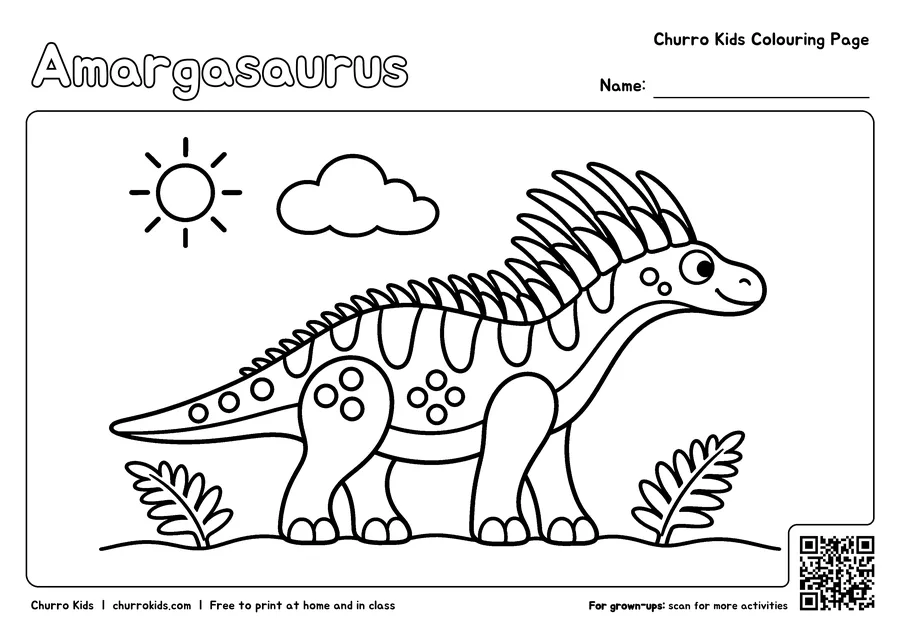
One A4 page, and it is free. Print it freely at home or in class.
Good for parents to know
- Scientists do not agree whether the neck spines were bare, horn-covered spikes or held up a sail of skin. A bone-tissue study in 2022 leaned toward a sail of skin. That is why pictures show it in different ways.
- Only one skeleton has been found, and only the back part of its skull is preserved. The shape of the snout is rebuilt from related dinosaurs. Length estimates also vary between sources, from about 9 to 13 metres.
- We do not know yet whether the spines protected its neck, or whether it lived in herds. It is best to say "scientists are still finding out."