"Why is this dinosaur holding its thumbs up?" your child asks, fiddling with the pointed thumb of a toy Iguanodon.
Iguanodon was a plant-eating dinosaur that lived in Europe in the Early Cretaceous. It was as long as a bus and had a pointed spike on each thumb. People long ago thought the spike was a horn on the nose, so they drew it on top of the nose. It was also the second dinosaur in the world to be given a name. Below are the questions children ask most, with answers at a child's level. You can read them out loud.
Fact cardIguanodon
- Name means
- iguana tooth
- Lived
- Early Cretaceous (about 126 to 122 million years ago)
- Length
- about 10 m (33 ft)
- Weight
- about 3 to 4.5 tonnes
- Food
- Plant-eater
- Found in
- Europe (Belgium, Germany, Spain, the UK)
- Group
- Duck-billed dinosaurs and friends
- A pointed thumb spike
- A mouth shaped like a beak
- Strong back legs and a thick tail
How big was Iguanodon? Measure it with your own height
When your child asks, answer like this
 What does Iguanodon mean?

How big was it?
What did it eat?
What did it do when a scary dinosaur came?
Who lived with it?
- Baryonyx predatorsame time and place
Baryonyx was a meat-eating dinosaur that lived in Europe at the same time. Inside the belly of a Baryonyx found in England there were fish scales and the bones of a young dinosaur from the Iguanodon group, so young Iguanodon probably had to be careful too. - Bernissartia neighboursame time and place
Bernissartia was a small relative of crocodiles that was found together with Iguanodon fossils in Belgium. It probably lived by the same swamps, eating fish and shellfish. - Mantellisaurus neighboursame time and place
Mantellisaurus was a relative that was smaller and slimmer than Iguanodon. Its fossils came from the same place in Belgium, so the two were probably neighbours that ate plants together.
When and where did it live?
What was it like as a baby? Did it live with friends?
Are there dinosaurs that look like it?
Who found it first?
Iguanodon facts that make kids say “Wow!”
- People long ago thought the pointed thumb spike was a horn on the nose, so they drew it on top of the nose.
- Iguanodon was the second dinosaur in the world to be given a name.
- In England, while a big Iguanodon statue was being made, a table was set inside it and about twenty people ate dinner there.
- At Goseong in Gyeongnam, South Korea, there are a great many footprints of plant-eating dinosaurs that were relatives of Iguanodon.
From head to tail
- Its teeth stood in rows, up to 29 on each side of the upper jaw and up to 25 in the lower jaw.
- Its front legs were long, as much as three quarters of the length of its back legs, so it walked well on four legs too.
- Its little finger could bend well, and it probably used it to hold food.
- Running on two legs, it could probably go about 24 km (15 miles) an hour, as fast as a bicycle.
A Iguanodon story to read aloud
It is morning by the swamp, and Iguanodon walks out slowly on four legs. It snips off horsetail and cycad leaves with its hard beak. It chews them well with its back teeth and swallows. When it wants a high branch, it stands up on its back legs and stretches its neck. At the water's edge, Bernissartia, a small relative of crocodiles, is lying in the sun. When a meat-eating dinosaur comes close, Iguanodon lifts its pointed thumb spike high. It feels safe with its friends around.
A quiz to do together
Tap an answer.
Where is the pointed spike of Iguanodon?
What does the name Iguanodon mean?
Where in Belgium were many Iguanodon bones found?
You finished the quiz! Well done.
Colouring page
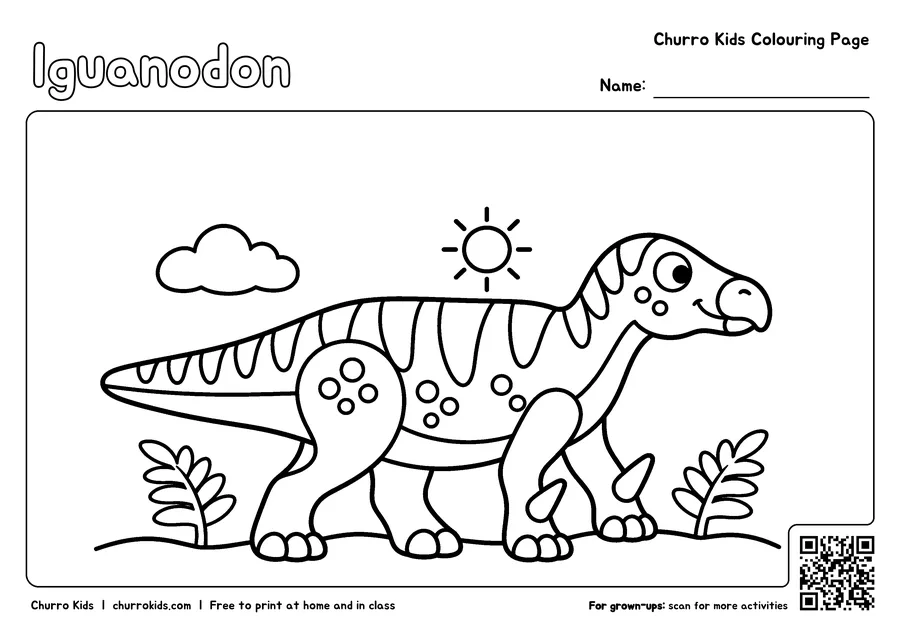
One A4 page, and it is free. Print it freely at home or in class.
Good for parents to know
- This guide groups it with the duck-billed dinosaurs, but Iguanodon is not a true duck-billed dinosaur. It is best described as a relative of the duck-bills.
- Sources give its length as about 9 or 10 metres, and up to 11 metres at most. Older books sometimes give a much longer span of time for when it lived, because many kinds that used to be called Iguanodon have since been moved to other names.
- What was found inside the belly of Baryonyx was the bones of a young dinosaur from the Iguanodon group. So it is enough to say "young Iguanodon probably had to be careful too." The idea that it swung its thumb spike to protect itself is also a guess.