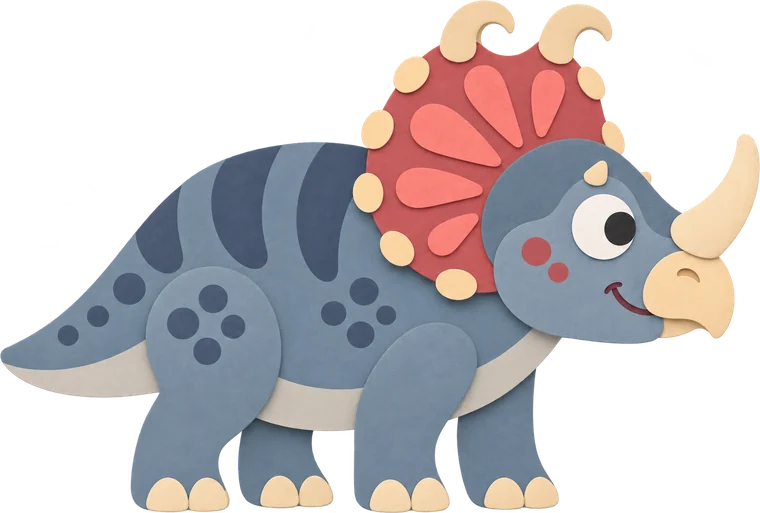
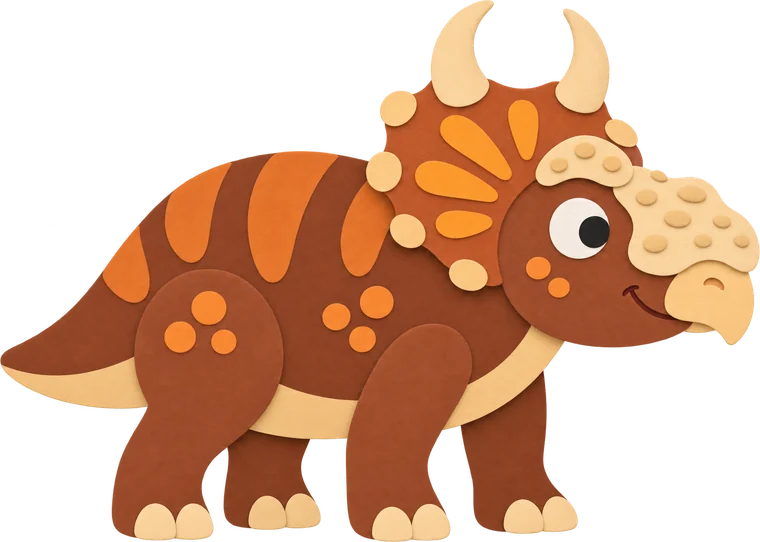
At the museum, your child stands in front of a small skeleton and tilts their head. "Mum, you said this is a horned dinosaur. So why does it have no horns?" Protoceratops often brings out this question.
Protoceratops was a small horned dinosaur that lived in the Late Cretaceous in the Gobi Desert, which today stretches across Mongolia and China. It was about 2 m (6.5 ft) long, the size of a sheep or a big dog. It had almost no horns, but it had a big beak like a parrot's. It is also famous for a fossil that shows it just as it was while fighting Velociraptor. Below are the questions children ask most, with answers at a child's level. You can read them out loud as they are.
Fact cardProtoceratops
- Name means
- first horned face
- Lived
- Late Cretaceous (about 75 to 71 million years ago)
- Length
- about 2 m (6.5 ft)
- Weight
- about 60 to 100 kg
- Food
- Plant-eater
- Found in
- Asia (Mongolia, China)
- Group
- Horned dinosaurs
- A face with almost no horns
- A small frill
- A big beak like a parrot's
How big was Protoceratops? Measure it with your own height
When your child asks, answer like this
 What does Protoceratops mean?

How big was it?
What did it eat?
What did it do when a scary dinosaur came?
Who lived with it?
- Velociraptor predatorfossil evidence
In 1971 a fossil was found in Mongolia that shows Protoceratops and Velociraptor just as they were while they were fighting. Protoceratops was holding the arm of Velociraptor tightly in its beak. - Oviraptor neighboursame time and place
Oviraptor, a feathered dinosaur with a beak, lived in the same desert. It probably spent its days nearby, guarding its nest. - Pinacosaurus neighboursame time and place
It lived on the same sandy land as Pinacosaurus, an armoured dinosaur.
When and where did it live?
What was it like as a baby? Did it live with friends?
Are there dinosaurs that look like it?
Who found it first?
Protoceratops facts that make kids say “Wow!”
- A fossil found in Mongolia shows Protoceratops and Velociraptor just as they were while they were fighting.
- Scientists say the eggs of Protoceratops had soft, squishy shells, like turtle eggs.
- The eggs that were once known as Protoceratops eggs were really the eggs of Oviraptor.
- So many fossils have been found, from babies to grown-ups, that we know the frill grew bigger and bigger as the animal grew up.
From head to tail
- It was about 2 m (6.5 ft) long, about the size of a sheep or a big dog.
- Its skull was about 50 cm (20 inches) long, so its head was very big for its body.
- Its eyes were big and faced forward, so it probably saw well in front of it.
- The bones in the middle of its tail stood up high, so the tail was tall and flat.
A Protoceratops story to read aloud
The sun rises over the sand dunes of the Gobi Desert. Protoceratops blinks its big eyes and gets up. It snaps off tough, low-growing plants with its big beak and eats them. In the nest, the baby Protoceratops are huddled close together. Far away, the armoured dinosaur Pinacosaurus walks past. When a Velociraptor comes near, Protoceratops stands up to it with its strong beak.
A quiz to do together
Tap an answer.
Which dinosaur was found in a fossil fighting with Protoceratops?
What kind of place did Protoceratops live in?
How big was Protoceratops?
You finished the quiz! Well done.
Colouring page
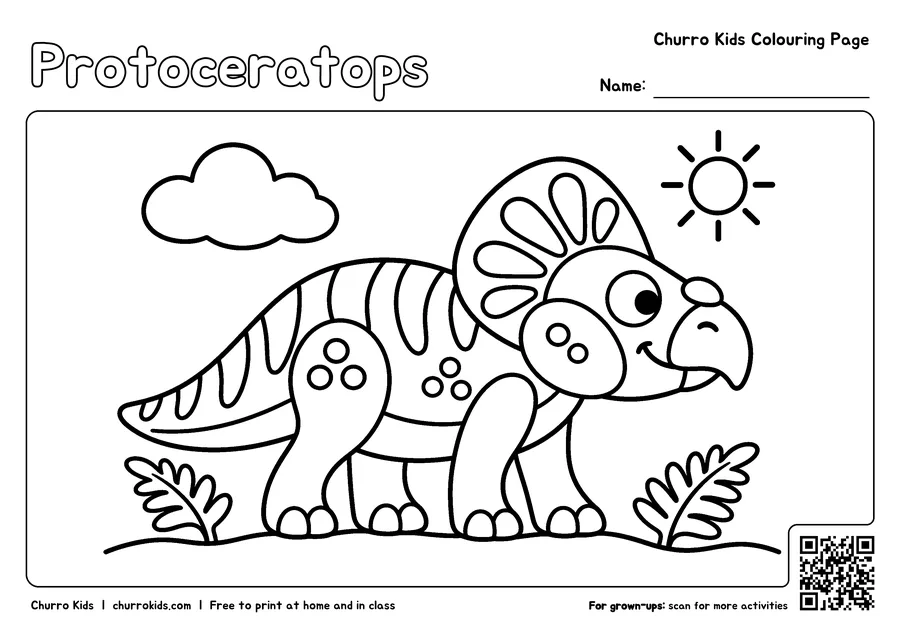
One A4 page, and it is free. Print it freely at home or in class.
Good for parents to know
- Weight differs a lot between sources. Recent studies put it at about 60 to 100 kg, but older sources go as high as 180 to 400 kg.
- The eggs that became famous in the 1920s as 'Protoceratops eggs' really belonged to Oviraptor. Older books may still carry the old story.
- The evidence that it fought Velociraptor is a fossil found in Mongolia in 1971. It shows Protoceratops biting the other animal's arm with its beak. Nobody knows who won, so it is safest to say "the two turned into a fossil just as they were while fighting."