"Is this Spinosaurus?" your child says, very sure, looking at a picture of a dinosaur with a sail on its back. If the snout is wide like a duck's, it is Ouranosaurus.
Ouranosaurus was a plant-eating dinosaur that lived in the Early Cretaceous in what is now Niger, Africa. It was about 7 metres (23 feet) long, as long as two cars in a row. A big sail rose from its back to its tail, and it tore off riverside plants with the wide beak at the end of its long, flat snout. Its name means "brave lizard." Below are the questions children ask most, with answers at a child's level. You can read them out loud.
Fact cardOuranosaurus
- Name means
- brave lizard
- Lived
- Early Cretaceous (about 125 to 100 million years ago)
- Length
- about 7 m (23 ft)
- Weight
- about 2.2 tonnes
- Food
- Plant-eater
- Found in
- Africa (Niger)
- Group
- Duck-billed dinosaurs and friends
- A big sail rising from its back
- A long, flat snout
- A small thumb spike
How big was Ouranosaurus? Measure it with your own height
When your child asks, answer like this
 What does Ouranosaurus mean?

How big was it?
What did it eat?
What did it do when a scary dinosaur came?
Who lived with it?
- Suchomimus predatorsame time and place
Suchomimus was a big meat-eating dinosaur with a snout like a crocodile's that lived by the same river in Niger. It mostly ate fish, but it probably went after young Ouranosaurus too. - Sarcosuchus predatorsame time and place
Sarcosuchus was a very big relative of crocodiles that lived in the same river. Ouranosaurus probably had to be careful when it came for a drink of water. - Nigersaurus neighboursame time and place
Nigersaurus was a long-necked dinosaur neighbour that cropped low plants on the ground with its wide mouth. The two probably ate plants side by side by the same river.
When and where did it live?
What was it like as a baby? Did it live with friends?
Are there dinosaurs that look like it?
Who found it first?
Ouranosaurus facts that make kids say “Wow!”
- A big sail rose from its back all the way to its tail, and it probably used it to look fine to its friends.
- The long bones on its back may have held up a thick, fleshy hump like a bison's in place of a thin sail, and scientists are still talking about it.
- The bones that were named first went back home to Niger and are on show in a museum in the capital city, Niamey.
- A nearly whole Ouranosaurus skeleton also stands in a museum in Venice, Italy.
From head to tail
- The tallest spine bone on its back was about 63 centimetres (25 inches) long, about as long as a child's leg.
- Its skull was about 67 centimetres (26 inches) long, and low and long in shape.
- Its front legs were a little more than half as long as its back legs.
- Two small, round bumps stood up in front of its eyes.
A Ouranosaurus story to read aloud
Morning comes to the plain where the big river runs. Ouranosaurus tears off big mouthfuls of riverside plants with its wide beak. It chews the tough leaves well with its back teeth. The big sail on its back shines in the sunlight. Next to it, long-necked Nigersaurus is cropping the low plants on the ground. A big Sarcosuchus is hiding in the river, so Ouranosaurus is very careful when it drinks. When it feels danger, it runs away fast on its strong back legs.
A quiz to do together
Tap an answer.
What rises from the back of Ouranosaurus?
What did Ouranosaurus eat?
What is the place where Ouranosaurus was found like today?
You finished the quiz! Well done.
Colouring page
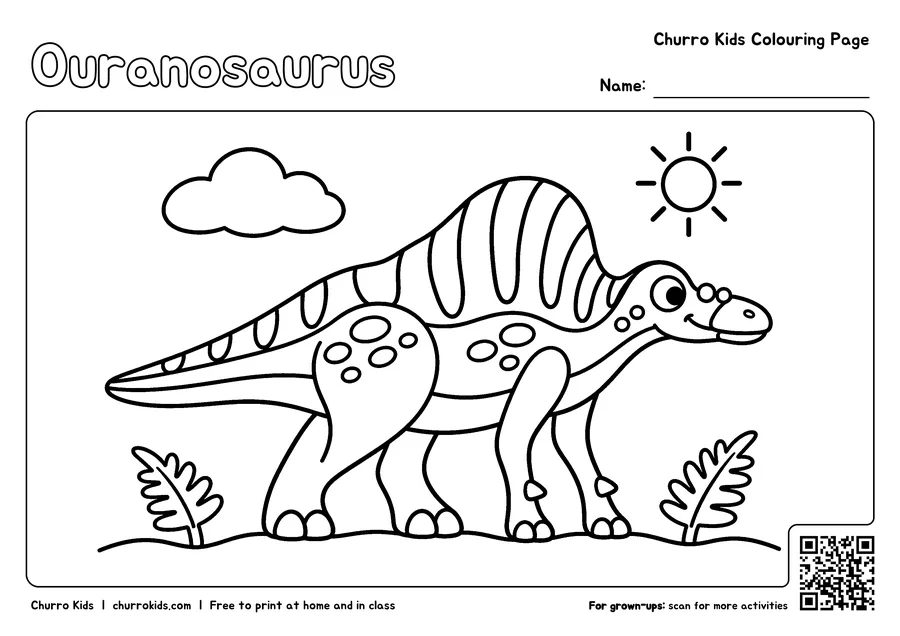
One A4 page, and it is free. Print it freely at home or in class.
Good for parents to know
- It is still not settled if the long spine bones on its back held up a thin sail or a thick, fleshy hump like a bison's. The idea that it used the sail to look fine to its friends is also a guess, so "it probably did" is the right way to say it.
- This guide groups it with the duck-billed dinosaurs, but Ouranosaurus is not a true duck-billed dinosaur. It is best described as a relative of the Iguanodon group.
- The time when it lived has not been worked out exactly, so sources give anything from about 125 to 100 million years ago. The idea that Suchomimus and Sarcosuchus went after it also comes from their living at the same time and place.