On a day when you saw swans at the lake, your child comes home, opens a dinosaur book and asks, "Is there a dinosaur that looks like a swan?" There really is a dinosaur with a swan in its name.
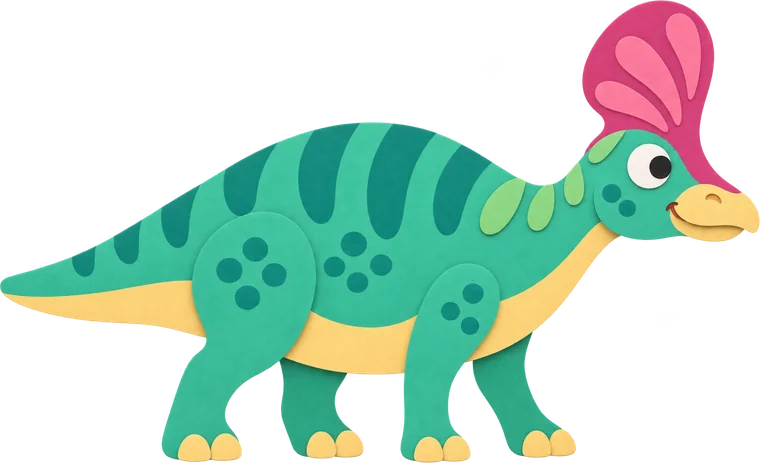
Olorotitan was a duck-billed dinosaur that lived in the very last part of the Late Cretaceous, in what is now the Amur region at the eastern end of Russia. It was about 8 metres (26 feet) long, as long as two cars in a row. Its neck was longer than the necks of other duck-billed dinosaurs, which is how it got the name "giant swan," and it had a crest on its head that spread out like a fan. Below are the questions children ask most, with answers at a child's level. You can read them out loud as they are.
Fact cardOlorotitan
- Name means
- giant swan
- Lived
- Late Cretaceous (about 72 to 66 million years ago)
- Length
- about 8 m (26 ft)
- Weight
- about 2.6 to 3.4 tonnes
- Food
- Plant-eater
- Found in
- Asia (the Amur region in the Russian Far East)
- Group
- Duck-billed dinosaurs and friends
- A crest spread out like a fan
- A longer neck than other duck-billed dinosaurs
- A flat duck bill
How big was Olorotitan? Measure it with your own height
When your child asks, answer like this
 What does Olorotitan mean?

How big was it?
What did it eat?
What did it do when a scary dinosaur came?
Who lived with it?
- Kundurosaurus neighboursame time and place
Kundurosaurus was a duck-billed dinosaur with no crest, found at Kundur in Russia, the same place as Olorotitan. They probably ate plants together in the same place. - Amurosaurus rivalsame time and place
Amurosaurus was a related duck-billed dinosaur with a crest that lived in the same Amur region. They probably shared the same kinds of plants. - An unnamed meat-eating dinosaur predatorsame time and place
Fossils of a meat-eating dinosaur were also found at the place where Olorotitan was found. Nobody knows its name yet, but it probably went after Olorotitan.
When and where did it live?
What was it like as a baby? Did it live with friends?
Are there dinosaurs that look like it?
Who found it first?
Olorotitan facts that make kids say “Wow!”
- Olorotitan had a longer neck than other duck-billed dinosaurs, and that is how it got the name "giant swan."
- Of all the dinosaurs found in Russia, Olorotitan has the most complete skeleton.
- Near the end of the age of dinosaurs, crested duck-billed dinosaurs had almost gone from North America, but in Asia many dinosaurs like Olorotitan were living.
- Olorotitan lived in the very last part of the Late Cretaceous, just before the dinosaurs disappeared.
From head to tail
- It had 18 neck bones, more than other duck-billed dinosaurs (which have up to 15).
- It stood about 3.5 metres (11.5 feet) tall at the hips, higher than a basketball hoop.
- Over its hips, about 15 back bones were joined into one block. Scientists think extra bones joined on because the animal was old.
- At the front of the tail the tips of the bones touched each other, so the tail was stiff.
A Olorotitan story to read aloud
Olorotitan is standing on a wide plain where a river runs. It stretches out its long neck and nips off leaves with its flat beak. It grinds them up like a millstone with its many, many teeth and swallows. The fan-like crest on its head is easy to see from far away. Close by, its neighbour Kundurosaurus, which has no crest, is eating plants too. In the river, turtles and crocodiles are swimming. When a meat-eating dinosaur comes near, Olorotitan makes a sound with its crest, and they all run away together.
A quiz to do together
Tap an answer.
What does the name Olorotitan mean?
In which country was Olorotitan found?
How many neck bones does Olorotitan have, next to other duck-billed dinosaurs?
You finished the quiz! Well done.
Colouring page
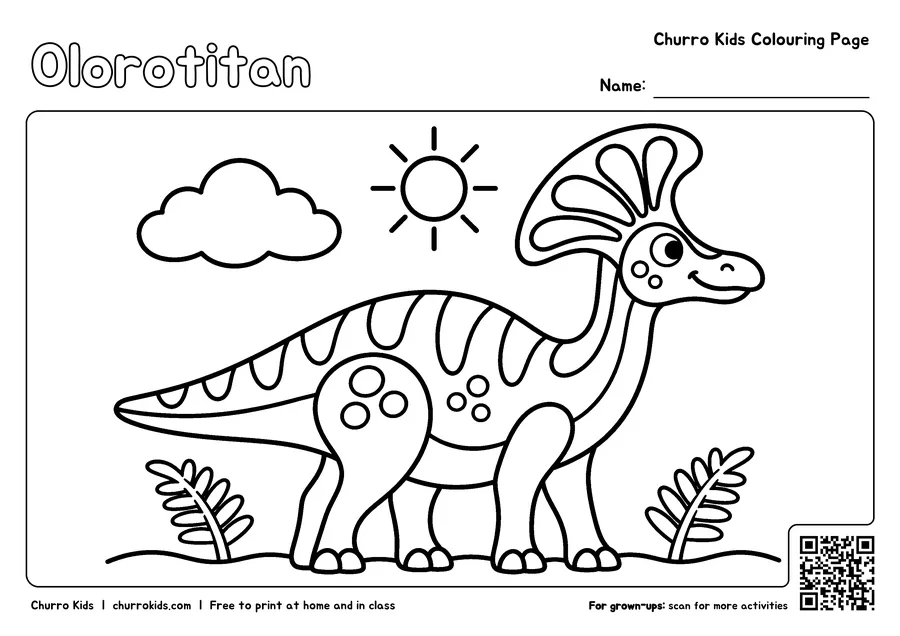
One A4 page, and it is free. Print it freely at home or in class.
Good for parents to know
- The name means "giant swan," but its neck was not thin and long like a real swan's. It had 18 neck bones, more than other duck-billed dinosaurs (up to 15), so the name only means its neck was long for a duck-billed dinosaur.
- Olorotitan is known mainly from one nearly whole skeleton. So size figures such as a length of about 8 metres are estimates.
- The ideas that it made sounds with its crest and that it lived with others are guesses. The meat-eating dinosaur listed as its predator has no name yet either, so "it probably did" is the right way to say it.