"Can this dinosaur climb a tree?" your child asks at the playground, looking up at a tree and waving a small toy dinosaur.
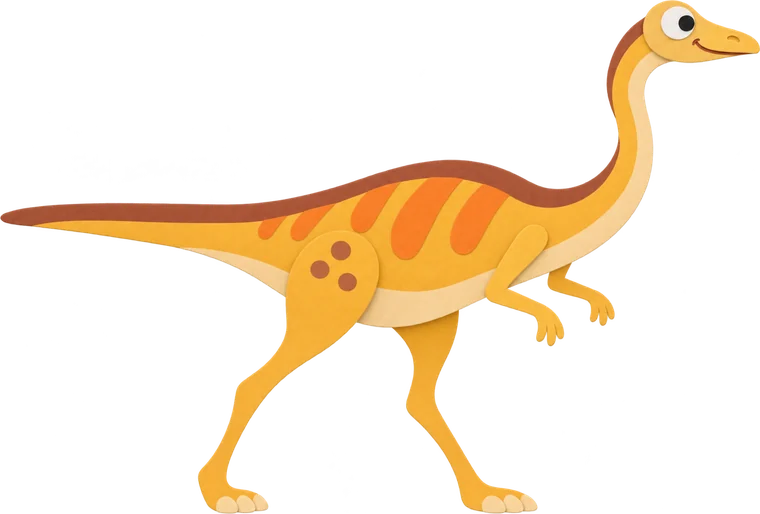
Hypsilophodon was a plant-eating dinosaur that lived in the Early Cretaceous, on what is now the Isle of Wight in the UK. Even when fully grown it was only as big as a large dog, and its light body and long legs let it run very fast on two legs. Because it ran so nimbly, it has the nickname "the deer of the dinosaur age". Below are the questions children ask most, with answers at a child's level. You can read them out loud.
Fact cardHypsilophodon
- Name means
- Hypsilophus tooth (Hypsilophus is a kind of iguana lizard)
- Lived
- Early Cretaceous (about 130 to 125 million years ago)
- Length
- about 1.8 m (6 ft)
- Weight
- about 20 kg
- Food
- Plant-eater
- Found in
- Europe (the Isle of Wight, UK)
- Group
- Duck-billed dinosaurs and friends
- A small, slim body
- Long, fast back legs
- A long tail held out straight
How big was Hypsilophodon? Measure it with your own height
When your child asks, answer like this
 What does Hypsilophodon mean?

How big was it?
What did it eat?
What did it do when a scary dinosaur came?
Who lived with it?
- Eotyrannus predatorsame time and place
Eotyrannus was a quick meat-eating dinosaur that lived on the same Isle of Wight in the UK, and a distant relative of Tyrannosaurus. It probably chased little Hypsilophodon. - Neovenator predatorsame time and place
Neovenator was a big meat-eating dinosaur that lived in the same place. When Hypsilophodon saw a hunter like this, it probably ran away quickly. - Polacanthus neighboursame time and place
Polacanthus was an armoured dinosaur neighbour with spikes on its back. They probably lived together in the same fields, eating low plants.
When and where did it live?
What was it like as a baby? Did it live with friends?
Are there dinosaurs that look like it?
Who found it first?
Hypsilophodon facts that make kids say “Wow!”
- Hypsilophodon had a light body and long legs, so it could run very fast on two legs.
- Scientists long ago thought Hypsilophodon lived up in the trees, but now we know it was a dinosaur that ran on the ground.
- Because it ran so nimbly, it has the nickname "the deer of the dinosaur age".
- Koreanosaurus, a small dinosaur that was a distant relative of Hypsilophodon, was found at Boseong in Jeonnam, South Korea.
From head to tail
- It had five fingers on each hand and four toes on each foot.
- It had about 48 tail bones, and hard tendons held the tail stiff like a rod.
- Inside its beak, at the front of the upper jaw, it also had small teeth, five on each side.
- Even the thigh bone of the biggest fossil is only about 20 cm (8 in), a little longer than a pencil.
A Hypsilophodon story to read aloud
A herd of Hypsilophodon has gathered in a warm field. They pick young shoots with their pointed beaks. They chew them small with their little teeth and swallow. Nearby, the armoured dinosaur Polacanthus is slowly eating plants. Just then Eotyrannus, a quick meat-eating dinosaur, appears. The Hypsilophodon zoom away on their long back legs. Their stiff tails keep them balanced, so they do not fall over.
A quiz to do together
Tap an answer.
What did Hypsilophodon do when it was in danger?
How big was Hypsilophodon?
How many fingers did Hypsilophodon have on each hand?
You finished the quiz! Well done.
Colouring page
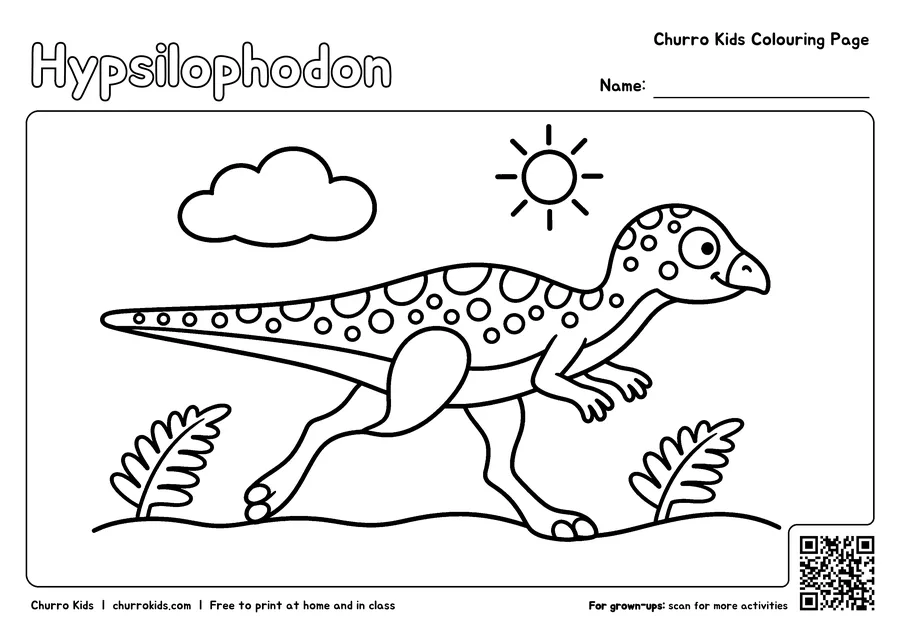
One A4 page, and it is free. Print it freely at home or in class.
Good for parents to know
- This guide groups it with the duck-billed dinosaurs, but Hypsilophodon is not a duck-billed dinosaur. It is best described as a small, quick plant-eating dinosaur.
- Long ago people thought it lived in trees or had armour on its body, and those ideas are no longer accepted. If you see it sitting in a tree in an old book, you can say "now we know it ran on the ground."
- Some sources give the meaning of the name as "high-ridged tooth", but Huxley, who named it, took the name from the lizard Hypsilophus. Fully grown animals were usually 1.5 to 1.8 metres (5 to 6 feet) long, and some sources say 2 metres (6.5 feet).