Brushing teeth in the evening, your child looks in the mirror and asks, "I have twenty teeth. How many does the dinosaur with the most teeth have?" Nigersaurus is a good dinosaur to talk about at a moment like this.
Nigersaurus was a long-necked plant-eating dinosaur that lived in the Early Cretaceous in what is now Niger, Africa. It was about 9 metres (30 feet) long, a little shorter than a bus, and its neck was short for a long-necked dinosaur. It had more than 500 teeth in a wide, flat mouth like a vacuum cleaner, and it cropped the plants that grew low and close to the ground. Each tooth was swapped for a new one after about 14 days. Below are the questions children ask most, with answers at a child's level. You can read them out loud as they are.
Fact cardNigersaurus
- Name means
- lizard of Niger
- Lived
- Early Cretaceous (about 115 to 105 million years ago)
- Length
- about 9 m (30 ft)
- Weight
- about 2 to 4 tonnes
- Food
- Plant-eater
- Found in
- Niger, Africa
- Group
- Dinosaurs from around the world
- A wide, flat mouth like a vacuum cleaner
- More than 500 teeth
- A short neck for a long-necked dinosaur
How big was Nigersaurus? Measure it with your own height
When your child asks, answer like this
 What does Nigersaurus mean?

How big was it?
What did it eat?
What did it do when a scary dinosaur came?
Who lived with it?
- Sarcosuchus predatorsame time and place
Sarcosuchus was a big relative of crocodiles, about 9 metres (30 feet) long, that lived in the same river. It may have gone after Nigersaurus when they came to the water's edge. - Suchomimus neighboursame time and place
Suchomimus was a big meat-eating dinosaur that lived by the same river, but it mostly ate fish. So it and Nigersaurus probably lived side by side, eating different food. - Ouranosaurus rivalsame time and place
Ouranosaurus was a plant-eating dinosaur with a sail on its back, and it ate plants on the same plains. The two probably jostled for the best spots with tasty plants.
When and where did it live?
What was it like as a baby? Did it live with friends?
Are there dinosaurs that look like it?
Who found it first?
Nigersaurus facts that make kids say “Wow!”
- Nigersaurus had more than 500 teeth in its wide, flat mouth, and it used them to crop the plants that grew low and close to the ground.
- Each tooth was swapped for a new one after about 14 days, which is the fastest of any dinosaur known so far.
- Under every tooth in use, as many as nine spare teeth were waiting.
- Because it cropped low plants, it has the nickname "the cow of the Mesozoic."
From head to tail
- Its teeth stood in 68 rows in the upper jaw and 60 rows in the lower jaw.
- Its skull was very thin, and in many places it was less than 2 millimetres (under a tenth of an inch) thick.
- It had 13 neck bones, so its neck was short for a long-necked dinosaur.
- Its thigh bone was about 1 metre (3 feet) long, and it weighed about as much as an elephant.
A Nigersaurus story to read aloud
On the wide plain by the river, Nigersaurus is having breakfast. It holds its wide, flat mouth close to the ground and snips, snips at the ferns and horsetails. Next to it, Ouranosaurus, with a sail on its back, is eating plants too. In the river, Suchomimus is busy catching fish. Nigersaurus walks carefully and keeps away from the deep water where Sarcosuchus is. Then it takes one more tasty bite of the low plants.
A quiz to do together
Tap an answer.
What does the mouth of Nigersaurus look like?
Where did the plants that Nigersaurus ate grow?
About how many teeth did Nigersaurus have?
You finished the quiz! Well done.
Colouring page
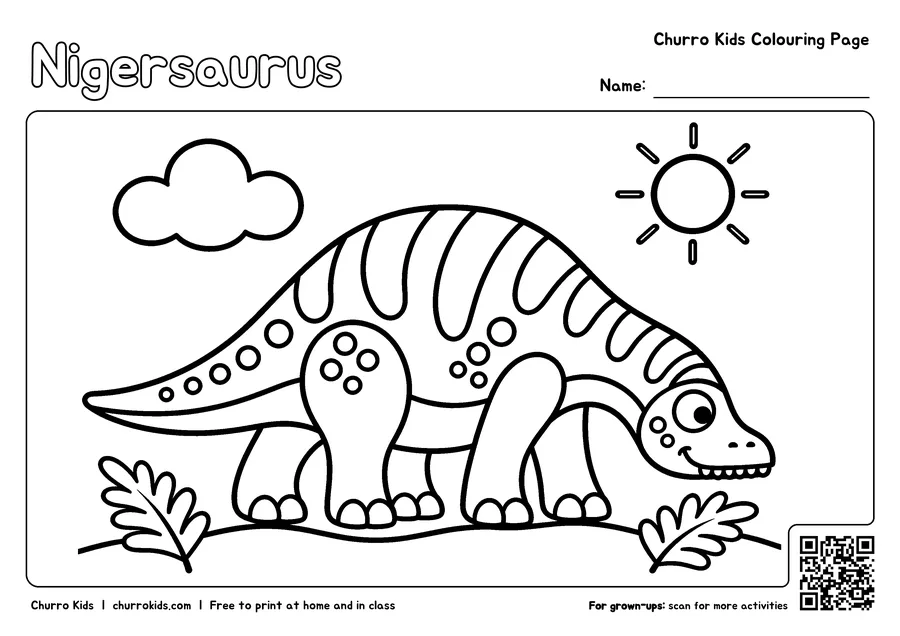
One A4 page, and it is free. Print it freely at home or in class.
Good for parents to know
- The 500 teeth were not all in use at once. The number counts every tooth, including the spare teeth stacked inside the jaws and waiting their turn.
- Sources give its length as anything from 9 metres to about 14 metres. Scientists also disagree about how far down it usually held its head.
- Nigersaurus ate soft, low plants such as ferns and horsetails. It did not eat grass like a lawn.