"Dad, could dinosaurs fly too?" If your child asks this while watching a crow outside the window, it is time for the story of Microraptor, a dinosaur the size of a crow.
Microraptor was a small feathered dinosaur that lived in the Early Cretaceous, in forests in what is now Liaoning Province in China. It had long feathers on both its arms and its legs, so it had four wings, and its feathers were black with a rainbow shine in the light. Small birds, lizards and fish were found in the bellies of fossils, so we also know what it ate. Below are the questions children ask most, with answers at a child's level. You can read them out loud.
Fact cardMicroraptor
- Name means
- small thief
- Lived
- Early Cretaceous (about 125 to 120 million years ago)
- Length
- about 0.8 m (2.6 ft)
- Weight
- about 1 kg
- Food
- Meat-eater (small animals and fish)
- Found in
- Asia (Liaoning Province, China)
- Group
- Small, fast and feathered dinosaurs
- Four wings
- Shiny black feathers
- A long tail with a fan of feathers
How big was Microraptor? Measure it with your own height
When your child asks, answer like this
 What does Microraptor mean?

How big was it?
What did it eat?
How did it hunt?
Who lived with it?
- A small early bird (an enantiornithine) preyfossil evidence
The wing and foot bones of a small early bird were found in the belly of a Microraptor fossil. Microraptor probably caught and ate birds that lived in the trees. - Indrasaurus (a lizard) preyfossil evidence
An almost whole lizard was found in the belly of a Microraptor. It was a kind of lizard nobody had seen before, so it was given a new name, Indrasaurus. - Confuciusornis neighboursame time and place
Confuciusornis, an ancient bird with a beak, lived in the same forest. The two probably came across each other among the trees.
When and where did it live?
What was it like as a baby? Did it live with friends?
Are there dinosaurs that look like it?
Who found it first?
Microraptor facts that make kids say “Wow!”
- Microraptor had long feathers on both its arms and its legs, so it had four wings.
- There was once a famous fake fossil made by sticking several fossils together, and its tail was the real tail of a Microraptor.
- Scientists worked out the colour of the feathers by looking through a microscope at tiny grains of colour inside the fossil feathers.
- Museums in China are said to hold more than 300 Microraptor fossils.
From head to tail
- Its body was about 77 cm (30 inches) long, and its wings were about 90 cm (3 ft) across when spread.
- It weighed about 1 kg (2.2 lb), about the same as a one-litre carton of milk.
- It had a diamond-shaped fan of feathers at the tip of its tail.
- Its feathers were black with a rainbow shine in the light, like a starling's.
A Microraptor story to read aloud
Morning sunlight shines into the forest by the lake. A Microraptor the size of a crow sits on the branch of a ginkgo tree. Its black feathers catch the sunlight and shine with rainbow colours. It spreads the four wings on its arms and legs wide and glides across to the next tree. The fan of feathers at the tip of its tail keeps it balanced. It spots a small lizard on a branch and gulps it down head first. Today it will try to catch a fish in the lake too.
A quiz to do together
Tap an answer.
How many wings did Microraptor have?
What colour were the feathers of Microraptor?
What food was found in the belly of Microraptor?
You finished the quiz! Well done.
Colouring page
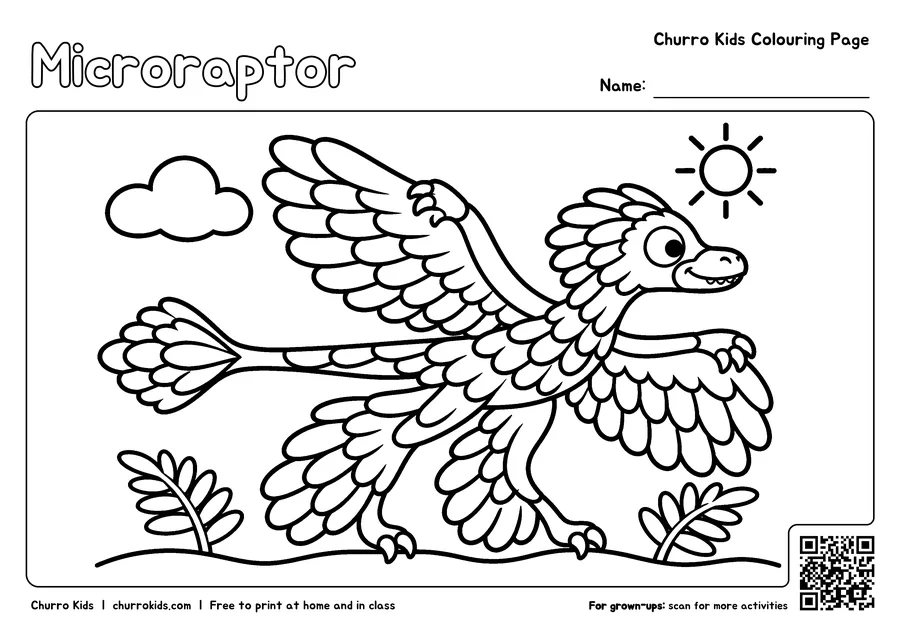
One A4 page, and it is free. Print it freely at home or in class.
Good for parents to know
- Scientists are still studying if it flew strongly by flapping its wings or only glided. You can tell your child "It probably flew between the trees or glided down."
- The shiny black colour of its feathers was worked out by studying the tiny grains of colour in the feathers of one fossil.
- It is often mixed up with Archaeopteryx. If the animal has long wing feathers on its legs too, so that it has four wings, it is Microraptor. Microraptor lived about 25 million years later.