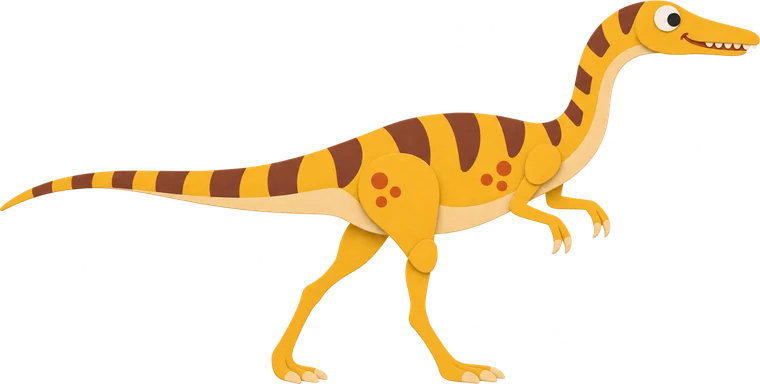
Looking at a book full of huge dinosaurs, your child asks, "Mum, were there any small dinosaurs? One I could hold!" There was Compsognathus, a dinosaur with a body about the size of a chicken.
Compsognathus was a small meat-eating dinosaur that lived in the Late Jurassic, about 150 million years ago. It lived on small islands scattered across what is now Germany and France. Scientists think it ran fast on its long, thin back legs, and its tail was longer than half of its body length. A small lizard, the last thing it ate, was found in the belly of a fossil. Below are the questions children ask most, with answers at a child's level. You can read them out loud as they are.
Fact cardCompsognathus
- Name means
- pretty jaw
- Lived
- Late Jurassic (about 150 million years ago)
- Length
- about 1 m (3.3 ft)
- Weight
- about 3 kg
- Food
- Meat-eater (small animals such as lizards)
- Found in
- Europe (Germany, France)
- Group
- Small, fast and feathered dinosaurs
- A small body the size of a chicken
- Long, thin back legs
- A tail longer than its body
How big was Compsognathus? Measure it with your own height
When your child asks, answer like this
 What does Compsognathus mean?

How big was it?
What did it eat?
How did it hunt?
Who lived with it?
- A small lizard (Schoenesmahl) preyfossil evidence
The bones of a small lizard were found in the belly of a Compsognathus fossil. It was its last meal, a lizard it had quickly chased and eaten. - Archaeopteryx neighboursame time and place
Archaeopteryx lived at the same time on the same islands. No fossil has been found yet that tells us how the two got along. - Rhamphorhynchus (a pterosaur) neighboursame time and place
Rhamphorhynchus, a pterosaur with a long tail, flew over the sea around the islands. Compsognathus probably looked up at it from the shore.
When and where did it live?
What was it like as a baby? Did it live with friends?
Are there dinosaurs that look like it?
Who found it first?
Compsognathus facts that make kids say “Wow!”
- A small lizard, the last thing it ate, was found in the belly of a Compsognathus fossil.
- For a long time, until the 1990s, Compsognathus was known as "the smallest dinosaur".
- Only two proper skeleton fossils have been found so far, one from Germany and one from France.
- Long ago a scientist named Huxley compared Compsognathus with Archaeopteryx and thought that birds and dinosaurs were closely related.
From head to tail
- The young fossil from Germany is 70 to 90 cm (28 to 35 inches) long, and the adult fossil from France is about 1.25 m (4 ft) long.
- The young fossil from Germany weighed about 0.3 to 0.6 kg (0.7 to 1.3 lb), as much as two or three apples.
- Each hand had two big fingers with claws and a very small third finger.
- Its tail was longer than half of its body length.
A Compsognathus story to read aloud
Morning comes to a small island in the middle of a warm sea. Compsognathus pokes its head out from the low bushes. It runs quickly across the sand on its long, thin back legs. Its tail, longer than its body, keeps it balanced behind. Oh, there is a small lizard! Compsognathus darts after it and gulps the lizard down. Overhead, the pterosaur Rhamphorhynchus flies out toward the sea.
A quiz to do together
Tap an answer.
What was found in the belly of a Compsognathus fossil?
What does the name Compsognathus mean?
What kind of place did Compsognathus live in?
You finished the quiz! Well done.
Colouring page
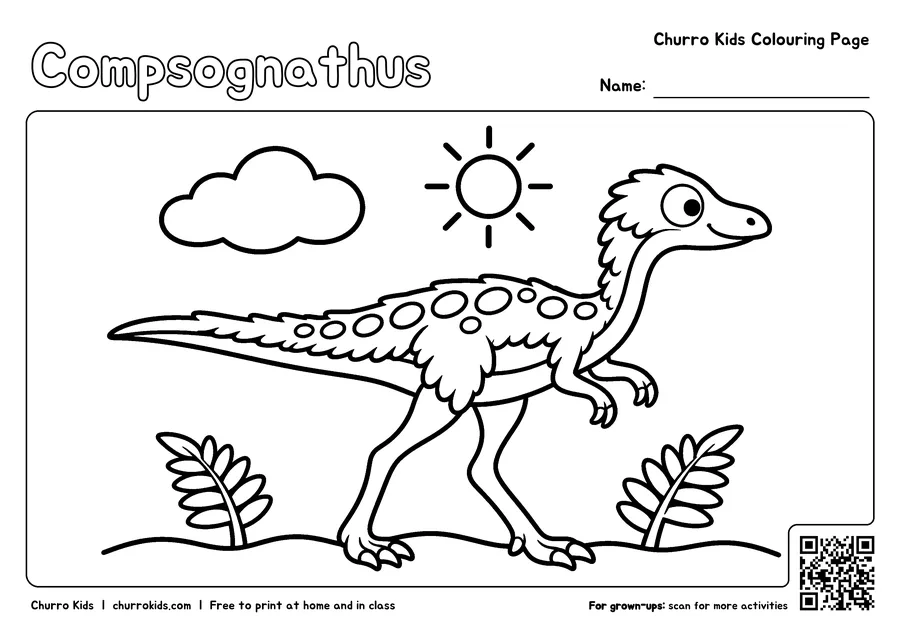
One A4 page, and it is free. Print it freely at home or in class.
Good for parents to know
- The German fossil known for being "the size of a chicken" (70 to 90 cm long) is a young dinosaur that was not fully grown. The adult fossil from France is about 1.25 metres long.
- No feathers have been found as fossils. Pictures that show a fuzzy covering on its body are a guess based on its relatives.
- Its body shape is very much like Archaeopteryx, and an Archaeopteryx fossil was once wrongly thought to be a Compsognathus. If it has long wing feathers, it is Archaeopteryx.