"Which dinosaur lived the longest time ago?" your child asks, opening the first page of a dinosaur book.
Eoraptor was a small dinosaur that lived in the Late Triassic, in the land that is now Argentina. It is one of the oldest dinosaurs known so far, and it was about the size of a dog. It had teeth that were good for cutting meat and teeth that were good for tearing plants, so it probably ate all sorts of things. Below are the questions children ask most, with answers at a child's level. You can read them out loud.
Fact cardEoraptor
- Name means
- dawn plunderer
- Lived
- Late Triassic (about 231 to 229 million years ago)
- Length
- about 1.2 m (4 ft)
- Weight
- about 10 kg
- Food
- Eats plants and animals
- Found in
- South America (Argentina)
- Group
- Very early dinosaurs (Triassic and Jurassic)
- A small body the size of a dog
- Long, thin back legs
- Five fingers on each hand
How big was Eoraptor? Measure it with your own height
When your child asks, answer like this
 What does Eoraptor mean?

How big was it?
What did it eat?
What did it do when a scary dinosaur came?
Who lived with it?
- Herrerasaurus predatorsame time and place
Herrerasaurus was a much bigger meat-eating dinosaur that lived in the same place. When little Eoraptor met Herrerasaurus, it probably ran away quickly. - Saurosuchus (a distant relative of crocodiles) predatorsame time and place
Saurosuchus was a reptile and the biggest hunter in that land at that time. Eoraptor probably kept away from this big neighbour. - Rhynchosaur (Hyperodapedon) neighboursame time and place
This was a chubby plant-eating reptile with a beak. Back then there were many more reptiles like this than dinosaurs, so Eoraptor probably met them everywhere.
When and where did it live?
What was it like as a baby? Did it live with friends?
Are there dinosaurs that look like it?
Who found it first?
Eoraptor facts that make kids say “Wow!”
- Eoraptor is one of the oldest dinosaurs known so far.
- When Eoraptor lived, dinosaurs were very rare. Only about 6 to 10 out of every 100 fossils found there are dinosaurs.
- Scientists are still talking about whether Eoraptor was a relative of the meat-eating dinosaurs or on the side of the far-off ancestors of the long-necked dinosaurs.
- The land where Eoraptor was found is protected as a UNESCO World Heritage site.
From head to tail
- It was about 1.2 m (4 ft) long (some sources say 1.7 m) and weighed about 10 kg, much like a dog.
- It had five fingers, and only the three long ones had big claws.
- Its front legs were only about half as long as its back legs.
- Its thigh bone was about 15 cm (6 in), a little shorter than a grown-up's hand span, and its shin was a little longer than that, so it was probably a good runner.
A Eoraptor story to read aloud
In a forest by a river in the Late Triassic, little Eoraptor opens its eyes. It trots between the ferns on its long, thin back legs. It grabs small prey with its three clawed fingers. When it is still a bit hungry, it nibbles plants too. It tiptoes past the chubby rhynchosaurs with their beaks. When it sees big Herrerasaurus far away, it runs quickly into the forest.
A quiz to do together
Tap an answer.
What is Eoraptor about the same size as?
How many fingers did Eoraptor have on each hand?
In which country were Eoraptor fossils found?
You finished the quiz! Well done.
Colouring page
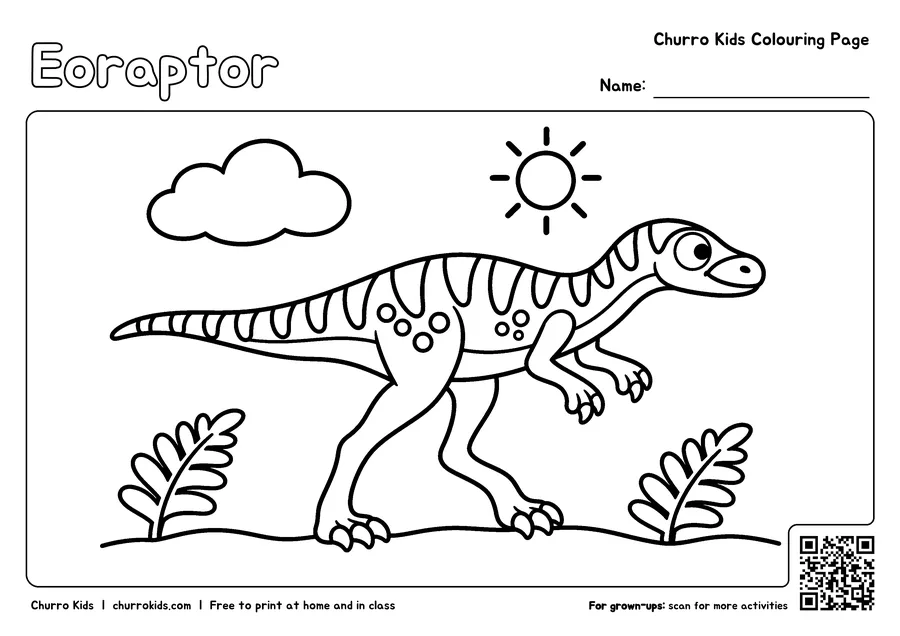
One A4 page, and it is free. Print it freely at home or in class.
Good for parents to know
- Eoraptor is "one of the oldest dinosaurs known so far". Nobody has settled that it was the very first dinosaur, so it is enough to say "it is one of the dinosaurs that lived a very, very long time ago."
- Scientists are still talking about whether it was a relative of the meat-eating dinosaurs or on the side of the far-off ancestors of the long-necked dinosaurs. Recent studies mostly place it with the far-off ancestors of the long-necked dinosaurs.
- The idea that it ate all sorts of things is a guess from its two mixed tooth shapes. We also do not know yet if it lived alone or in a group. It is fine to tell your child "nobody knows yet."