"Whose name is Herrera?" your child asks, sounding out the long name on a dinosaur card one bit at a time.
Herrerasaurus was a meat-eating dinosaur that lived in the Late Triassic, in the land that is now Argentina. It was as long as a car, with pointed, sharp teeth and hands with hooked claws. It is named after Mr Herrera, the goat herder who first found its fossils. Below are the questions children ask most, with answers at a child's level. You can read them out loud.
Fact cardHerrerasaurus
- Name means
- Herrera's lizard (Herrera is the name of the man who first found the fossils)
- Lived
- Late Triassic (about 231 to 229 million years ago)
- Length
- about 4.5 m (15 ft)
- Weight
- about 200 to 350 kg
- Food
- Meat-eater
- Found in
- South America (Argentina)
- Group
- Very early dinosaurs (Triassic and Jurassic)
- A long head
- Pointed, sharp teeth
- Hands with hooked claws
How big was Herrerasaurus? Measure it with your own height
When your child asks, answer like this
 What does Herrerasaurus mean?

How big was it?
What did it eat?
How did it hunt?
Who lived with it?
- Another Herrerasaurus rivalfossil evidence
Bite marks were found on the skull of one Herrerasaurus. From the size and direction of the marks, scientists think one Herrerasaurus had quarrelled with another. - Saurosuchus (a distant relative of crocodiles) predatorsame time and place
Saurosuchus was a meat-eating reptile that was even bigger than Herrerasaurus. Even Herrerasaurus probably had to be careful around this big hunter. - Rhynchosaur (Hyperodapedon) preysame time and place
This was a chubby plant-eating reptile, and a great many of them lived in that land. Herrerasaurus probably hunted them often.
When and where did it live?
What was it like as a baby? Did it live with friends?
Are there dinosaurs that look like it?
Who found it first?
Herrerasaurus facts that make kids say “Wow!”
- Herrerasaurus is named after Mr Herrera, the goat herder who first found its fossils.
- When Herrerasaurus lived, dinosaurs were rare. Only about 6 to 10 out of every 100 fossils from that place are dinosaurs.
- A complete skull was not found until 1988, about 30 years after the first discovery.
- From the fossil droppings, scientists think Herrerasaurus could digest even bones.
From head to tail
- The skull of a big one was as long as 56 cm (22 in).
- Its front legs were less than half as long as its back legs.
- Of its five fingers, only three had sharp curved claws, and the other two were very small.
- Their length differed a lot, from about 3 m (10 ft) to 6 m (20 ft).
A Herrerasaurus story to read aloud
In a forest by a river in the Late Triassic, Herrerasaurus walks out on its two back legs. Between the ferns and the tall conifers, chubby rhynchosaurs are nibbling plants. Herrerasaurus creeps closer, then runs on its strong legs. It grabs its food with its hooked claws and holds it tightly with its jaw that moves back and forth. When big Saurosuchus appears, Herrerasaurus carefully moves away. When its tummy is full, it rests in the shade of the forest.
A quiz to do together
Tap an answer.
Whose name does Herrerasaurus come from?
What did Herrerasaurus eat?
When did Herrerasaurus live?
You finished the quiz! Well done.
Colouring page
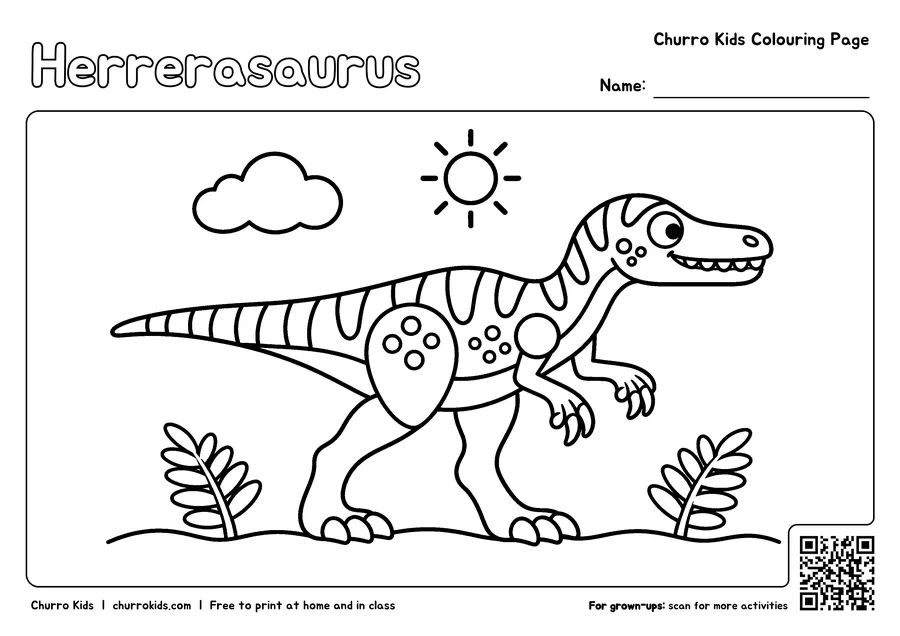
One A4 page, and it is free. Print it freely at home or in class.
Good for parents to know
- Its length differs from fossil to fossil, and sources give anything from about 3 to 6 metres (10 to 20 feet). The 4.5 metres (15 feet) in this guide is a number from the middle of that range.
- The dinosaur is Herrerasaurus and the man who found the fossils is Mr Herrera. The dinosaur's name comes straight from his.
- The idea that one Herrerasaurus quarrelled with another is a guess from marks left on a skull. What it hunted is also a guess from the animals that lived at the same time and place. Scientists are still talking about which family of very early dinosaurs it belongs to.