A child looking at Triceratops in a dinosaur book sometimes asks, "Dad, were there horned dinosaurs in Korea too?" Koreaceratops is the dinosaur to tell them about.
Koreaceratops was a plant-eating dinosaur that lived in the Early Cretaceous, about 103 million years ago, in what is now Hwaseong in Gyeonggi Province. It was a distant relative of Triceratops, but it had no big horns, it was about the size of a big dog, and its tail was tall and flat. Below are the questions children ask most, with answers at a child's level, and you can read them out loud as they are.
Fact cardKoreaceratops
- Name means
- Korean horned face
- Lived
- Early Cretaceous (about 103 million years ago)
- Length
- about 1.5 m (5 ft)
- Weight
- about 30 to 45 kg
- Food
- Plant-eater
- Found in
- Asia (Hwaseong, Gyeonggi Province, South Korea)
- Group
- Dinosaurs of Korea and Asia
- A tall, flat tail
- A beak like a parrot's
- A small body
How big was Koreaceratops? Measure it with your own height
When your child asks, answer like this
 What does Koreaceratops mean?

How big was it?
What did it eat?
What did it do when a scary dinosaur came?
Who lived with it?
- Neighbours we do not know yet neighboursame time and place
Only one Koreaceratops has been found, inside a block of rock that was used to build a seawall. So nothing reliable is known yet about which animals it lived with.
When and where did it live?
What was it like as a baby? Did it live with friends?
Are there dinosaurs that look like it?
Who found it first?
Koreaceratops facts that make kids say “Wow!”
- Koreaceratops was a distant relative of Triceratops, but it had no big horns and was only about as big as a dog.
- Koreaceratops is the first dinosaur of the horned dinosaur group found in Korea.
- The block of rock with the fossil inside was used to build a seawall, so it sat there for about 14 years without anyone knowing.
- Only the tail, hip and back leg bones were found, so nobody has ever seen its face.
From head to tail
- It was about 1.3 to 1.8 m (4 to 6 ft) long, about the size of a big dog.
- It was found with 36 tail bones still joined together in a row.
- The spines that stick up from the tail bones are more than five times as tall as the main part of each tail bone.
- It weighed about 30 to 45 kg, about the same as one primary school child.
A Koreaceratops story to read aloud
A river trickles through the dry land. An eight-year-old Koreaceratops walks along the riverbank on its strong back legs. Its tall, flat tail sways gently with every step. It snips off fern leaves with its parrot-like beak. It has no big horns, but it does not worry. If it hears a noise, it can simply run away fast. With a full tummy, Koreaceratops rests for a while by the river.
A quiz to do together
Tap an answer.
Where was the Koreaceratops fossil hiding?
What did the tail of Koreaceratops look like?
Whose distant relative is Koreaceratops?
You finished the quiz! Well done.
Colouring page
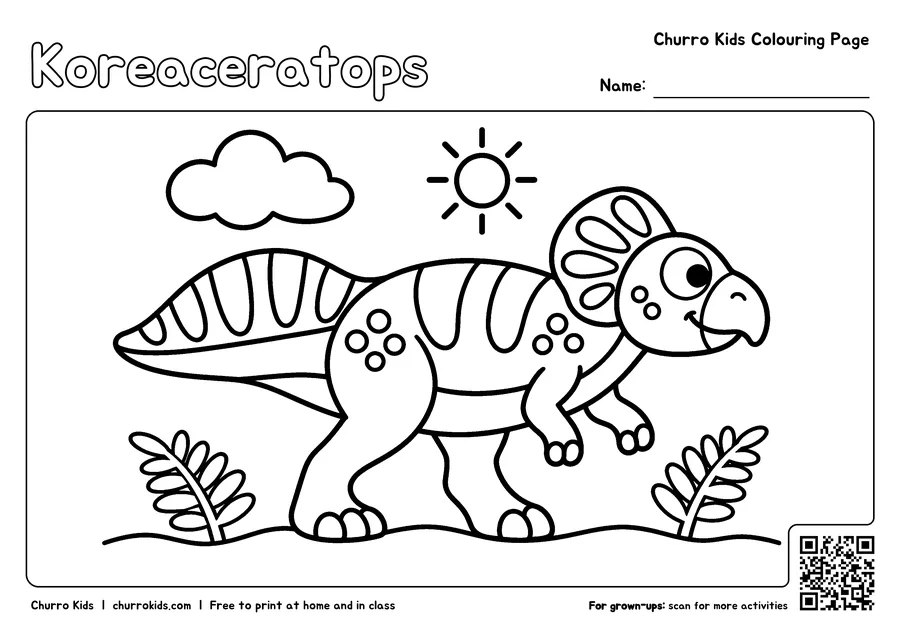
One A4 page, and it is free. Print it freely at home or in class.
Good for parents to know
- All that has been found is the tail, hips and back leg bones of one animal that was not fully grown. There is no skull, so the face and beak are drawn from related dinosaurs.
- Its length is given as about 1.3 to 1.8 metres, depending on the source. Some places say 2.3 metres and 150 kilograms, but those numbers are not backed up by scientific papers. The weight of 30 to 45 kilograms comes from the 2010 announcement.
- That it swam with its tall, flat tail is still only an idea. That it walked on two legs is also worked out from its back foot and its relatives, so it is best to say "it may have."