"This dinosaur has no horns and no armour. What does it do?" your child asks in a worried voice, holding up the Dryosaurus card from a row of dinosaur cards.
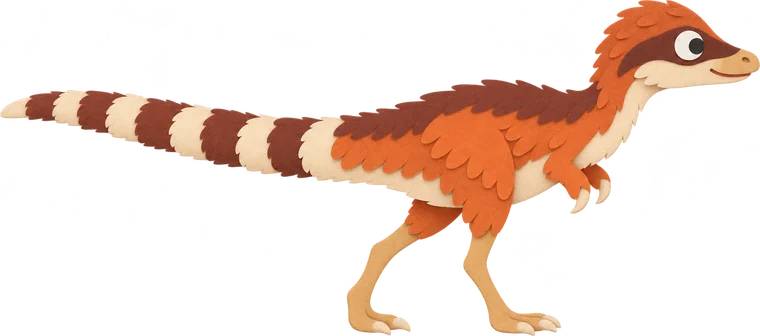
Dryosaurus was a small, slim plant-eating dinosaur that lived in the Late Jurassic in what is now the west of the USA. It had no horns and no armour, so running fast was its way of staying safe. In Colorado in the USA, the bones of several baby Dryosaurus were even found together with eggshells. Below are the questions children ask most, with answers at a child's level. You can read them out loud.
Fact cardDryosaurus
- Name means
- tree lizard (also translated as oak lizard)
- Lived
- Late Jurassic (about 155 to 145 million years ago)
- Length
- about 3 m (10 ft)
- Weight
- about 100 kg
- Food
- Plant-eater
- Found in
- North America (USA)
- Group
- Very early dinosaurs (Triassic and Jurassic)
- Long, slim back legs
- A long, stiff tail
- A mouth shaped like a beak
How big was Dryosaurus? Measure it with your own height
When your child asks, answer like this
 What does Dryosaurus mean?

How big was it?
What did it eat?
What did it do when a scary dinosaur came?
Who lived with it?
- Allosaurus predatorsame time and place
Allosaurus was the most common big meat-eating dinosaur in the same place. When Dryosaurus saw an Allosaurus, it probably ran away fast. - Camptosaurus rivalsame time and place
Camptosaurus was a bigger plant-eating relative that lived in the same place. The two probably shared the low plants. - Stegosaurus neighboursame time and place
Stegosaurus was a plant-eating dinosaur with plates on its back that lived on the same plains. Dryosaurus probably fed on plants beside this big neighbour.
When and where did it live?
What was it like as a baby? Did it live with friends?
Are there dinosaurs that look like it?
Who found it first?
Dryosaurus facts that make kids say “Wow!”
- When Dryosaurus met a scary dinosaur, it probably ran away fast on its long legs.
- No fossil of a fully grown adult Dryosaurus has ever been found yet.
- The name "tree lizard" was given because people thought it lived in forests.
- In 2018 a second kind of Dryosaurus was given a new name.
From head to tail
- The ones that have been found were up to about 3 m (10 ft) long and about 100 kg (220 pounds) in weight.
- It had five fingers at the end of each short arm.
- As a baby it had big eyes and a short snout, and the snout grew longer as it got older.
- Its back legs were long and slim, just right for running.
A Dryosaurus story to read aloud
The morning sun comes up over the wide plains of the Late Jurassic. Beside the tree fern forest by the river, Dryosaurus nips off low ferns with its beak. It chews the leaves up small with its back teeth. Nearby, a Stegosaurus with plates on its back plods slowly along. Far away, an Allosaurus appears. Dryosaurus balances with its stiff tail and dashes away on its long legs.
A quiz to do together
Tap an answer.
What did Dryosaurus do when it met a scary dinosaur?
How many fingers does Dryosaurus have on each hand?
What were the eyes of a baby Dryosaurus like?
You finished the quiz! Well done.
Colouring page
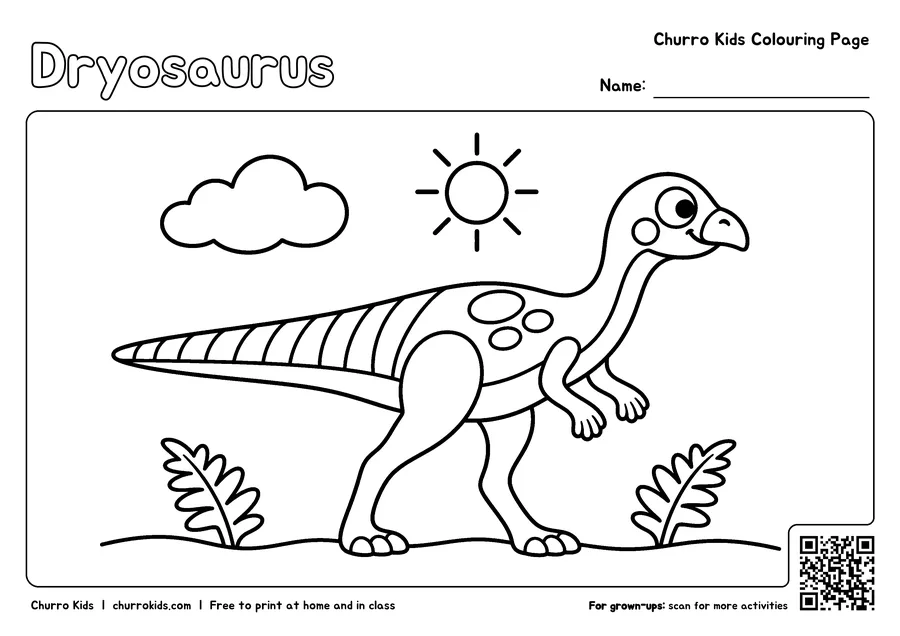
One A4 page, and it is free. Print it freely at home or in class.
Good for parents to know
- No fossil of a fully grown adult has ever been found. So the true adult size is unknown, and sources guess about 3 to 4 metres. The 3 metres and 100 kg in this guide are the size of the fossils found so far.
- The name can make people think it lived up in trees. Tell your child that "tree lizard" was given because people thought it lived in forests.
- It is easy to mix up with its relative Camptosaurus, which lived in the same place. Camptosaurus is much bigger and heavier, and Dryosaurus is small and slim. The idea that it ran away from Allosaurus is a guess based on the two living at the same time and place.