On a snowy day your child looks out of the window and asks, "Mum, did dinosaurs live in cold places too?" Pachyrhinosaurus is just the dinosaur for this question.
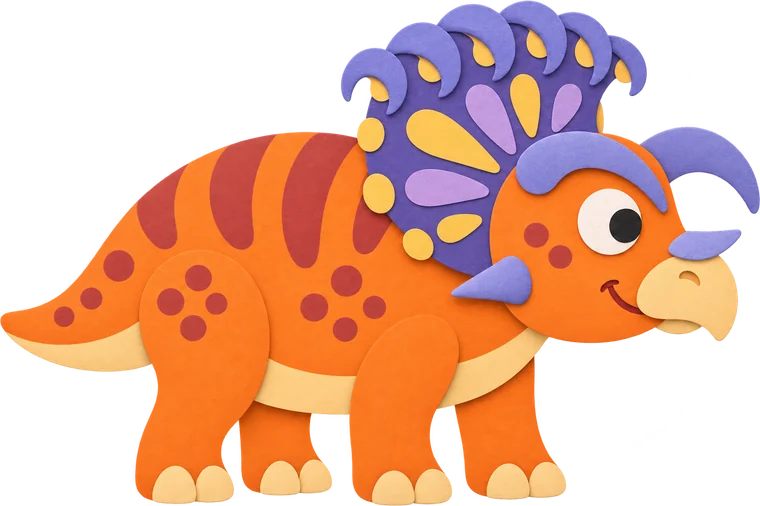
Pachyrhinosaurus was a horned dinosaur that lived in the Late Cretaceous in what are now Alberta in Canada and Alaska in the USA. It had no pointy horn on its nose. It had a thick, flat lump of bone there, and two curved horns stood up from the top of its frill. In Alaska it even lived in a cold place where the sun does not rise for about four months in winter. Below are the questions children ask most, with answers at a child's level. You can read them out loud as they are.
Fact cardPachyrhinosaurus
- Name means
- thick-nosed lizard
- Lived
- Late Cretaceous (about 73.5 to 69 million years ago)
- Length
- about 6 m (20 ft)
- Weight
- about 2 to 4 tonnes
- Food
- Plant-eater
- Found in
- North America (Canada, Alaska in the USA)
- Group
- Horned dinosaurs
- A bumpy lump on the nose in place of a horn
- Two horns on top of the frill
- A big, strong body
How big was Pachyrhinosaurus? Measure it with your own height
When your child asks, answer like this
 What does Pachyrhinosaurus mean?

How big was it?
What did it eat?
What did it do when a scary dinosaur came?
Who lived with it?
- Nanuqsaurus predatorsame time and place
In cold Alaska, Nanuqsaurus, a relative of Tyrannosaurus, lived in the same place. It probably hunted Pachyrhinosaurus. - Albertosaurus predatorsame time and place
In Canada, the big meat-eating dinosaur Albertosaurus lived on the same land and probably hunted Pachyrhinosaurus. - Edmontosaurus neighboursame time and place
The duck-billed dinosaur Edmontosaurus was its neighbour.
When and where did it live?
What was it like as a baby? Did it live with friends?
Are there dinosaurs that look like it?
Who found it first?
Pachyrhinosaurus facts that make kids say “Wow!”
- Pachyrhinosaurus had no pointy horn on its nose. It had a thick, flat lump of bone there.
- The Pachyrhinosaurus of Alaska lived in a place that stays dark in winter, where the sun does not rise for about four months.
- The bones of Pachyrhinosaurus that lived in cold places got a new line every winter, like the rings of a tree.
- One kind is named Pachyrhinosaurus lakustai, after the science teacher who found the field of fossils.
From head to tail
- A fossil called 'Big Sam' has a skull about 1.4 m (4.5 ft) long.
- The lump of bone on the nose of that fossil is about 40 cm (16 inches) wide, as big as a large pizza.
- Depending on the kind, it was about 5 to 8 m (16 to 26 ft) long.
- Two curved horns stand up from the top of its frill.
A Pachyrhinosaurus story to read aloud
In the northern forest, the long winter is over and the sun comes up. A herd of Pachyrhinosaurus walks slowly to the river. The babies walk in between the grown-ups. They nip off tough plants with their beaks and cut them with their strong teeth. Nearby, an Edmontosaurus is eating plants too. Two of them press the thick lumps on their noses together to see who is stronger.
A quiz to do together
Tap an answer.
What is on the nose of Pachyrhinosaurus?
Which cold place did Pachyrhinosaurus live in?
What did Pachyrhinosaurus eat?
You finished the quiz! Well done.
Colouring page
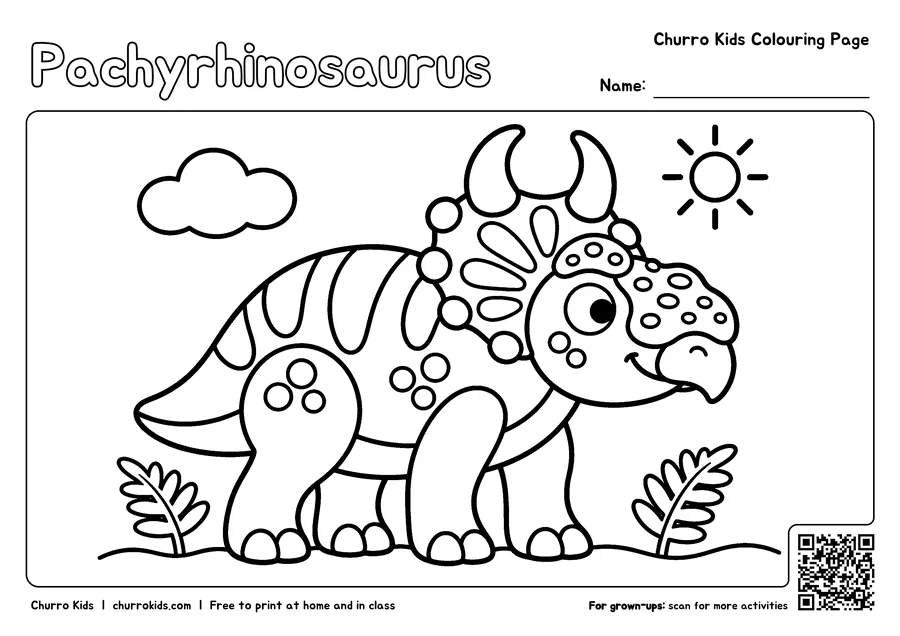
One A4 page, and it is free. Print it freely at home or in class.
Good for parents to know
- Size depends on the kind. The smaller kind was about 5 metres (16 ft) long and about 2 tonnes, and the bigger kind was 6 to 8 metres (20 to 26 ft) and about 3 to 4 tonnes. That is why books give different numbers.
- Nobody knows yet if the lump of bone on the nose was covered by a horn in life, or if it was just a tough lump. Pictures may show the nose a little differently.
- There is no fossil evidence that Nanuqsaurus or Albertosaurus hunted Pachyrhinosaurus. We only know that they lived at the same time in the same place. The idea that they pushed with their nose lumps comes from some scientists, so it is safest to say "maybe they did."