Your child is lining up toy dinosaurs in one long row and asks, "Dad, did dinosaurs go around with their friends too?" Centrosaurus is a good dinosaur to talk about at a moment like this.
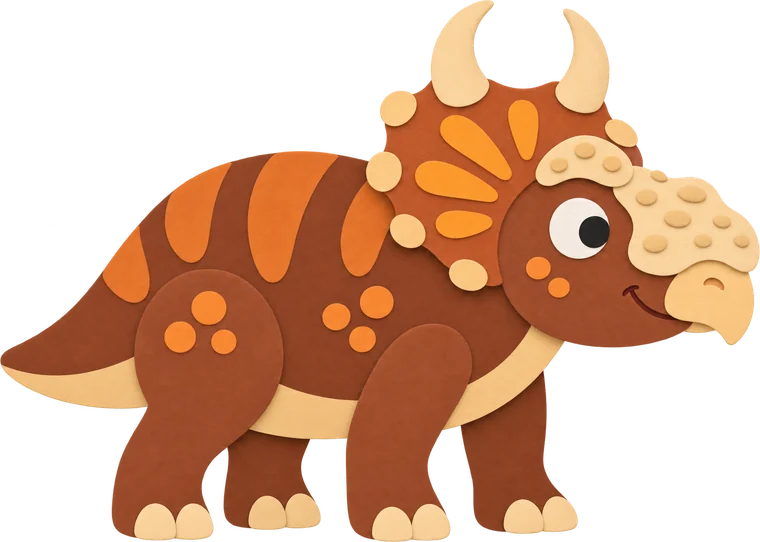
Centrosaurus was a horned dinosaur that lived in the Late Cretaceous in what is now Alberta, Canada. It had one big horn on its nose and two small hook-shaped horns on top of its short, round frill. The bones of thousands were found in one place, so scientists think it lived in big herds. Below are the questions children ask most, with answers at a child's level. You can read them out loud as they are.
Fact cardCentrosaurus
- Name means
- pointed lizard
- Lived
- Late Cretaceous (about 76.5 to 75.5 million years ago)
- Length
- about 5.5 m (18 ft)
- Weight
- about 2 to 2.5 tonnes
- Food
- Plant-eater
- Found in
- North America (Canada)
- Group
- Horned dinosaurs
- One big horn on the nose
- Two hook-shaped horns on top of the frill
- A short, round frill
How big was Centrosaurus? Measure it with your own height
When your child asks, answer like this
 What does Centrosaurus mean?

How big was it?
What did it eat?
What did it do when a scary dinosaur came?
Who lived with it?
- Gorgosaurus predatorsame time and place
Gorgosaurus, a big meat-eating dinosaur that lived in the same place, probably hunted the herds of Centrosaurus. - Chasmosaurus neighboursame time and place
It lived on the same land as the horned dinosaur Chasmosaurus. Their snouts were different shapes, so they probably picked different plants to eat. - Corythosaurus neighboursame time and place
Corythosaurus had a round crest on its head. The two probably lived by the same rivers.
When and where did it live?
What was it like as a baby? Did it live with friends?
Are there dinosaurs that look like it?
Who found it first?
Centrosaurus facts that make kids say “Wow!”
- The bones of thousands of Centrosaurus were found in one place, so it probably lived in big herds.
- A leg bone of a Centrosaurus was found that had cancer in it, so we learned that dinosaurs got cancer too.
- The name Centrosaurus comes from the small hooks on its frill. It does not come from the nose horn.
- Its name sounds like Kentrosaurus, which lived in Africa, but that one is a completely different dinosaur with spikes on its back.
From head to tail
- It was about 5.5 m (18 ft) long, a little longer than a car.
- It weighed about 2 to 2.5 tonnes, about the same as a big rhinoceros.
- It had one big horn on its nose. On some animals the horn curved forward, and on others it curved backward.
- On top of its frill were two small hook-shaped horns that bent forward.
A Centrosaurus story to read aloud
Morning breaks over the warm plain. A herd of Centrosaurus tramps down to the river together. Babies and grown-ups all walk along side by side. They nip off low ferns with their beaks and slice them with their teeth. Next to them, a Corythosaurus with a round crest is eating leaves. A Gorgosaurus watches from far away, but the herd is big, so they feel safe.
A quiz to do together
Tap an answer.
Where is the big horn of Centrosaurus?
How did Centrosaurus live?
What is on top of the frill of Centrosaurus?
You finished the quiz! Well done.
Colouring page
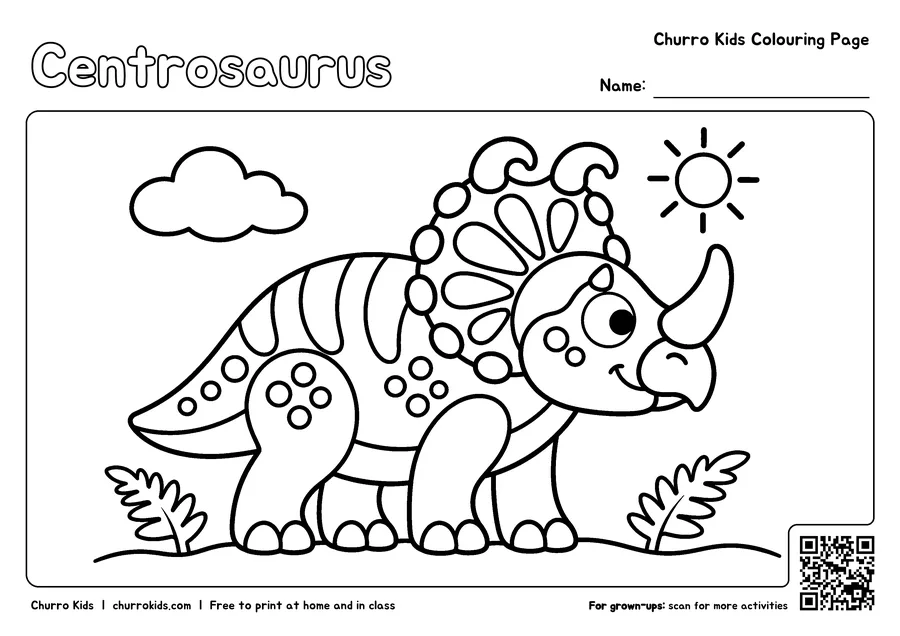
One A4 page, and it is free. Print it freely at home or in class.
Good for parents to know
- Its weight is given as anything from about 1 to 2.5 tonnes, depending on the source. This guide uses about 2 to 2.5 tonnes.
- On some animals the nose horn curved forward, and on others it curved backward. Pictures in different books may differ, and both shapes were real.
- It is easy to mix up with Kentrosaurus from Africa because the names sound alike, but that one is a completely different dinosaur with spikes on its back. Also, there is no fossil evidence that Gorgosaurus hunted Centrosaurus, so it is safest to say "it may have hunted them."