At dinner your child holds up a spoon and says, "There was a dinosaur with teeth shaped like spoons!" That dinosaur is Camarasaurus.
Camarasaurus was a long-necked dinosaur that lived in North America in the Late Jurassic. It was about as long as one and a half buses, with a big, boxy head and strong, spoon-shaped teeth. It is also the long-necked dinosaur found most often in the western USA. Below are the questions children ask most, with answers at a child's level. You can read them out loud like a storybook.
Fact cardCamarasaurus
- Name means
- chambered lizard
- Lived
- Late Jurassic (about 155 to 145 million years ago)
- Length
- about 15 m (49 ft)
- Weight
- about 8 to 17 tonnes
- Food
- Plant-eater
- Found in
- North America (USA)
- Group
- Long-necked dinosaurs
- A big, boxy head
- Spoon-shaped teeth
- A plump, sturdy body
How big was Camarasaurus? Measure it with your own height
When your child asks, answer like this
 What does Camarasaurus mean?

How big was it?
What did it eat?
What did it do when a scary dinosaur came?
Who lived with it?
- Allosaurus predatorfossil evidence
In Wyoming, USA, the bones of a young Camarasaurus were found together with teeth that had fallen out of Allosaurus and with scratches made by teeth. Scientists think the Allosaurus fed on it after it had died. It does not look like a hunt. - Diplodocus neighboursame time and place
Diplodocus ate soft plants and Camarasaurus ate tough leaves, so they could probably live together on the same plains. - Stegosaurus neighboursame time and place
Stegosaurus probably lived as a neighbour on the same plains too, eating low plants.
When and where did it live?
What was it like as a baby? Did it live with friends?
Are there dinosaurs that look like it?
Who found it first?
Camarasaurus facts that make kids say “Wow!”
- Camarasaurus had strong teeth shaped like spoons, so it could pull off and eat even tough leaves.
- Camarasaurus is the long-necked dinosaur found most often in the western USA.
- A fossil of a Camarasaurus that lived to about forty years old has been found.
- Scientists long ago wrongly thought that Camarasaurus lived in water.
From head to tail
- Each side of the upper jaw had 13 or 14 spoon-shaped teeth.
- Each tooth was replaced by a new one about every two months (about 62 days).
- Its bite was about four times as strong as the bite of Diplodocus.
- Skin fossils show that it was covered in six-sided scales, like a honeycomb.
A Camarasaurus story to read aloud
Camarasaurus walks into the riverside forest of the Late Jurassic. It lifts its big, boxy head and looks for conifer leaves 2 to 5 metres (6.5 to 16 feet) up. With its strong, spoon-shaped teeth it snaps off the tough leaves and eats them. Beside it, Diplodocus is eating soft ferns, so they do not quarrel. A young Camarasaurus stays right next to the adults and watches out for Allosaurus. When the dry season comes, they set off on a long journey to find water and food.
A quiz to do together
Tap an answer.
What were the teeth of Camarasaurus shaped like?
What shape is the head of Camarasaurus?
Whose teeth were found beside the bones of a young Camarasaurus?
You finished the quiz! Well done.
Colouring page
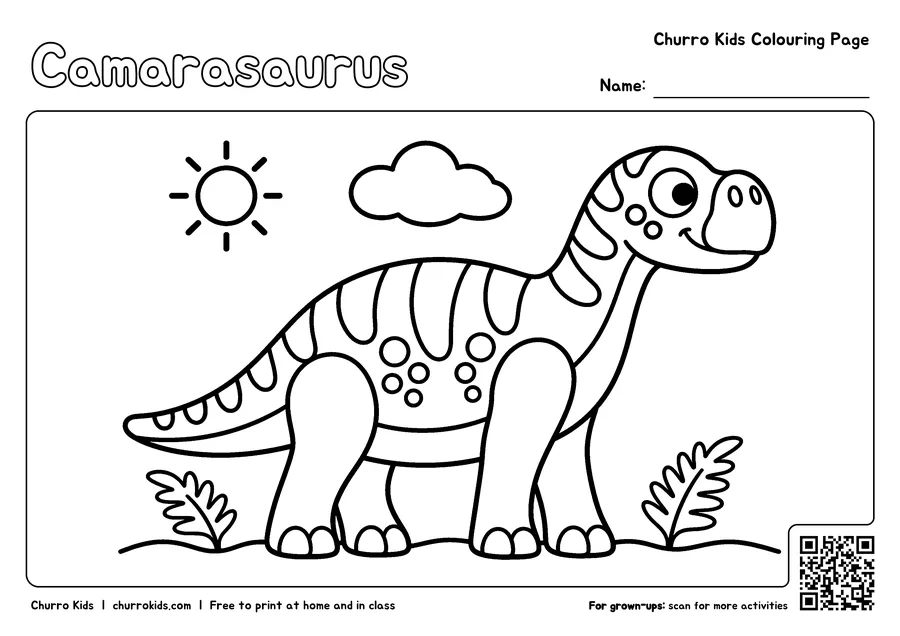
One A4 page, and it is free. Print it freely at home or in class.
Good for parents to know
- Size depends on the kind. The common kind was about 15 metres long, and the largest kind is estimated at about 18 to 23 metres. If a book gives a bigger number, it is not wrong.
- The bones of a young Camarasaurus were found together with teeth that had fallen out of Allosaurus and with scratches made by teeth. Scientists read this as feeding after the animal had died. For a child, it is enough to say "there are signs that Allosaurus ate it."
- It can be mixed up with Brachiosaurus. Camarasaurus is much smaller, has a shorter neck, and has a big, boxy head. The idea that it travelled a long way in the dry season is a guess.