"Are Apatosaurus and Brontosaurus the same dinosaur?" When a child who knows every dinosaur name asks this, even a grown-up has to stop and think.
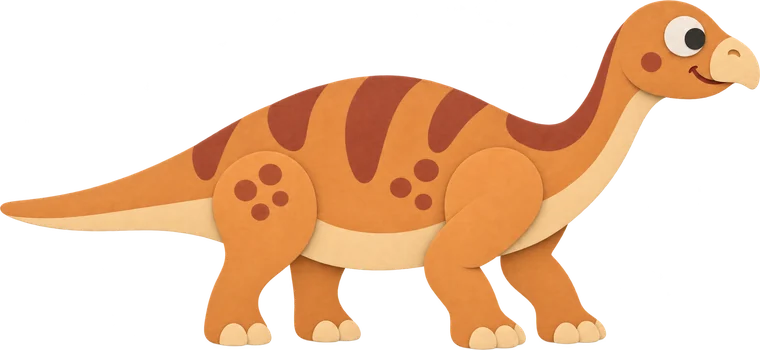
Apatosaurus was a long-necked dinosaur that lived in North America in the Late Jurassic. It was as long as two buses in a row, with a thick neck and legs as thick as pillars. It is also the dinosaur that stood in museums for a long time with another dinosaur's skull on it by mistake. Below are the questions children often ask, with answers in a child's words. You can read them out loud like a storybook.
Fact cardApatosaurus
- Name means
- deceptive lizard
- Lived
- Late Jurassic (about 152 to 151 million years ago)
- Length
- about 22 m (72 ft)
- Weight
- about 16 to 22 tonnes
- Food
- Plant-eater
- Found in
- North America (USA)
- Group
- Long-necked dinosaurs
- A thick, strong neck
- Legs as thick as pillars
- A long tail like a whip
How big was Apatosaurus? Measure it with your own height
When your child asks, answer like this
 What does Apatosaurus mean?

How big was it?
What did it eat?
What did it do when a scary dinosaur came?
Who lived with it?
- Allosaurus predatorsame time and place
Some Apatosaurus bone fossils have tooth marks from a big meat-eating dinosaur. Nobody is sure who made them, but Allosaurus was the most common meat-eater of that time, and it may have fed on an Apatosaurus that had already died. - Diplodocus neighboursame time and place
It probably lived on the same plains as its close relative Diplodocus, eating plants side by side. - Stegosaurus neighboursame time and place
Stegosaurus fossils are often found in the same places as Apatosaurus, so the two probably lived close to each other.
When and where did it live?
What was it like as a baby? Did it live with friends?
Are there dinosaurs that look like it?
Who found it first?
Apatosaurus facts that make kids say “Wow!”
- For a long time, Apatosaurus stood in museums with the skull of a different dinosaur on it by mistake.
- Scientists long ago thought Apatosaurus was so heavy that it lived in water, but now we know it lived on land.
- Some scientists think it pushed against its friends with its thick neck to see who was stronger.
- Its bones had hollow spaces for air inside, so they were light for such a big body.
From head to tail
- Each front foot had just one big thumb claw.
- It weighed about 16 to 22 tonnes, as much as three or four elephants put together.
- It was about 22 m (72 ft) long, as long as two buses in a row.
- It was probably an adult by about twenty years old, but scientists do not all agree.
A Apatosaurus story to read aloud
Thump, thump. Apatosaurus walks up to a river in the Late Jurassic. It lowers its thick neck and pulls up ferns and horsetails with its wide snout. It gulps them down without chewing and takes another mouthful. Nearby, Diplodocus and Stegosaurus are eating plants too. When an Allosaurus comes into view far away, Apatosaurus turns its heavy body and swings its long tail. When the sun goes down, it sets off slowly with its herd for the next feeding ground.
A quiz to do together
Tap an answer.
What does the name Apatosaurus mean?
What was the neck of Apatosaurus like?
How many big claws did Apatosaurus have on each front foot?
You finished the quiz! Well done.
Colouring page
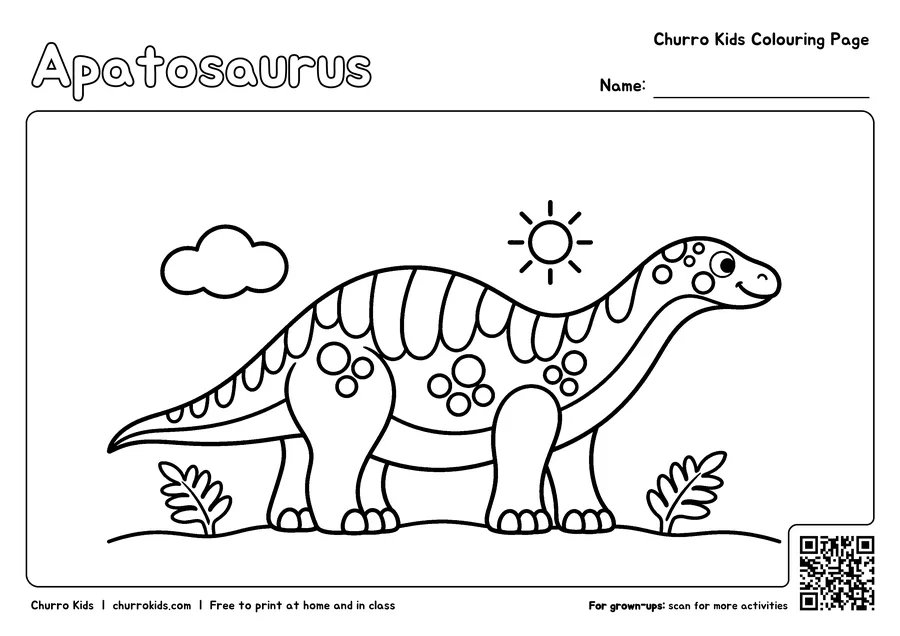
One A4 page, and it is free. Print it freely at home or in class.
Good for parents to know
- It looks so much like Brontosaurus that the two were treated as one dinosaur for a long time. Scientists still disagree about which kinds belong to Apatosaurus and which belong to Brontosaurus.
- Size figures vary a lot between sources. Here we give about 22 metres and about 16 to 22 tonnes, but rare giant individuals may have reached about 30 metres.
- There are bone fossils with tooth marks from a big meat-eating dinosaur, but nobody is sure who made them. It is also not certain that it swung its long tail to drive enemies away, so it is best to say "it may have."