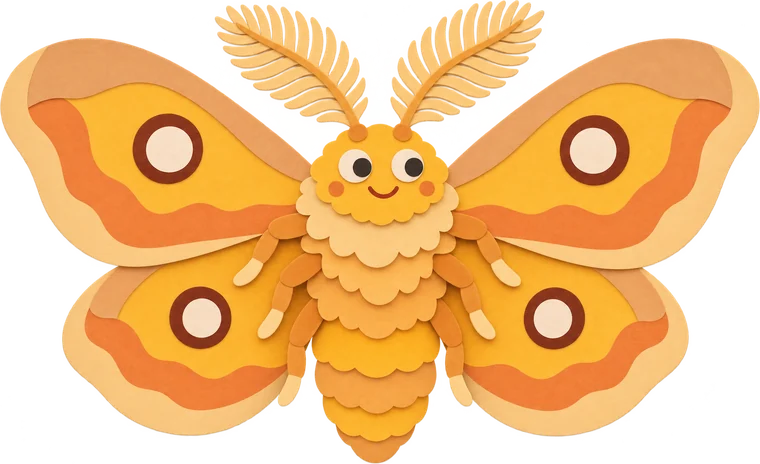
You switch on the porch light on a summer night, a moth flutters in, and your child asks, "Why do moths keep coming to the light? What's the difference between a moth and a butterfly?"
Moths belong to the same insect group as butterflies but come in far more kinds. Their antennae are thread-like or feathery and most fly at night. They circle lamps because they keep their backs towards the brightest light. They pollinate flowers at night and feed bats and birds. Below are the questions children ask most, with answers you can read aloud.
Fact cardMoth Insect · butterfly and moth group
- Group
- same order as butterflies (Lepidoptera)
- Kinds
- far more kinds than butterflies
- Antennae
- thread-like or feathery, no club at the tip
- Active
- mostly at night
- Life stages
- egg → caterpillar → pupa → moth
- Japanese oak silkmoth
- wingspan about 11-15 cm
- The butterfly's cousin that flies through the night
Moth in a child's words
- Moths belong to the same insect group as butterflies. They have six legs and four wings covered in tiny scales.
- There are far more kinds of moth than butterfly. Britain has 60 butterfly species but more than 2,500 moths.
- A butterfly's antennae end in small knobs; a moth's are thread-like or feathery, with no knob.
- Most moths fly at night or at dusk, though some fly by day.
- Moths grow in four steps like butterflies: egg, caterpillar, pupa, adult. Many caterpillars spin a silk cocoon to pupate in.
- Moths pollinate flowers at night while sipping nectar, and they are important food for bats and birds.
- The Japanese oak silkmoth of Korean oak woods has a wingspan of about 11-15 cm.
When your child asks, answer like this
 What is the difference between a butterfly and a moth?

Why do moths fly round lights?
What is the dust on a moth's wings?
What do moths eat?
Are moths bad insects?
Can I touch a moth?
Moth facts that make kids say “Wow!”
- About nine in every ten kinds of butterfly-and-moth are moths: butterflies are just a small branch.
- While bees sleep, moths keep visiting flowers and carrying pollen, including flowers bees seldom visit.
- Silk is made from the thread of cocoons spun by silkworms, the caterpillars of the silk moth.
A quiz to do together
Tap an answer.
When do most moths fly?
Which has more kinds, moths or butterflies?
What is the dust on a moth's wings?
You finished the quiz! Well done.
Colouring page
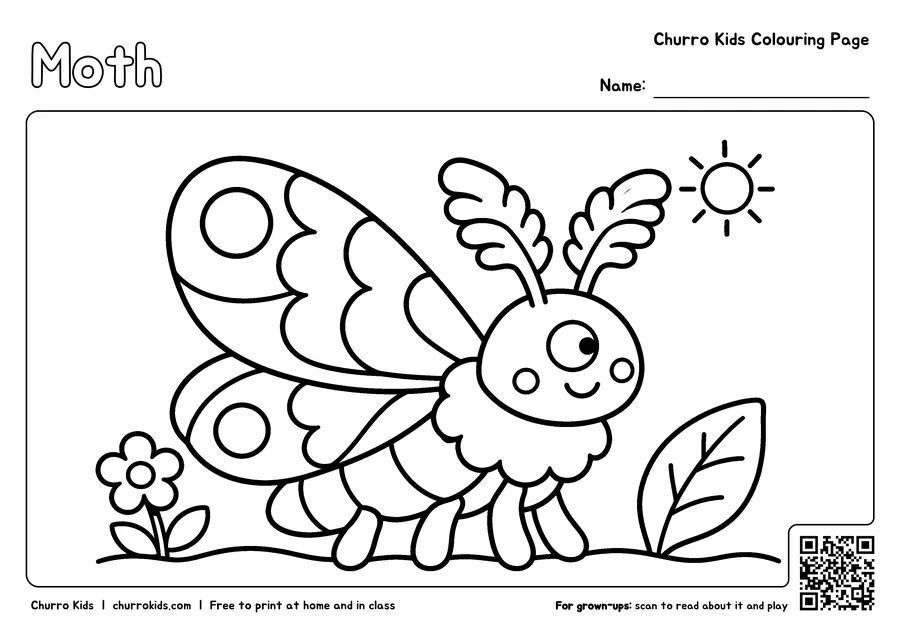
One A4 page, and it is free. Print it freely at home or in class.
Good for parents to know
- Moths and butterflies are not two neat scientific groups: butterflies are one branch within the order, and everything else is a moth. Antennae and flying time work most of the time but have exceptions. About 160,000 moth species have been named, a number that keeps changing.
- Moths at lights were long explained as 'confused moon navigation'. A 2024 study concluded instead that insects keep their backs towards the brightest light, which traps them around lamps; research continues.
- The hairs of some moths and their caterpillars (such as spongy moth and tussock moths) can make skin itch or swell. Keep children from handling them, and wash any contact gently with soap and water rather than rubbing. Most moths are harmless, so there is no need for fear.
Things to try together
- On a summer night, watch the moths near the porch light from a little distance and look for thread-like and feathery antennae.
- Draw a butterfly's antennae (by day) and a moth's (by night) side by side and compare them.
- Draw a moth and give its wings round eyespots. Talk about which pattern might startle a bird.
Sources
- nature.com/articles/s41467-024-44785-3
- butterfly-conservation.org/moths/why-moths-matter
- butterfly-conservation.org/butterflies
- poison.org/articles/caterpillar-stings
- en.wikipedia.org/wiki/Moth
- ko.wikipedia.org/wiki/나방
- ko.wikipedia.org/wiki/참나무산누에나방
- en.wikipedia.org/wiki/Antheraea_yamamai
- en.wikipedia.org/wiki/Bombyx_mori