Stories · Bug Friends · Insect
Longhorn Beetle Facts for Kids: Why Are Their Antennae So Long?
· Churro Kids
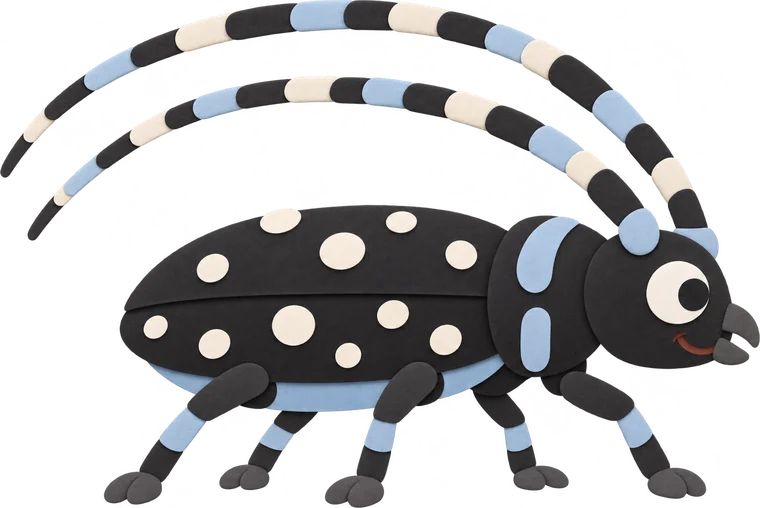
On a walk in the park your child spots a black beetle on a tree trunk and points: "Why are its feelers so long? They're longer than its body!"
Longhorn beetles are beetles whose antennae are as long as the body or longer. Their larvae live inside tree trunks, chewing tunnels for anything from a few months to several years, before the adult chews its way out. There are more than 35,000 kinds, and Korea's largest, Callipogon relictus, is a protected Natural Monument. Below are the questions children ask most, with answers you can read aloud.
Fact cardLonghorn Beetle Insect · beetle
- Length
- about 2.5-3.5 cm (citrus longhorn beetle)
- Antennae
- as long as the body or longer
- Where larvae live
- inside tree trunks and branches
- Time as a larva
- a few months to several years
- Kinds worldwide
- more than 35,000
- Korea's biggest
- Callipogon relictus, a Natural Monument
- The beetle with feelers longer than its body
Longhorn Beetle in a child's words
- A longhorn beetle is a beetle with very long antennae, often as long as its body or longer.
- Its English name comes from those long antennae, which look like horns.
- The mother lays her eggs in tree bark. The larvae that hatch chew tunnels inside the trunk and live there.
- How long they stay larvae depends on the kind: some grow up in a few months, others take several years.
- The citrus longhorn beetle, black with white spots, is about 2.5-3.5 cm (1-1.4 in) long and has banded antennae.
- There are more than 35,000 kinds of longhorn beetle in the world.
- Some longhorn beetles squeak when picked up, by moving part of the body against another.
Longhorn Beetle: measure it with your own height
When your child asks, answer like this
 Why are a longhorn beetle's antennae so long?

Where do longhorn beetle larvae live?
What do longhorn beetles eat?
Why does a longhorn beetle squeak?
Do longhorn beetles bite?
What is the biggest longhorn beetle in Korea?
Can longhorn beetles fly?
Longhorn Beetle facts that make kids say “Wow!”
- The titan beetle of South America can be more than 16 cm (6.3 in) long and is counted among the largest insects in the world.
- In 1968 Callipogon relictus became the first insect in Korea to be named a Natural Monument.
- In the wild in Korea, a Callipogon relictus larva is said to take about 5-7 years to become an adult.
A quiz to do together
Tap an answer.
What is special about a longhorn beetle?
Where do longhorn beetle larvae live?
Which big longhorn beetle is protected as a Natural Monument in Korea?
You finished the quiz! Well done.
Good for parents to know
- Longhorn beetles are a huge family and vary a lot. The body length here is for the citrus longhorn beetle (Anoplophora chinensis, 알락하늘소), which also turns up on park and street trees; sources give anything from 2.1 to 3.7 cm.
- Larval life varies with species and climate: about two to three years for the citrus longhorn beetle, and five to seven years for Callipogon relictus in Korea, though a Chinese account gives about two. 'Several years' is the honest answer.
- Callipogon relictus is a Natural Monument and a Class I endangered species in Korea, so it must not be caught or kept without a permit. Other longhorns can give a finger a sharp nip, so don't let children grab them.
Things to try together
- Use string or wool to make 'longhorn antennae' as long as your child is tall, and talk about how it would feel to carry them around.
- Look for small round holes in tree trunks in the park: they may be where a wood-boring beetle like a longhorn came out.
- Draw a longhorn beetle and count the segments of its antennae, then count its legs.
Sources
- en.wikipedia.org/wiki/Longhorn_beetle
- insect-books.com/cerambycidae/
- uwm.edu/field-station/?p=3826
- inspection.canada.ca/en/plant-health/invasive-pests-and-plants/insects/citrus-long-horned-beetle/fact-sheet
- rhs.org.uk/Advice/profile?PID=761
- ko.wikipedia.org/wiki/알락하늘소
- ko.wikipedia.org/wiki/장수하늘소
- wikitree.co.kr/articles/1047355
- koreascience.kr/article/JAKO201065251814683.page?lang=en
- kyeonggi.com/article/20250803580260
- khan.co.kr/article/201502042121175