Stories · Bug Friends · Insect
Diving Beetle Facts for Kids: How Does It Breathe Under Water?
· Churro Kids
Peering into a nature-centre pond, your child spots a black beetle zooming through the water and asks, "Doesn't it need to breathe? Is it a fish?"
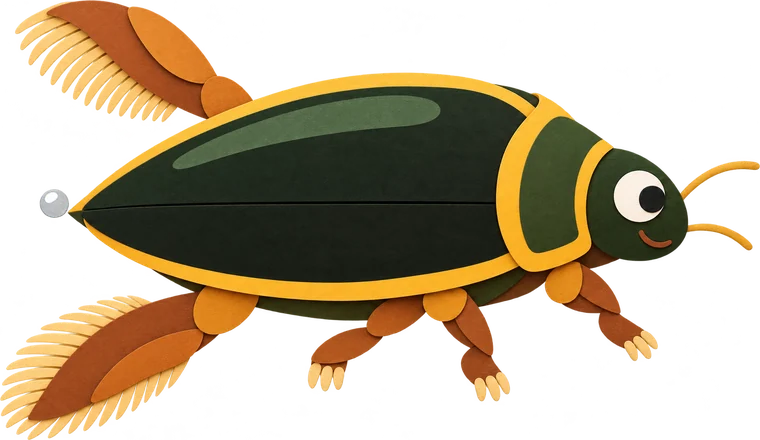
A diving beetle is not a fish but a beetle that lives in ponds and rice paddies. It pokes its tail end out of the water to store an air bubble under its wing covers, breathes from it while diving, and rows with its hairy back legs. It is about 3.5-4 cm (1.4-1.6 in) long and can even fly to new ponds at night. Once common, it has become rare. Below are the questions children ask most, with answers you can read aloud.
Fact cardDiving Beetle Insect · beetle
- Length
- about 3.5-4 cm (1.4-1.6 in)
- Home
- ponds, rice paddies and pools
- Breathing
- an air bubble under its wing covers
- Swimming
- hairy back legs used like oars
- Food
- small fish, tadpoles and water insects
- Flying
- flies at night to other ponds
- A swimming champion with an air bubble under its wings
Diving Beetle in a child's words
- The diving beetle is a beetle that lives in ponds and rice paddies. Korea's big species is about 3.5-4 cm (1.4-1.6 in) long, black with a dark green sheen.
- Its smooth, egg-shaped body slips easily through the water.
- Its back legs are flat and fringed with thick hairs, and it rows with both of them at once, like oars.
- It breathes air even under water: it pokes its tail end above the surface, stores air under its wing covers and breathes from that bubble.
- It eats small fish, tadpoles and water insects.
- Its larvae live in the water too. When fully grown they leave the water and become pupae in the soil.
- Diving beetles can fly. If their pond dries up, they fly off at night to find new water.
Diving Beetle: measure it with your own height
When your child asks, answer like this
 How does a diving beetle breathe under water?

Why is a diving beetle such a good swimmer?
What do diving beetles eat?
Can diving beetles fly?
What do baby diving beetles look like?
Can I catch a diving beetle?
Diving Beetle facts that make kids say “Wow!”
- The air bubble a diving beetle carries is thought to take in a little oxygen from the water, helping it stay under longer.
- Diving beetles kick both back legs together, while look-alike water scavenger beetles move them one after the other, so you can tell them apart by how they swim.
- Diving beetle larvae live in the water, but to become pupae they must climb out and burrow into the mud at the water's edge.
A quiz to do together
Tap an answer.
What does a diving beetle breathe under water?
Which legs does a diving beetle swim with?
Can a diving beetle fly?
You finished the quiz! Well done.
Good for parents to know
- This page is about Korea's largest common diving beetle, Cybister chinensis (formerly Cybister japonicus). Sources give its length as 3.3-4.2 cm or 3.5-4.5 cm. In Korean, 물방개 is also used loosely for the smaller diving beetles.
- Diving beetles have declined as wetlands and ponds disappeared and water quality fell. Some sources list it as an endangered species in Korea, so encourage watching rather than catching and keeping.
- Diving beetles can bite with their jaws, and it hurts. On pond or paddy outings, remind children not to grab them, and always keep an adult close by near water.
Things to try together
- Hold a spoon in each hand and row both at once in a basin of water to feel how a diving beetle swims.
- Push an upside-down clear cup straight down into water and see the air trapped inside: that is the idea behind the beetle's air bubble.
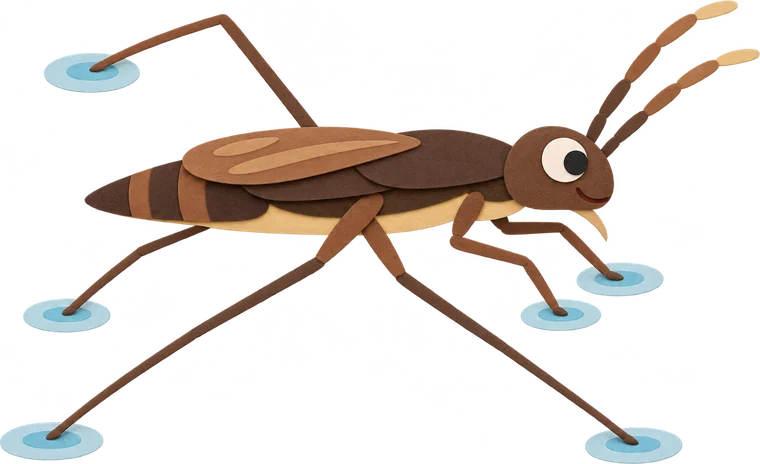
- On a pond or rice-paddy nature walk, look with a grown-up for diving beetles, water scavenger beetles and water striders.
Sources
- ko.wikipedia.org/wiki/물방개
- en.wikipedia.org/wiki/Cybister_chinensis
- mdc.mo.gov/discover-nature/field-guide/predaceous-diving-beetles-water-tigers
- genent.cals.ncsu.edu/bug-bytes/aquatic-respiration/
- zin.ru/Animalia/Coleoptera/eng/biol755.htm
- m.korea.kr/news/pressReleaseView.do?newsId=156524122
- m.go.seoul.co.kr/news/2018/01/11/20180111014010
- index.go.kr/unify/idx-info.do?idxCd=1463
- dailyvet.co.kr/print?id=177090