Stories · Bug Friends · Not an insect
Pill Bug Facts for Kids: Why Do Roly-Polies Roll Up, and Are They Insects?
· Churro Kids
Your child lifts a stone in the playground flowerbed and holds out a tiny curled-up ball: "Why did it turn into a ball? Is it an insect?"
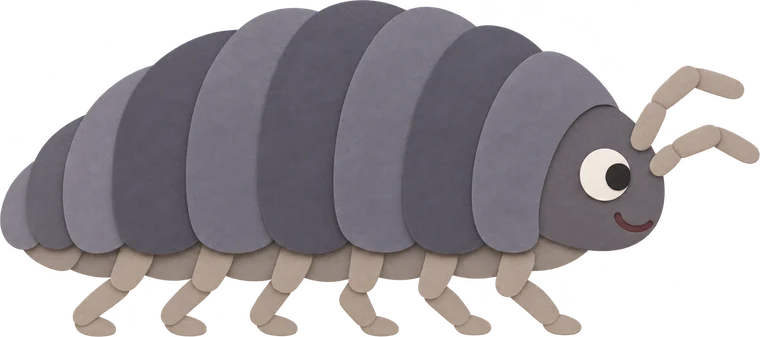
A pill bug rolls up when startled, wrapping its hard back plates around its soft belly. With fourteen legs it is not an insect at all but a crustacean, a land-living cousin of shrimps and crabs, and its gill-like breathing plates must stay damp, so it lives in dark, moist places. It is a little recycler that turns dead leaves back into soil. Below are the questions children ask most, with answers you can read aloud.
Fact cardPill Bug Not an insect · crustacean, a cousin of shrimps and crabs
- Length
- about 1 cm, under 2 cm even when big
- Legs
- 14 (7 pairs)
- Group
- crustacean (related to shrimps and crabs)
- Food
- rotting leaves and fungi
- Likes
- damp, dark places
- Lifespan
- about 2-3 years
- A shrimp cousin that turns into a ball when touched
Pill Bug in a child's words
- When touched, a pill bug rolls its body into a ball, which is how it got its name. Children also call it a roly-poly.
- A pill bug is not an insect: insects have six legs, but a pill bug has fourteen.
- It is a crustacean, related to shrimps and crabs, one of the few crustaceans that live entirely on land.
- Its back is made of seven hard plates that overlap like roof tiles. When it rolls up, they cover its soft underside.
- It breathes with gill-like plates under its abdomen. They must stay moist, so it likes damp places.
- It eats rotting leaves, wood and fungi, helping turn them back into soil.
- The mother carries her eggs in a pouch under her body, and the young stay inside for a while after hatching.
Pill Bug: measure it with your own height
When your child asks, answer like this
 Why does a pill bug roll into a ball?

Is a pill bug an insect?
What's the difference between a pill bug and a woodlouse that doesn't roll?
What do pill bugs eat?
Why are pill bugs always under stones?
Do pill bugs shed their skin?
Can I keep a pill bug?
Pill Bug facts that make kids say “Wow!”
- A pill bug does not moult all at once: the back half comes off first and the front half later.
- Pill bugs have two pairs of antennae. One pair is so tiny you can hardly see it; the big pair is the one you notice.
- A mother carries her eggs in a water-filled pouch, and more than 30 young can come out of one brood.
A quiz to do together
Tap an answer.
How many legs does a pill bug have?
Which animals are pill bugs related to?
Where do pill bugs like to live?
You finished the quiz! Well done.
Colouring page
One A4 page, and it is free. Print it freely at home or in class.
Good for parents to know
- A pill bug is not an insect because it does not have six legs. It sits in this insect book anyway, which makes it a good chance to teach children that counting legs tells you whether something is an insect.
- Body length is given as roughly 0.6-1.8 cm depending on the source. Lifespan is 'up to three years' in one source and 'several years' in another, so 'about 2-3 years' is used here. Brood sizes also vary between sources: up to 40, or 30-80.
- Pill bugs do not bite or sting and are safe to hold. Handle them gently, put them back where you found them and wash hands afterwards.
Things to try together
- Put a pill bug in a clear tub for a moment and count its legs with a magnifying glass. Are there fourteen? Compare with an insect's six.
- Lift a flowerpot or a pile of leaves and look for pill bugs and sowbugs. The one that curls up when lightly touched is the pill bug.
- Line half a box with damp paper and half with dry paper, put a pill bug in the middle and see which side it chooses, then let it go.