Stories · Bug Friends · Insect
Dung Beetle Facts for Kids: Why Do Dung Beetles Roll Dung?
· Churro Kids
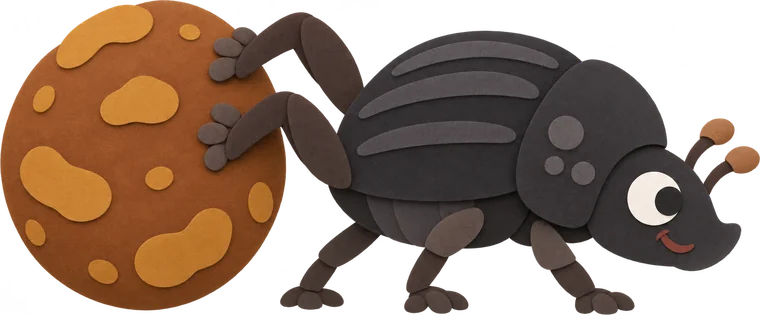
Your child giggles at a picture of a beetle rolling a ball of dung, then asks quite seriously, "Why does it roll poo? Does it eat it?"
Dung beetles eat the dung of plant-eating animals and raise their young inside dung balls. A roller pushes its ball with its back legs, head down, and keeps a straight line by the Sun, the Moon and even the Milky Way. They clean up fields and enrich the soil, but Korea's ball-rolling species has not been seen there since the 1970s and is being brought back. Below are the questions children ask most, with answers you can read aloud.
Fact cardDung Beetle Insect · beetle
- Length
- about 1-1.5 cm (Gymnopleurus mopsus)
- Food
- dung of plant-eating animals such as cows and horses
- How it rolls
- head down, pushing with its back legs
- Finding the way
- Sun, Moon and the Milky Way
- Kinds worldwide
- more than 5,000
- In Korea
- gone since the 1970s; being brought back
- The little cleaner that rolls dung balls and reads the stars
Dung Beetle in a child's words
- Dung beetles are beetles that live on the dung of plant-eating animals such as cows and horses.
- A roller shapes dung into a ball and rolls it away from the dung pile.
- It rolls the ball walking backwards, front legs on the ground and head down, pushing with its back legs.
- It buries the ball to eat later or lays an egg in it, and the larva grows up inside, eating the dung.
- Not all dung beetles roll balls: some dig tunnels under the dung and some live inside the pile.
- By clearing dung away and burying it, dung beetles make the soil richer.
- Korea's ball-roller, Gymnopleurus mopsus, is about 1-1.5 cm long. It has not been seen in Korea since the 1970s, and beetles of the same species from Mongolia are being used to bring it back.
Dung Beetle: measure it with your own height
When your child asks, answer like this
 Why do dung beetles roll dung?

How do dung beetles find their way?
Why does a dung beetle spin around on top of its ball?
Isn't eating dung dirty?
Are dung beetles strong?
Are there dung beetles in Korea?
Why did dung beetles disappear from Korea?
Dung Beetle facts that make kids say “Wow!”
- Dung beetles were the first insects shown to find their way by the Milky Way; scientists proved it with experiments in a planetarium.
- One kind of horned dung beetle pulled 1,141 times its own body weight, like a person shifting the weight of six full double-decker buses.
- Gymnopleurus mopsus is said to roll a ball about as big as its own body.
A quiz to do together
Tap an answer.
How does a dung beetle roll its ball?
On a moonless night, what does a dung beetle use to find its way?
What does a dung beetle put inside a dung ball?
You finished the quiz! Well done.
Colouring page
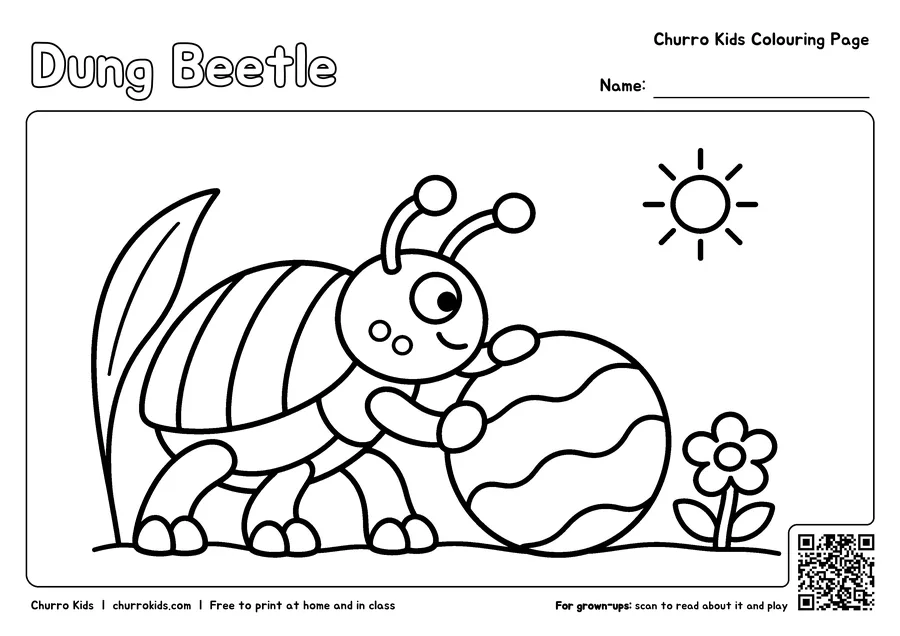
One A4 page, and it is free. Print it freely at home or in class.
Good for parents to know
- In Korean, the dictionary word is 쇠똥구리 while the official species name is 소똥구리; this page uses the first for dung beetles in general and the second for the Korean species. Its body length is given as roughly 0.7-1.5 cm depending on the source.
- Gymnopleurus mopsus was last recorded in Korea in 1971, is regarded as locally extinct and is listed as Endangered Class II. Its loss is linked to the end of open grazing and the move to barn-fed cattle and veterinary drugs. Restoration with Mongolian beetles has been reported, but the year and numbers differ between reports.
- The 1,141-times figure comes from males of a different, horned species pulling a weighted thread in a tunnel, not from ball-rolling. Make sure children wash their hands after watching dung beetles.
Things to try together
- Make a small ball of clay and try rolling it backwards like a dung beetle. Keeping a straight line is harder than it looks.
- On a clear night somewhere dark, look for the Moon or the Milky Way: the dung beetle's signposts.
- Draw a dung beetle with its ball, and underground, the larva growing inside a buried ball.
Sources
- ko.wikipedia.org/wiki/소똥구리
- en.wikipedia.org/wiki/Dung_beetle
- kids.nationalgeographic.com/animals/invertebrates/facts/dung-beetle
- nationalgeographic.com/science/phenomena/2013/01/24/dung-beetles-watch-the-galaxy-thats-how-they-roll/
- journals.plos.org/plosone/article?id=10.1371/journal.pone.0030211
- qmul.ac.uk/sbbs/news/items/super-bug-worlds-strongest-insect-revealed-by-dr-rob-knell.html
- khan.co.kr/article/201712061549001/amp
- newneek.co/@newneek/article/8489
- naturadb.de/tiere/gymnopleurus-mopsus/
- sdu.dk/en/om-sdu/fakulteterne/naturvidenskab/nyheder-2025/bogong-moths