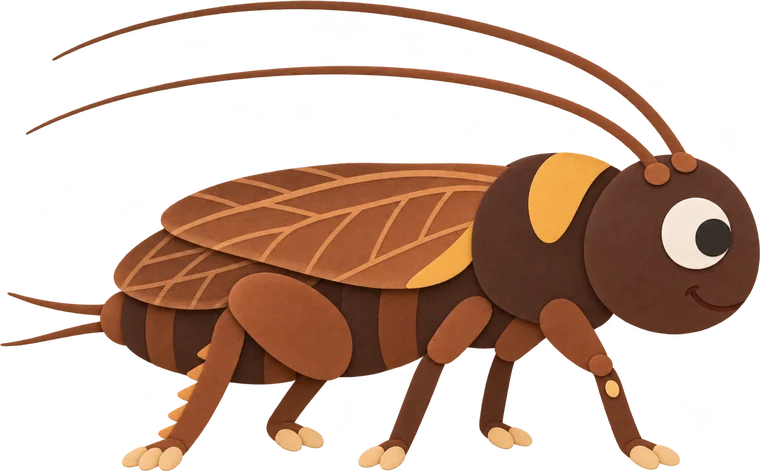
Lying in bed on an autumn night, your child listens to the sound outside the window and asks, "Does the cricket sing with its mouth? Why only at night?"
Crickets sing by rubbing their front wings together, and only males sing. Their ears are on their front legs. They are night insects, so the singing starts after dark, and it speeds up on warm nights. The common Korean field cricket can be heard from August to November. Below are the questions children ask most, with answers you can read aloud.
Fact cardCricket Insect · relative of grasshoppers
- Length
- about 2.5-3.5 cm (Teleogryllus emma)
- Who sings
- males only
- Sound from
- the front wings
- Ears
- on the front legs
- Antennae
- longer than the body
- When to hear
- August-November, mostly at night
- A singer that rubs its wings to fill autumn nights with song
Cricket in a child's words
- A cricket is an insect with six legs. It belongs to the same big group as grasshoppers but has antennae longer than its body.
- Only male crickets chirp. They sing to call females.
- A male raises his front wings and rubs them together: a file-like vein on one wing is scraped by the edge of the other.
- A cricket's ears are on its front legs, where a thin membrane picks up sound.
- The common Korean field cricket, Teleogryllus emma, is about 2.5-3.5 cm long and is around from August to November.
- Crickets are mostly active at night and hide under stones or in the grass by day.
- Adults die when winter comes, but their eggs survive in the ground. Young that hatch in spring look like small wingless crickets and grow by moulting.
Cricket: measure it with your own height
When your child asks, answer like this
 How does a cricket make its sound?

Do female crickets sing?
Where are a cricket's ears?
Why do crickets sing at night?
Does the weather change a cricket's song?
What do crickets eat?
What are the two strands at a cricket's tail?
Cricket facts that make kids say “Wow!”
- Crickets have ears on their legs: look closely at a front leg and you may spot a small shiny membrane.
- The warmer it is, the faster crickets chirp, and people have used chirp counts to estimate the temperature.
- Crickets grow without a pupa stage: the young look like adults, just without wings.
A quiz to do together
Tap an answer.
What does a cricket use to make its sound?
Which crickets sing, males or females?
Where are a cricket's ears?
You finished the quiz! Well done.
Colouring page
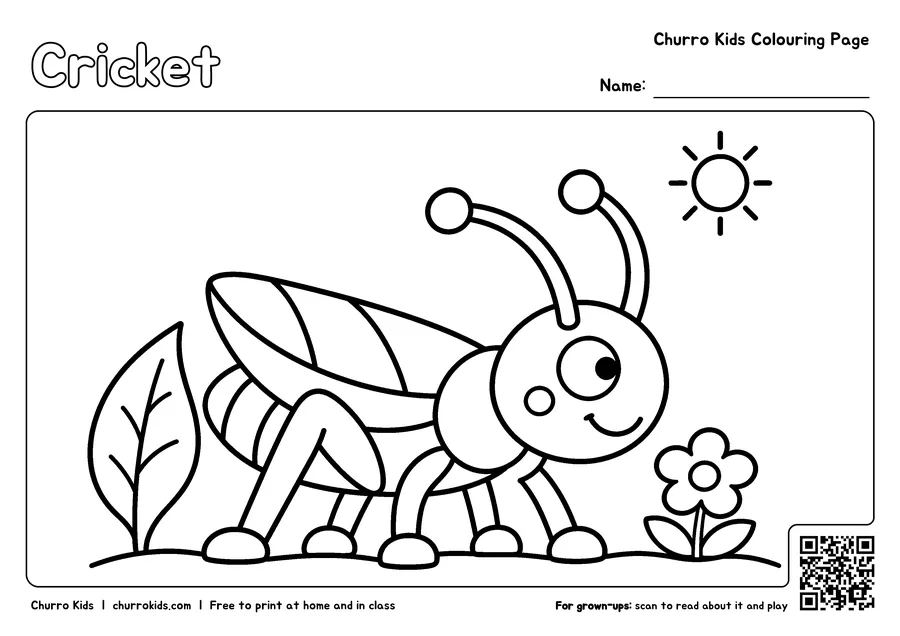
One A4 page, and it is free. Print it freely at home or in class.
Good for parents to know
- Teleogryllus emma is given as 26-32 mm and 26-34 mm in different sources, hence 'about 2.5-3.5 cm'; adults are around from August to November. The well-known chirps-to-temperature formula was worked out for an American tree cricket and does not fit Korean crickets exactly.
- The female's long ovipositor looks like a needle, but it is only for laying eggs in soil. It cannot sting, so reassure your child.
- If you keep a cricket briefly to watch, give it soil and somewhere to hide, and release it where you found it afterwards. Turning off the lights on an autumn evening and simply listening is a lovely way to observe too.
Things to try together
- On an autumn night, open the window, turn off the light and count the chirps for one minute. Compare a warm night with a cool one.
- Rub your palms together, or scrape a fingernail along a comb, to copy how a cricket makes sound by rubbing.
- Draw a grasshopper and a cricket side by side and compare the length of the antennae and where the ears are.