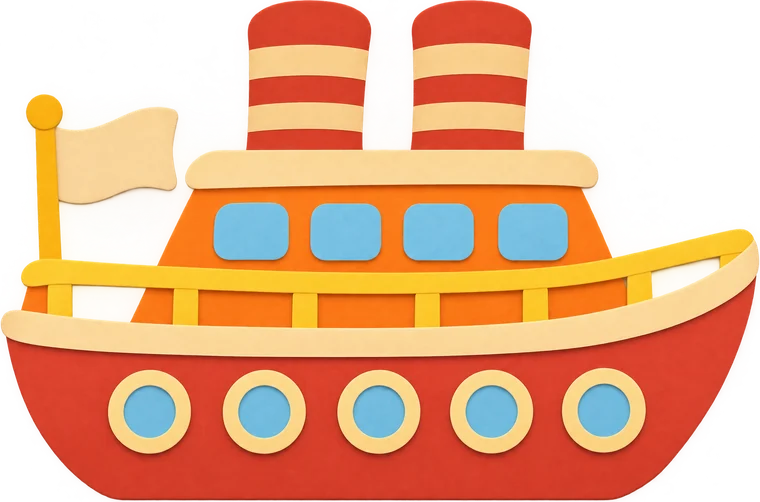
Floating a toy boat in the bath, your child asks: "Real ships are made of iron and they're so heavy - why don't they sink?"
A ship is hollow and full of air, and the water it pushes aside pushes it back up. A propeller under the stern drives it forward and a rudder steers it. Ship speed is measured in knots, and the biggest cargo ships are about 400 m (1,300 ft) long. Below are the questions children ask most, with answers you can read aloud as they are.
Fact cardShip Vehicle · water vehicle
- Job
- carries people and cargo across seas and rivers
- Why it floats
- the water it pushes aside pushes it up
- What drives it
- a propeller turning underwater at the back
- Speed unit
- knots (1 knot = 1.852 km/h, about 1.15 mph)
- Longest cargo ships today
- about 400 m long (1,300 ft)
- Side lights at night
- facing forward: red on the left (port), green on the right (starboard)
- Made of heavy iron, yet it floats
Ship in a child's words
- A ship carries people and cargo across seas and rivers.
- Big ships are made of heavy steel but still float: the ship pushes water aside, and that water pushes the ship up.
- A ship is full of hollow spaces filled with air, so overall it is lighter than the same amount of water, and it floats.
- Underwater at the back, a propeller spins and pushes the ship forward, and the rudder behind it changes direction.
- The pointed bow slices the water aside so the ship moves along more easily.
- Ship speed is measured in knots. One knot is 1.852 km/h (about 1.15 mph).
- The longest cargo ships sailing today are about 400 m (1,300 ft) long - about as long as four football pitches in a row.
When your child asks, answer like this
 Iron sinks, so why does an iron ship float?

What happens when a ship is loaded with lots of cargo?
How does a ship move forward?
Why is a ship's speed measured in knots?
How do ships see each other at night?
Who drives a ship?
What should we be careful about on a boat?
Ship facts that make kids say “Wow!”
- Measuring speed in 'knots' goes back about 400 years, to sailors timing a knotted rope as it ran out behind the ship.
- The longest cargo ships are about 400 m long, about the length of four football pitches end to end.
- Water presses harder the deeper you go: every 10 m (33 ft) adds as much pressure as the whole weight of the air above us. That is why water pushes so firmly up on the bottom of a ship.
A quiz to do together
Tap an answer.
Why does a big iron ship float?
What colour light does a ship show on its left side at night?
What must children wear on a small boat?
You finished the quiz! Well done.
Colouring page
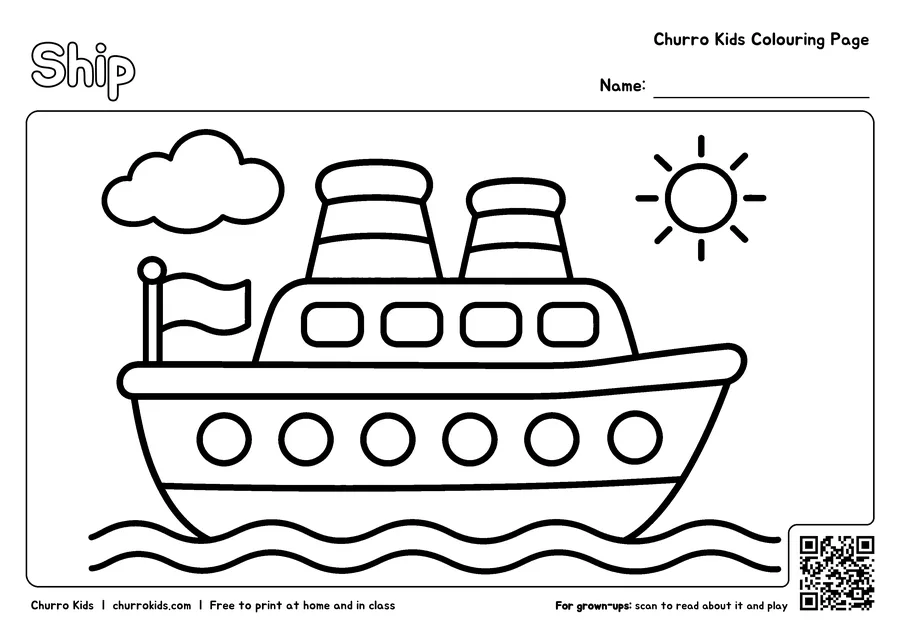
One A4 page, and it is free. Print it freely at home or in class.
Good for parents to know
- 'Heavy things sink, light things float' is only half right: floating depends on shape and volume, not just weight. A ball of modelling clay sinks, but the same clay spread into a bowl can float. This is Archimedes' principle.
- Sources give the biggest container ships as 399.9 m long, while news reports say 'about 1,400 ft' or 'longer than four football fields', so the page says 'about 400 m'. Ship speeds vary too much for a single number (large container ships usually sail at 16-25 knots, about 30-46 km/h).
- Put children in a properly fitting child-size life jacket - adult ones can slip off. The US Coast Guard notes that most boating drownings happen on nice days, so do not skip it when the weather is calm.
Things to try together
- Fold a small boat from kitchen foil, float it and add coins one at a time. Count how many it holds and watch it sit lower in the water.
- Drop a ball of modelling clay into water, then shape the same clay into a bowl and try again. Shape changes whether it floats.
- Tie knots along a string and count how many pass through your hand as you pull - the way sailors once measured speed.
Sources
- explainthatstuff.com/how-ships-work.html
- grc.nasa.gov/www/k-12/WindTunnel/Activities/buoy_Archimedes.html
- oceanservice.noaa.gov/facts/nautical-mile-knot.html
- oceanservice.noaa.gov/facts/pressure.html
- boatus.org/study-guide/navigation/lights/
- uscgboating.org/recreational-boaters/life-jacket-wear-wearing-your-life-jacket.php
- aljazeera.com/news/2021/3/26/maritime-traffic-jam-grows-outside-blocked-suez-canal
- nbcnews.com/news/world/suez-canal-ship-ever-given-partially-refloated-after-huge-effort-n1262299
- en.wikipedia.org/wiki/Buoyancy
- en.wikipedia.org/wiki/Knot_(unit)
- en.wikipedia.org/wiki/Container_ship
- en.wikipedia.org/wiki/List_of_largest_container_ships
- en.wikipedia.org/wiki/List_of_longest_ships
- en.wikipedia.org/wiki/Navigation_light
- en.wikipedia.org/wiki/Ship