"Why does Triceratops have three horns?" If you live with a dinosaur fan, you hear questions like this many times a day.
Triceratops was a horned dinosaur that lived in North America in the Late Cretaceous, at the very end of the age of dinosaurs. It was as long as a bus, had three horns and a big frill, and ate plants. Below are the questions children ask most, with answers at a child's level. You can read them out loud as they are.
Fact cardTriceratops
- Name means
- three-horned face
- Lived
- Late Cretaceous (about 68 to 66 million years ago)
- Length
- about 9 m (30 ft)
- Weight
- about 6 to 10 tonnes
- Food
- Plant-eater
- Found in
- North America (USA, Canada)
- Group
- Horned dinosaurs
- Three horns
- A big frill behind the head
- A beak like a parrot's
Watch the video
Hana asks and Churro explains all about Triceratops. The video is in Korean; the facts below are the same ones.
How big was Triceratops? Measure it with your own height
When your child asks, answer like this
 What does Triceratops mean?

How big was it?
What did it eat?
What did it do when a scary dinosaur came?
Who lived with it?
- Tyrannosaurus predatorfossil evidence
Triceratops bones have been found with Tyrannosaurus tooth marks on them. One horn looks as if it was bitten and then healed, so some scientists think that Triceratops fought back and survived. - Edmontosaurus neighboursame time and place
The duck-billed dinosaur Edmontosaurus lived in the same places. They probably ate different plants and got along side by side. - Torosaurus neighboursame time and place
Torosaurus, a horned dinosaur that looked very similar, lived on the same land. They probably ate similar plants and bumped into each other now and then.
When and where did it live?
What was it like as a baby? Did it live with friends?
Are there dinosaurs that look like it?
Who found it first?
Triceratops facts that make kids say “Wow!”
- The head of Triceratops was huge. The skull alone could be more than 2 metres (over 6 feet) long.
- When the first Triceratops horns were found, the scientist thought they belonged to a giant bison.
- The horns of a young Triceratops curved backward, and as it grew up they curved forward.
- Triceratops was one of the very last dinosaurs alive at the end of the age of dinosaurs.
From head to tail
- The biggest skull is about 2.5 m (8 ft) long, about one third of the whole body.
- The horns above the eyes were about 1 m (3 ft) long, as tall as a small child.
- Its mouth held as many as 800 teeth, stacked up in rows.
- Its skin was covered in scales, and the big ones were about 9 cm (3.5 inches) wide.
A Triceratops story to read aloud
The morning sun comes up, and Triceratops walks slowly out onto the plain by the river. It nips off low ferns with its parrot-like beak. The many teeth in its mouth slice the leaves like scissors. Far away, a duck-billed Edmontosaurus is eating plants too. A Tyrannosaurus appears at the edge of the forest, so Triceratops points its two long horns forward and stands firm. The Tyrannosaurus turns away, and Triceratops walks on to find more tasty leaves.
A quiz to do together
Tap an answer.
How many horns does Triceratops have?
What did Triceratops eat?
Does the frill bone of Triceratops have big holes in it?
You finished the quiz! Well done.
Colouring page
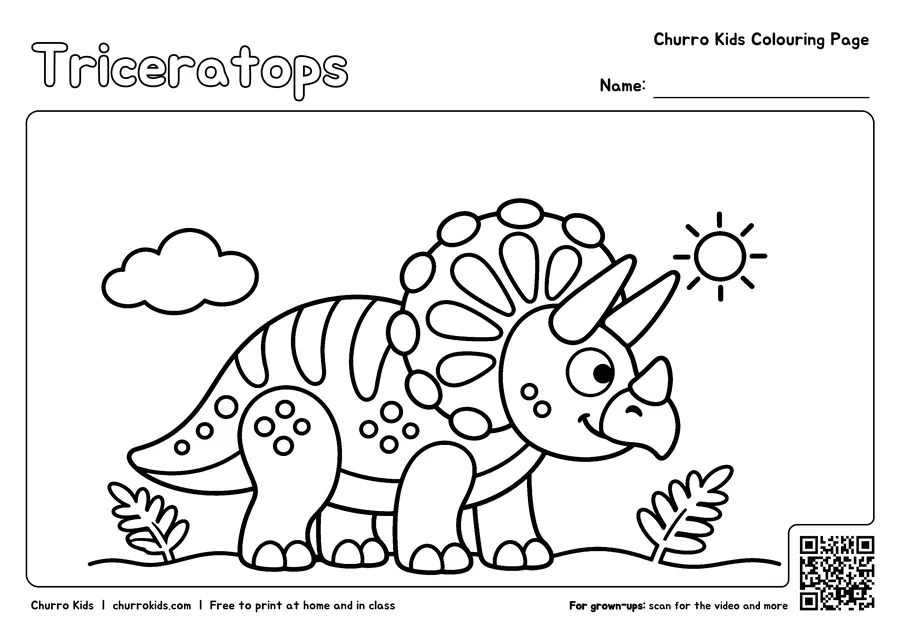
One A4 page, and it is free. Print it freely at home or in class.
Good for parents to know
- Length and weight differ from fossil to fossil, so books give slightly different numbers. Usually it is put at 8 to 9 metres long and 6 to 10 tonnes.
- In 2010 it was suggested that Torosaurus is a fully grown Triceratops, but most recent studies treat them as two different dinosaurs.
- The evidence that it really met Tyrannosaurus is a horn that healed after a bite and bones with tooth marks. Nobody knows who won, so it is safest to say "there are signs that the two met."