Open a dinosaur book and Tyrannosaurus is often the first one your child looks for. "Mum, does T. rex eat bones too?" What is a good answer?
Tyrannosaurus was a big meat-eating dinosaur that lived in North America in the Late Cretaceous, about 69 to 66 million years ago. It was as long as a bus and had teeth as thick as bananas. Its bite was so strong that it could crunch through hard bones. Its arms were short, with only two fingers on each hand. Below are the questions children ask most, with answers at a child's level. You can read them out loud.
Fact cardTyrannosaurus
- Name means
- tyrant lizard
- Lived
- Late Cretaceous (about 69 to 66 million years ago)
- Length
- about 12 m (39 ft)
- Weight
- about 6 to 9 tonnes
- Food
- Meat-eater
- Found in
- North America (USA, Canada)
- Group
- Big meat-eating dinosaurs
- A very big head
- Short arms with two fingers
- Thick, strong teeth
Watch the video
Hana asks and Churro explains all about Tyrannosaurus. The video is in Korean; the facts below are the same ones.
How big was Tyrannosaurus? Measure it with your own height
When your child asks, answer like this
 What does Tyrannosaurus mean?

How big was it?
What did it eat?
How did it hunt?
Who lived with it?
- Edmontosaurus preyfossil evidence
A fossil tail bone from a duck-billed dinosaur, thought to be Edmontosaurus, has a piece of Tyrannosaurus tooth stuck in it. The bone healed afterwards, so this dinosaur was bitten, got away and lived. - Triceratops preyfossil evidence
A Triceratops hip bone has been found with deep Tyrannosaurus tooth marks in it. There are also horn and frill fossils that look as if they were bitten and then healed, so some scientists think that some Triceratops met a Tyrannosaurus and lived. - Ankylosaurus neighboursame time and place
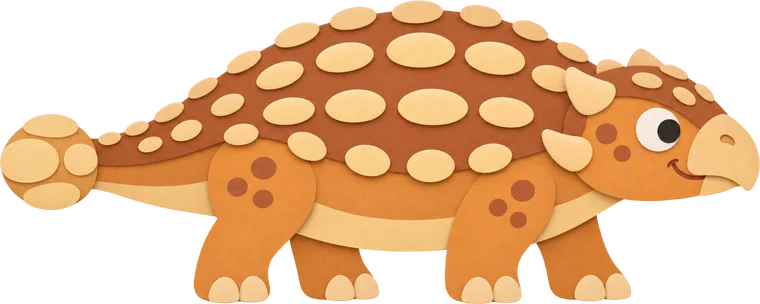
Ankylosaurus, with its armour and tail club, lived in the same forests. Its armour was so hard that even Tyrannosaurus probably found it difficult to attack.
When and where did it live?
What was it like as a baby? Did it live with friends?
Are there dinosaurs that look like it?
Who found it first?
Tyrannosaurus facts that make kids say “Wow!”
- Tyrannosaurus had a very strong bite. It could even crunch through hard bones.
- Of all the dinosaurs studied so far, Tyrannosaurus is counted as the one with the best sense of smell.
- A Tyrannosaurus fossil nicknamed Sue was found in South Dakota, USA, in 1990. Almost the whole skeleton is there.
- Scientists say its ears were especially good at hearing low, deep sounds.
From head to tail
- The biggest teeth were about 30 cm (12 inches) long with the root, longer than a big banana.
- It had about 60 of these thick teeth in its mouth.
- Its arms were about 1 m (3 ft) long, very short for its body, and each hand had only two fingers.
- Fossil skin prints show that its tail, hips and neck were covered in small scales.
A Tyrannosaurus story to read aloud
Morning comes to the warm forest. Tyrannosaurus lifts its big head and sniffs the air. The smell of Edmontosaurus comes from the river far away. It walks on its thick back legs, thump, thump, and its long tail keeps it balanced behind. With its two forward-facing eyes it looks to see how far away its prey is. Each short arm has two fingers. Tyrannosaurus opens its mouth wide, full of teeth as thick as bananas.
A quiz to do together
Tap an answer.
How many fingers does Tyrannosaurus have on each hand?
The teeth of Tyrannosaurus are as thick as what?
Which dinosaur left a fossil that shows it was bitten by Tyrannosaurus and lived?
You finished the quiz! Well done.
Colouring page
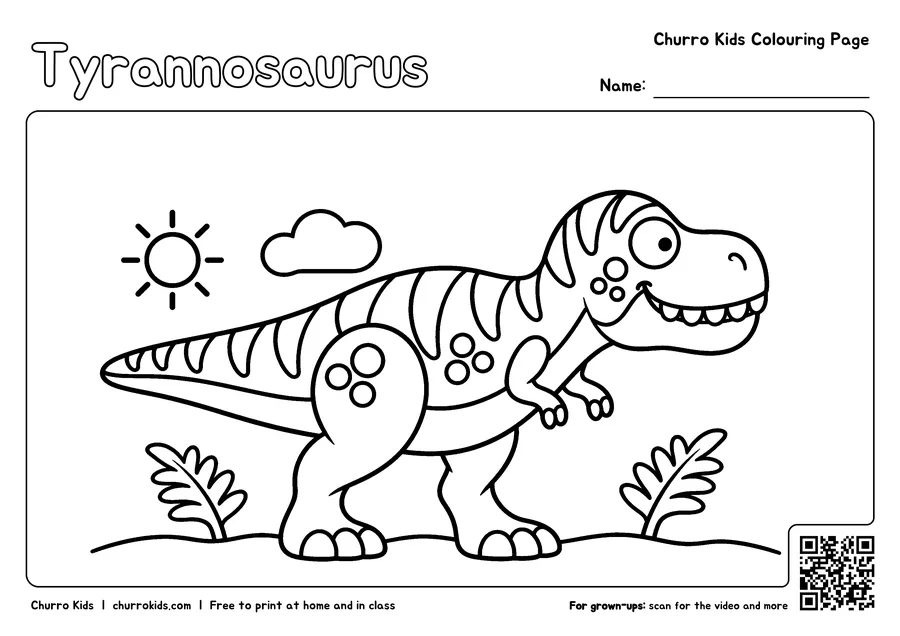
One A4 page, and it is free. Print it freely at home or in class.
Good for parents to know
- The weight of a fully grown Tyrannosaurus differs from study to study, from about 5.4 tonnes to nearly 9 tonnes. This guide gives about 6 to 9 tonnes.
- Nobody knows yet if adult Tyrannosaurus had any feathers. The skin prints found so far show scales. If your child asks, you can say "The skin prints they found are scaly, and nobody knows yet if it had feathers too."
- We know it bit Edmontosaurus and Triceratops from fossils such as a tail bone with a piece of tooth stuck in it and a hip bone with tooth marks. Scientists still do not know if it lived alone or in groups.