Your child swings the tail of a toy Ankylosaurus and asks, "Mum, can this tail stop a Tyrannosaurus?" Any child who loves armoured dinosaurs asks this sooner or later.
Ankylosaurus was an armoured dinosaur that lived in North America in the Late Cretaceous, and it was one of the very last dinosaurs alive at the end of the age of dinosaurs. Hard bony armour covered its back and neck, and a bony club about 60 cm (24 inches) long sat at the tip of its tail. Scientists have worked out that the big tail clubs of fully grown dinosaurs in the Ankylosaurus family were probably strong enough to break bones. Below are the questions children ask most, with answers at a child's level. You can read them out loud as they are.
Fact cardAnkylosaurus
- Name means
- fused lizard
- Lived
- Late Cretaceous (about 68 to 66 million years ago)
- Length
- about 7 m (23 ft)
- Weight
- about 5 to 8 tonnes
- Food
- Plant-eater
- Found in
- North America (USA, Canada)
- Group
- Armoured and plated dinosaurs
- A huge club at the tip of its tail
- Hard bony armour covering its back
- A flat, wide body
Watch the video
Hana asks and Churro explains all about Ankylosaurus. The video is in Korean; the facts below are the same ones.
How big was Ankylosaurus? Measure it with your own height
When your child asks, answer like this
 What does Ankylosaurus mean?

How big was it?
What did it eat?
What did it do when a scary dinosaur came?
Who lived with it?
- Tyrannosaurus predatorsame time and place
Tyrannosaurus was the biggest meat-eating dinosaur that lived at the same time in the same place. Ankylosaurus probably stood up to it with its hard armour and its tail club. - Triceratops neighboursame time and place
Triceratops, with its three horns, lived on the same land and ate plants too. Both ate low plants, so they probably met each other up close. - Edmontosaurus neighboursame time and place
The duck-billed dinosaur Edmontosaurus also lived at the same time in the same place. They probably did not quarrel, and each ate its own plants.
When and where did it live?
What was it like as a baby? Did it live with friends?
Are there dinosaurs that look like it?
Who found it first?
Ankylosaurus facts that make kids say “Wow!”
- Ankylosaurus probably swung the heavy bony club at the tip of its tail to protect itself.
- Ankylosaurus was one of the very last dinosaurs alive at the end of the age of dinosaurs.
- One scientist worked out that it probably had to eat about 60 kg (about 130 lb) of ferns a day.
- The pieces of bony armour were thin and light inside, but they were still built to be strong.
From head to tail
- The tail club was about 60 cm (24 inches) long and 49 cm (19 inches) wide, bigger than a child's school bag.
- The biggest skull was 64.5 cm (25 inches) long and 74.5 cm (29 inches) wide, so it was wider than it was long.
- The pieces of bony armour ranged from small ones of 1 cm (less than half an inch) to big ones of more than 35 cm (14 inches).
- Its lower jaw had about 70 small, leaf-shaped teeth.
A Ankylosaurus story to read aloud
Ankylosaurus plods along on its own between the small trees. It sniffs the air to find the smell of tasty ferns. It nips off ferns with its wide beak and gulps them down. Not far away, a Triceratops is eating plants too. When a Tyrannosaurus comes into view far off, Ankylosaurus crouches low and swings its tail club from side to side. Its back is covered in hard bony armour, so it feels safe. The Tyrannosaurus goes past, and Ankylosaurus goes back to eating ferns.
A quiz to do together
Tap an answer.
What is at the tip of the tail of Ankylosaurus?
Which meat-eating dinosaur lived at the same time and place as Ankylosaurus?
What covers the back of Ankylosaurus?
You finished the quiz! Well done.
Colouring page
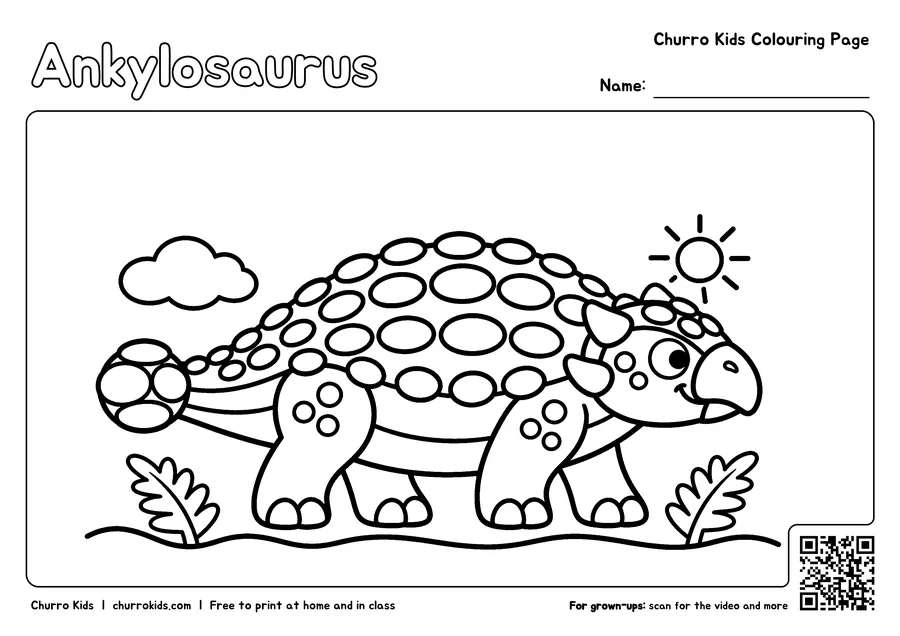
One A4 page, and it is free. Print it freely at home or in class.
Good for parents to know
- No complete skeleton has ever been found. So its length is usually estimated at 6 to 8 metres (20 to 26 ft), and the way the armour sat on its body is also an estimate.
- There is no fossil evidence that it fought Tyrannosaurus. We only know that they lived at the same time in the same place, so it is safest to say "it probably stood up to it with its armour and its club."
- It looks a lot like Euoplocephalus, so the two are easy to mix up. Ankylosaurus was bigger and lived later.