Your child is stacking pointy blocks along the back of a toy dinosaur and asks, "Dad, why does Stegosaurus have these on its back?" Scientists have not settled on one answer to this question yet.
Stegosaurus was a plated dinosaur that lived in the Late Jurassic, and its fossils have been found in the western USA and in Portugal. It had 17 to 22 huge plates standing up on its back, and four sharp spikes at the tip of its tail, each 60 to 90 cm (2 to 3 feet) long. It was about 7 m (23 ft) long, as long as a small bus. Below are the questions children ask most, with answers at a child's level. You can read them out loud as they are.
Fact cardStegosaurus
- Name means
- roof lizard
- Lived
- Late Jurassic (about 155 to 145 million years ago)
- Length
- about 7 m (23 ft)
- Weight
- about 3.5 to 5 tonnes
- Food
- Plant-eater
- Found in
- North America (western USA), Europe (Portugal)
- Group
- Armoured and plated dinosaurs
- Huge plates standing up on its back
- Four sharp spikes at the tip of its tail
- A very small head
Watch the video
Hana asks and Churro explains all about Stegosaurus. The video is in Korean; the facts below are the same ones.
How big was Stegosaurus? Measure it with your own height
When your child asks, answer like this
 What does Stegosaurus mean?

How big was it?
What did it eat?
What did it do when a scary dinosaur came?
Who lived with it?
- Allosaurus predatorfossil evidence
A tail bone of an Allosaurus has been found with a hole that fits a Stegosaurus tail spike exactly. It means that a Stegosaurus once swung its tail and hit an Allosaurus. - Diplodocus neighboursame time and place
The long-necked Diplodocus lived on the same plains. Stegosaurus ate low plants, and Diplodocus could also eat leaves higher up, so they probably got along side by side. - Camptosaurus neighboursame time and place
The plant-eating dinosaur Camptosaurus lived in the same place too. The two probably fed on plants close to each other.
When and where did it live?
What was it like as a baby? Did it live with friends?
Are there dinosaurs that look like it?
Who found it first?
Stegosaurus facts that make kids say “Wow!”
- Stegosaurus probably swung the four spikes at the tip of its tail to protect itself from meat-eating dinosaurs.
- Under the neck of Stegosaurus, lots of small pieces of bone were packed closely together to protect its neck.
- The name 'thagomizer' for the tail spikes was made up as a joke in a cartoon that came out in 1982, and now scientists use it too.
- 'Sophie', the Stegosaurus at the Natural History Museum in London, England, is a very well-preserved fossil with 85 percent of its bones.
From head to tail
- It had 17 to 22 plates on its back, and the biggest was about 1 m (3 ft) tall, as tall as a five-year-old child.
- Each tail spike was 60 to 90 cm (2 to 3 feet) long, as long as a grown-up's arm.
- Even at top speed it probably went only about 15 to 18 km (9 to 11 miles) an hour, about as fast as riding a bicycle slowly.
- Its body weighed more than 3 tonnes, but its brain weighed about 80 grams (about 3 ounces), as small as a puppy's brain.
A Stegosaurus story to read aloud
The morning sun comes up, and Stegosaurus walks slowly to the fern forest by the river. It lowers its small head and snips off fern and cycad leaves with its hard beak. Beside it, baby Stegosaurus follow close behind the grown-ups. Far away, a long-necked Diplodocus is eating leaves high in the trees. Just then, an Allosaurus comes closer through the bushes. Stegosaurus turns around and swings its spiky tail as hard as it can. The Allosaurus backs away, and Stegosaurus goes back to munching plants at its own slow pace.
A quiz to do together
Tap an answer.
How many spikes are at the tip of the tail of Stegosaurus?
What did Stegosaurus eat?
Which dinosaur has a fossil with a mark from the tail spike of a Stegosaurus?
You finished the quiz! Well done.
Colouring page
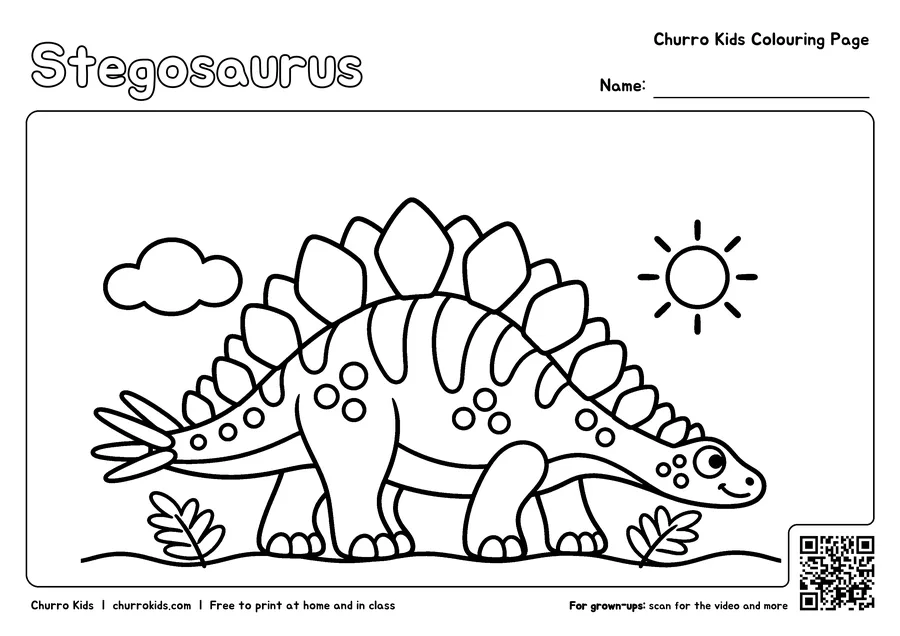
One A4 page, and it is free. Print it freely at home or in class.
Good for parents to know
- What the plates on its back were for is still debated. The ideas include showing off, keeping its body at the right temperature, and protection, so you can say "scientists are still working it out."
- The stories that its brain was 'the size of a walnut' or that it had 'a second brain in its hips' are exaggerated or wrong. It is enough to say that its brain was about 80 grams (about 3 ounces), which is small for such a big body.
- The evidence that it really faced Allosaurus is an Allosaurus tail bone with a hole that fits a Stegosaurus tail spike exactly. The idea that it got along with Diplodocus and Camptosaurus is a guess based on them living at the same time in the same place.