Your child brings you a toy dinosaur with a horn on its nose and asks, "Dad, did it fight with this horn?" Scientists today do not think so.
Ceratosaurus was a meat-eating dinosaur that lived in the Late Jurassic, in what is now the USA and Portugal. It had a horn on top of its nose and a row of small bumps down the middle of its back. It was smaller than Allosaurus, which lived in the same place, and there were far fewer of them. Below are the questions children ask most, with answers at a child's level. You can read them out loud.
Fact cardCeratosaurus
- Name means
- horned lizard
- Lived
- Late Jurassic (about 152 to 145 million years ago)
- Length
- about 6 m (20 ft)
- Weight
- about 0.5 to 1 tonne
- Food
- Meat-eater
- Found in
- North America (USA), Europe (Portugal)
- Group
- Big meat-eating dinosaurs
- A horn on top of its nose
- A row of small bumps down the middle of its back
- Long, sharp upper teeth
How big was Ceratosaurus? Measure it with your own height
When your child asks, answer like this
 What does Ceratosaurus mean?

How big was it?
What did it eat?
How did it hunt?
Who lived with it?
- Allosaurus rivalsame time and place
The bigger Allosaurus lived in the same place, and there were many more of them. Ceratosaurus probably chose different food from Allosaurus and so stayed out of its way. - Torvosaurus rivalsame time and place
Torvosaurus, a big meat-eating dinosaur, hunted on the same plains. Ceratosaurus probably kept away from the bigger hunters. - Dryosaurus preysame time and place
Dryosaurus, a small, quick plant-eater, lived in the same place. Ceratosaurus probably hunted Dryosaurus with its long teeth.
When and where did it live?
What was it like as a baby? Did it live with friends?
Are there dinosaurs that look like it?
Who found it first?
Ceratosaurus facts that make kids say “Wow!”
- Ceratosaurus probably used the horn on its nose for showing off more than for fighting.
- The first Ceratosaurus skeleton came from the very same quarry where Allosaurus was found.
- A single row of small bony bumps ran down the middle of its back. Very few meat-eating dinosaurs have this.
- Marsh, the scientist who named it, thought the horn on its nose was a powerful weapon, but scientists today do not think so.
From head to tail
- The bone of the nose horn was about 13 cm (5 inches) long and about 7 cm (3 inches) tall.
- Its upper teeth were 7 to 9 cm (about 3 to 3.5 inches) long, as long as a grown-up's finger.
- It had four fingers, one more than Allosaurus.
- Its tail had about 50 bones in a row and made up about half of its body length.
A Ceratosaurus story to read aloud
A river runs across the Jurassic plain. Ceratosaurus walks along the riverbank with the horn on its nose held high. A row of small bumps runs down the middle of its back. Far away it sees a big Allosaurus, so Ceratosaurus quietly takes a different path. A small Dryosaurus runs through the ferns. Ceratosaurus opens its mouth so that its long, sharp upper teeth show. It swings its long tail and runs after it.
A quiz to do together
Tap an answer.
Where is the horn of Ceratosaurus?
How many fingers does Ceratosaurus have on each hand?
Which meat-eating dinosaur lived at the same time and in the same place as Ceratosaurus?
You finished the quiz! Well done.
Colouring page
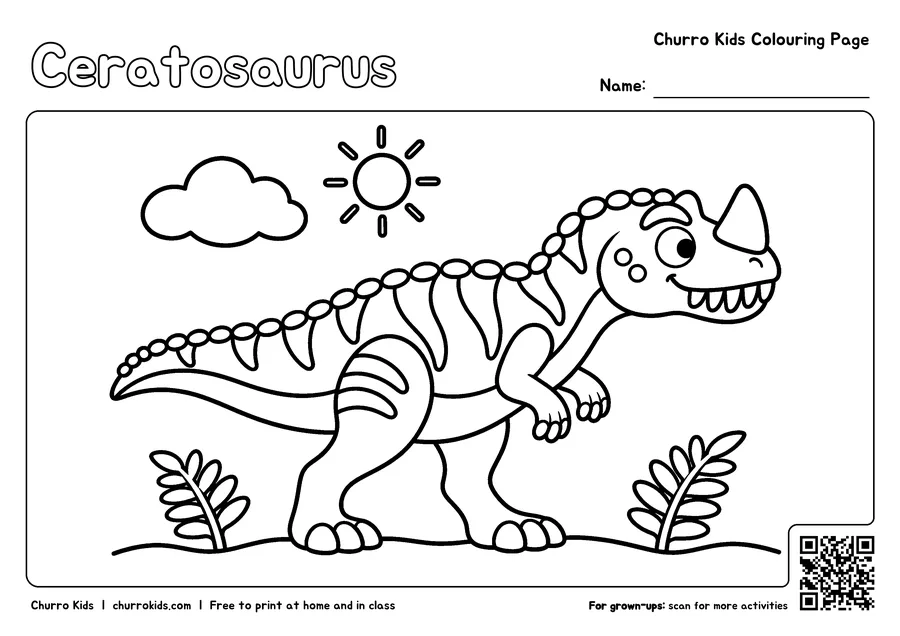
One A4 page, and it is free. Print it freely at home or in class.
Good for parents to know
- Its length differs from fossil to fossil. The first skeleton found is about 5.3 metres long, and the biggest fossils are about 7 metres. This guide gives 6 metres.
- The idea that the nose horn was for showing off is a guess by scientists. Marsh, who named the dinosaur, thought it was a powerful weapon. You can tell your child "It probably used the horn for showing off more than for fighting."
- People once thought it ate fish and crocodiles at the water's edge, but recent studies say it ate land animals. What we say about Allosaurus, Torvosaurus and Dryosaurus is a guess based on the fact that they lived at the same time and in the same place.