In front of a skeleton at the museum, your child points at one toe. "Dad, that claw is huge! What did it do with it?" This is Deinonychus, a dinosaur whose very name means "terrible claw".
Deinonychus was a meat-eating dinosaur that lived in North America in the Early Cretaceous. It was as long as a small car, and it had a hooked claw more than 12 cm (almost 5 inches) long on its second toe. The raptors in the film "Jurassic Park" are called Velociraptor, but their looks were modelled largely on Deinonychus. Below are the questions children ask most, with answers at a child's level. You can read them out loud.
Fact cardDeinonychus
- Name means
- terrible claw
- Lived
- Early Cretaceous (about 115 to 108 million years ago)
- Length
- about 3.4 m (11 ft)
- Weight
- about 70 to 100 kg
- Food
- Meat-eater
- Found in
- North America (Montana, Wyoming, Oklahoma and Utah in the USA)
- Group
- Small, fast and feathered dinosaurs
- A big, curved claw
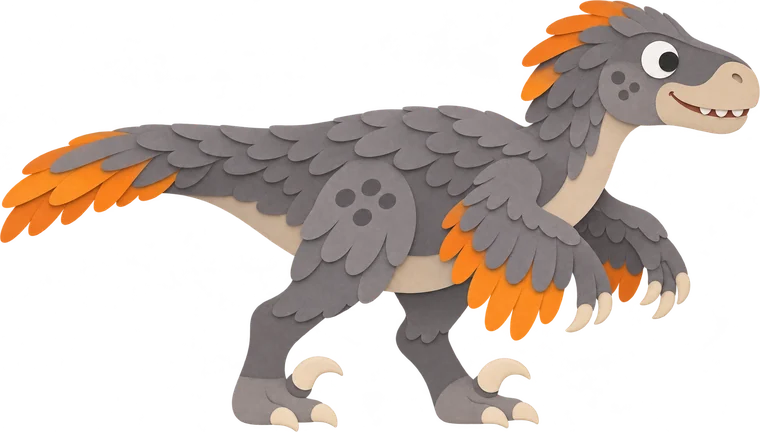
- Feathered arms
- A long tail for balance
How big was Deinonychus? Measure it with your own height
When your child asks, answer like this
 What does Deinonychus mean?

How big was it?
What did it eat?
How did it hunt?
Who lived with it?
- Tenontosaurus preyfossil evidence
Deinonychus teeth are often found beside Tenontosaurus bones. Some fossil bones also have Deinonychus tooth marks on them. - Sauropelta neighboursame time and place
Sauropelta, which had armour on its back and long spikes on its neck, lived in the same place. Its armour was so hard that Deinonychus probably found it difficult to hunt. - Acrocanthosaurus rivalsame time and place
In what is now Oklahoma, USA, it lived alongside Acrocanthosaurus, a much bigger meat-eating dinosaur. Deinonychus probably kept out of the way of this big dinosaur.
When and where did it live?
What was it like as a baby? Did it live with friends?
Are there dinosaurs that look like it?
Who found it first?
Deinonychus facts that make kids say “Wow!”
- Deinonychus had a hooked claw on its second toe that was as long as a grown-up's palm.
- After Deinonychus was found, the old idea that "dinosaurs were slow and dull" began to change into "dinosaurs were quick and lively".
- The raptors in the film "Jurassic Park" are called Velociraptor, but their looks were modelled largely on Deinonychus.
- Ostrom's team dug up more than 1,000 Deinonychus bones over two summers.
From head to tail
- Its skull was about 41 cm (16 inches) long, longer than a grown-up's arm from elbow to wrist.
- Its hooked claw was more than 12 cm (almost 5 inches) long, longer than a crayon.
- It had about 70 teeth in its mouth, and they curved like blades.
- Scientists compared the lengths of its leg bones and say it was not a very fast runner like an ostrich.
A Deinonychus story to read aloud
Morning comes to the warm, damp forest. Deinonychus stretches its long tail out straight and walks along the riverbank. It holds the big hooked claw on its second toe up, so that it does not touch the ground. Far away, a Tenontosaurus is eating plants. An armoured Sauropelta walks slowly by with its spikes up. Deinonychus folds its feathered arms and waits quietly for its chance.
A quiz to do together
Tap an answer.
What does the name Deinonychus mean?
Which plant-eating dinosaur did Deinonychus often eat?
About how many teeth did Deinonychus have?
You finished the quiz! Well done.
Colouring page
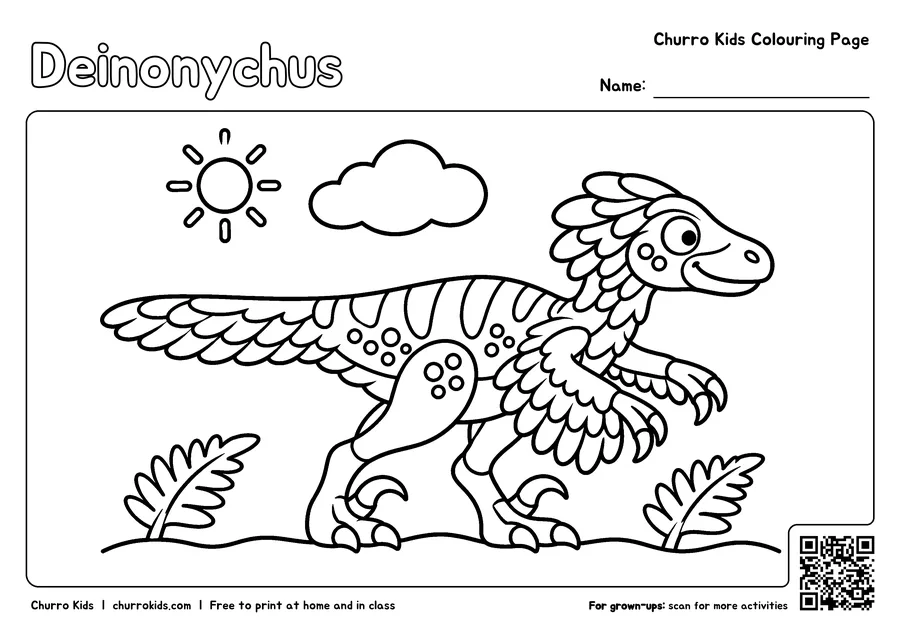
One A4 page, and it is free. Print it freely at home or in class.
Good for parents to know
- No skin or feather prints of Deinonychus have been found yet. The idea that it had feathers is a guess based on its close relatives.
- Scientists do not agree on whether it hunted in packs like wolves. Four adults and one youngster were found in one place, so it seems that several of them sometimes gathered together, but nobody knows yet if they hunted together.
- Going by most of the fossils, it lived about 115 to 108 million years ago. Some sources say it lived on until about 98 million years ago.